Grant Hollembeck
Fictional. Generated by AI — not a real person, and no likeness of one is intended.
51, carpenter in Los Angeles · rolled by @colin.hasbrook · card — no film
History
who has worn him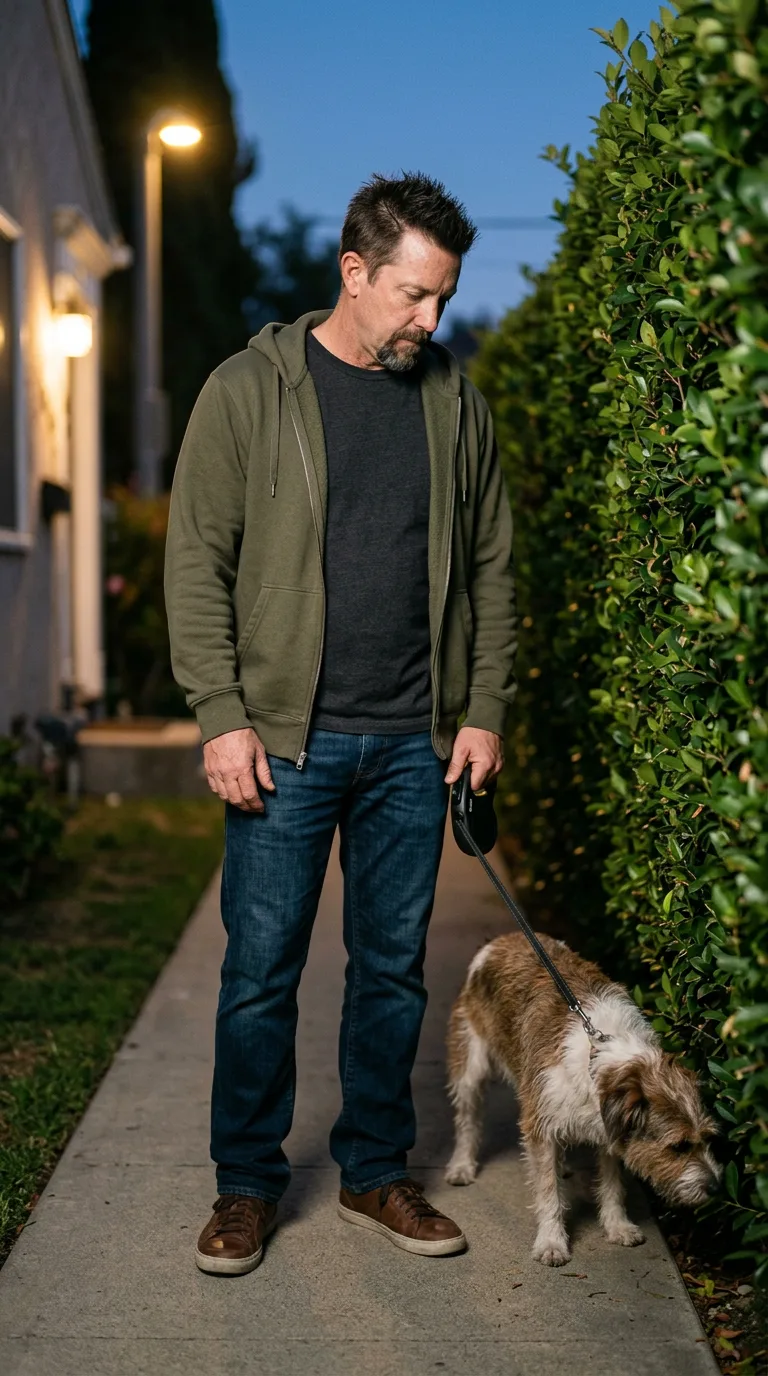
Rarest thing about him: 6'2" — common, 1 in 29
Season 1seed 1693529486 · engine v11
Character card
lineage 2NZHHJ
His body-swap story
@colin.hasbrook, wearing Ramiro Escalante, rolled the wheel on and woke up as Grant Hollembeck, spent under a minute in him, then spun the wheel and woke up as Warren Puskarich
---
Ramiro's hands are on the wheel of the rig, parked at a rest stop off I-20, and they are not good hands anymore — the knuckles ache when the AC kicks too cold, the old break in the nose throbs sometimes for no weather reason at all, just memory living in bone. Fifty-three years in this one, and less than a minute of it since the wheel gave him over. He came back to the site out of a feeling he wouldn't have named if you'd asked him — not boredom exactly. More like the second minute of anything good already tasting like the first. He's sitting in a cab that smells like his cab, with his radio still tuned to his station, and some part of him that isn't quite him anymore is already gone, already leaning through the screen of the phone propped on the dash, thumb over the spin.
The bar hits its color the second before the leash goes slack.
You are standing on a sidewalk in a body six inches taller than the one you left, and the evening is a different evening — softer, westward, the sky still holding a strip of blue behind a stucco roofline. Your hand — his hand — is holding a retractable leash, and the dog at the end of it looks up past a hedge with its ears back, like it heard something no one said. You feel the weight settle into you: heavier through the shoulders than Ramiro, looser in the knees, a body that has spent decades bending at the waist instead of the back. Your hand winds the leash twice, an old habit that isn't your habit yet, and starts walking before you've decided to.
The dog has to trot to catch the new stride.
The flannel comes first — worn soft at the elbows, sun-faded at the shoulder seam where it rides against a truck window most mornings, and it brings a smell of cut pine and gypsum dust that unspools into a whole morning: him standing in a bedroom with gray light coming through blinds, buttoning it one-handed while checking a text from the job site, a shirt he's had four years and won't retire because it already fits like it forgives him. The tool belt at his hip is heavier than it looks, worn shiny at the buckle, and it gives you his hands — not your hands, his — knowing without looking where the sixteen-ounce hammer sits, how a nail gun hose likes to kink if you don't walk it out straight first. Today: a slab in Van Nuys, framing a wall in the flat orange heat before noon, the satisfying chunk-thock of studs going up plumb, a foreman's radio playing norteño two lots over. He likes the work. He has liked it since he was nineteen and a man named Hutch taught him to read a tape measure like it was a sentence.
The freckles are the thing everyone says first, and you feel them now as texture rather than sight — thirty years of sun on a nose and cheekbones that never tanned, only freckled harder, his mother's Irish skin refusing to learn.
The jeans against your legs know a garage in Reseda, a mortgage he still owes eleven years on despite the number sitting in his accounts that would embarrassingly cover it twice over — money from a duplex he flipped at exactly the wrong time to be humble about it and exactly the right time to be rich, money he doesn't spend like he has it because spending it would mean admitting the man from the framing crew doesn't live here anymore. Two kids surface through the denim at the knee — a scraped-in memory of a driveway basketball hoop, a girl's graduation gown, an ex-wife's voice from a kitchen that isn't his kitchen now, gone gently rather than badly, which somehow aches worse. A girlfriend's laugh comes through the phone shape in his back pocket, a woman named Denise who texts him dog memes and doesn't know about the duplex money either, not really, not the whole number.
The dog's leash handle, looped twice around your knuckles, gives you the dog itself — three years old, found off a highway on-ramp, named Biscuit by his younger kid over his objection, and loved anyway, completely, the way he loves most things he didn't plan on.
Your shoulders carry fifty-one years the way a beam carries a house — not without complaint, an ache low in the lower back from decades of bending to a chalk line, forearms ropy and strong in a way gyms don't make. You feel, distantly, how good it is to stand up straight in this one after Ramiro's road-slumped spine. The boots on your feet know concrete. Everything about this body is a man who is fine, who was fine, who was going to keep being fine for a long time yet, walking his dog in the last of the light before dinner with a woman he likes okay and children he loves completely and a bank balance that would surprise every person who's ever handed him a beer.
You lift your hands into the porch light spilling off a neighbor's window and turn them over — his hands, calloused at the base of each finger, one nail gone permanently blue-black from a hammer strike years back, freckled clean to the wrist.
Biscuit sits, waiting, tail going.
"Good boy," you say, in his voice, to no one who will ever know it wasn't him — and somewhere behind the words is the small flat wondering, already there, already comfortable, of how many evenings like this one you'll get before the wheel starts calling again.