Gerald Truscott
Fictional. Generated by AI — not a real person, and no likeness of one is intended.
52, assembly line worker in Denver · rolled by @colin.hasbrook · card — no film
History
who has worn him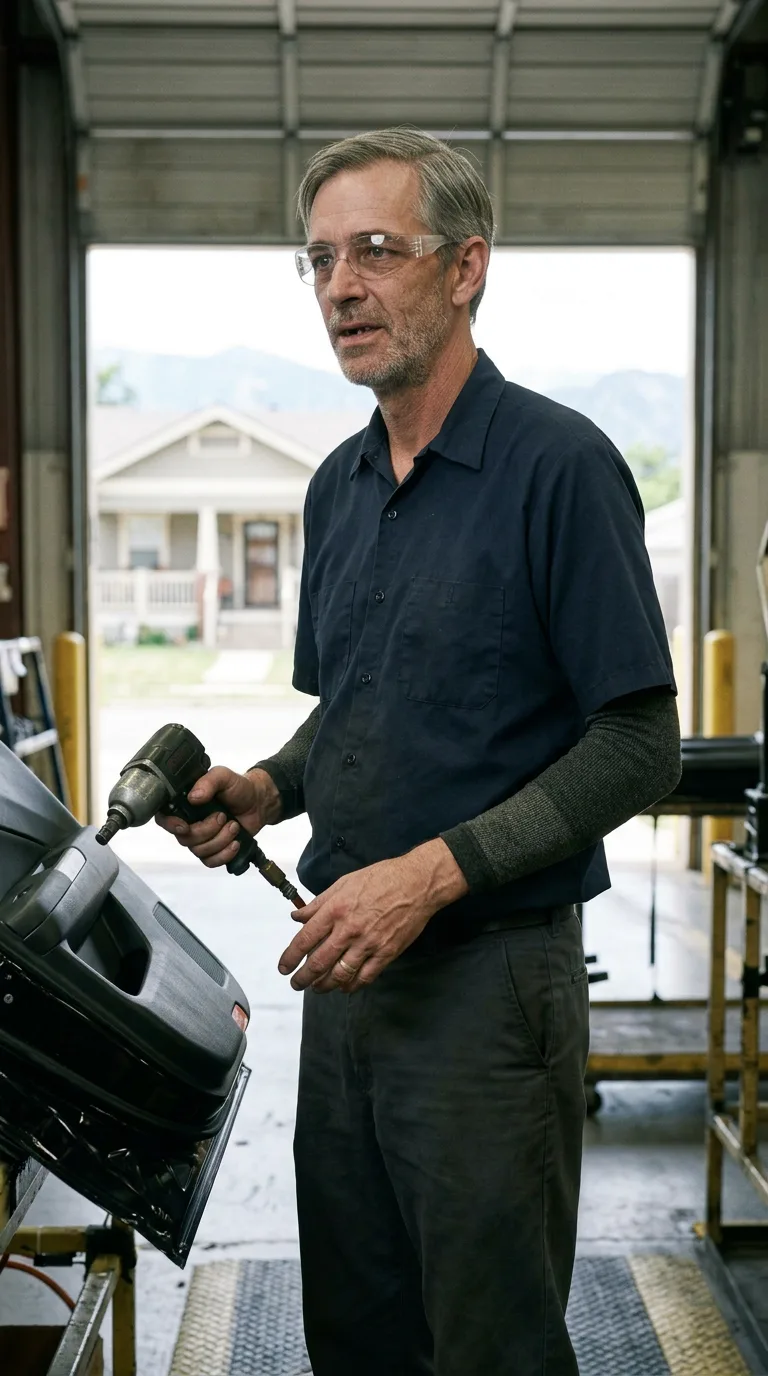
Rarest thing about him: A missing front tooth — uncommon, 1 in 158
Season 1seed 2038356998 · engine v11
Character card
lineage 2NZHHJ
His body-swap story
@colin.hasbrook, wearing Craig Ostrander, rolled the wheel on and woke up as Gerald Truscott, spent under a minute in him, then spun the wheel and woke up as Otis Marable
Craig Ostrander's lunch break is thirty-one minutes old and his knees already ache in a way thirty-year-old knees should not ache, which is the first thing you notice, again, every time you come back into him. Boston light through a break-room window with a crack taped over in packing tape. Someone's radio two stations over from anything good. You have been Craig less than a minute, by his clock — you spun into him last, and immediately, before his body had even finished sitting down at the folding table, you were already opening the site again on the phone that is not yours, in a hand that is not yours, because thirty years old and blond and average was never the point. It was never going to be enough to just be somebody. You have done this eight hundred and eleven times and the tell you know best in yourself is the itch that starts before the last man has even cooled — not boredom exactly, something closer to the feeling of a slot machine's arm still swinging. Craig Ostrander's thumb, which knows nothing of this, taps the screen. The wheel turns without you having to want it to, exactly, because wanting stopped being a separate step around spin two hundred.
It lands on gray.
—
The impact wrench is heavier than you expect, though you don't get to finish that thought before it's not a thought, it's just weight, in a hand at the end of an arm that aches at the elbow in a specific old way, hanging at the end of a motion that was already three-quarters complete when you arrive in the middle of it. The bolt is half-seated. The door panel is coming down the line toward you on its hook, patient, gray, exactly like the last four thousand. Your — his — finger is on the trigger and the trigger does not fire, for half a second, because for half a second nobody who knows how is in charge of the finger. Then it does. Wrong. A stripped half-turn, caught, backed out, set again, slow enough that if anyone down the line were watching they'd wonder. Nobody is watching. The next ten bolts go in checked, one at a time, a job that stopped needing that kind of attention twenty-two years ago, in a body that is fifty-two years old and standing in it the way you'd stand in a coat two sizes wrong in ways you can't yet name.
The shirt is what gives you the first of him — navy, breast pockets, the collar gone soft with washing, and under it a compression sleeve on the left forearm that his own hand pulls at without thinking, a tic, the kind of thing a body does when the mind's not renting the room anymore. The sleeve remembers a doctor's office, a diagnosis with a long unfriendly name for something that just means the elbow hurts doing what the elbow does eight hours a day, and a foreman named Petrosky who said *wear the sleeve or don't come back* like it was a kindness. It was, actually. Gerald had almost been grateful.
Gerald. The name comes up out of the shirt collar like steam off asphalt, and then it's just there, whole, the way names are once you have them: Gerald Truscott, and everyone on the floor calling him Ger, and the plant twenty minutes from a house he doesn't live in anymore.
The ring finger is bare and pale where a band sat for twenty-six years, and that's the second door, opened by nothing but his own hand brushing his own hand, an old habit relocating itself to skin instead of gold. Denise. Not gone, not dead, just gone from him specifically — the finalization two years back signed in a lawyer's office that smelled like the inside of a new car, which he'd found funny in a way he didn't say out loud, working where he worked. Three kids between them, one of them, Marisol, twenty-six now and still calling him every Sunday like clockwork whether he picked up or not, and he mostly picked up. The other two further out, one in Colorado Springs, one somewhere he genuinely had to think to remember, and that not-remembering costs something every single time, a small tax he pays and pays.
The missing tooth is his own hand's business too, tongue finding the gap it's found ten thousand mornings running, front left, gone fourteen years to a hockey puck at a company picnic that everyone still brings up like it's the funniest thing that ever happened in the parking lot of this building. He'd laughed about it then. He laughs about it now, mostly, except at the mirror, some mornings, where it makes him look like exactly what he is: a man whose face stopped being anyone's first choice a while ago.
The boots against the concrete are the last door and the widest one — twenty-two years of this floor, this line, this exact stretch of it under this exact stretch of fluorescent light, and under that: mornings. This morning specifically, sleeve by sleeve, the shirt going on in a kitchen with one chair pushed in and three not, the belt cinched to the notch that's worn shiny now, the boots laced by feel because his eyes go straight to the coffee maker and stay there till it's done. Nights before that, a drink or two on the porch of the bungalow, the mountains doing the thing they do at dusk where they go from blue to nothing, a ring he doesn't wear anymore turning over and over between two fingers of the hand that used to wear it, because some things a body keeps doing long after the reason's filed away in a drawer in a lawyer's office.
You look down at the hand. It's still turning nothing between its fingers, out of old habit, empty, and you let it stop.
You look up into the light coming through the bay door, mountains behind the rooflines, someone's porch across the lot, and you say, out loud, to no one who's listening, "Hang on — start that one again."
Nobody hears the *again* the way you mean it.