Gerald Muncaster
Fictional. Generated by AI — not a real person, and no likeness of one is intended.
53, professor in Philadelphia · rolled by @colin.hasbrook · card — no film
History
who has worn him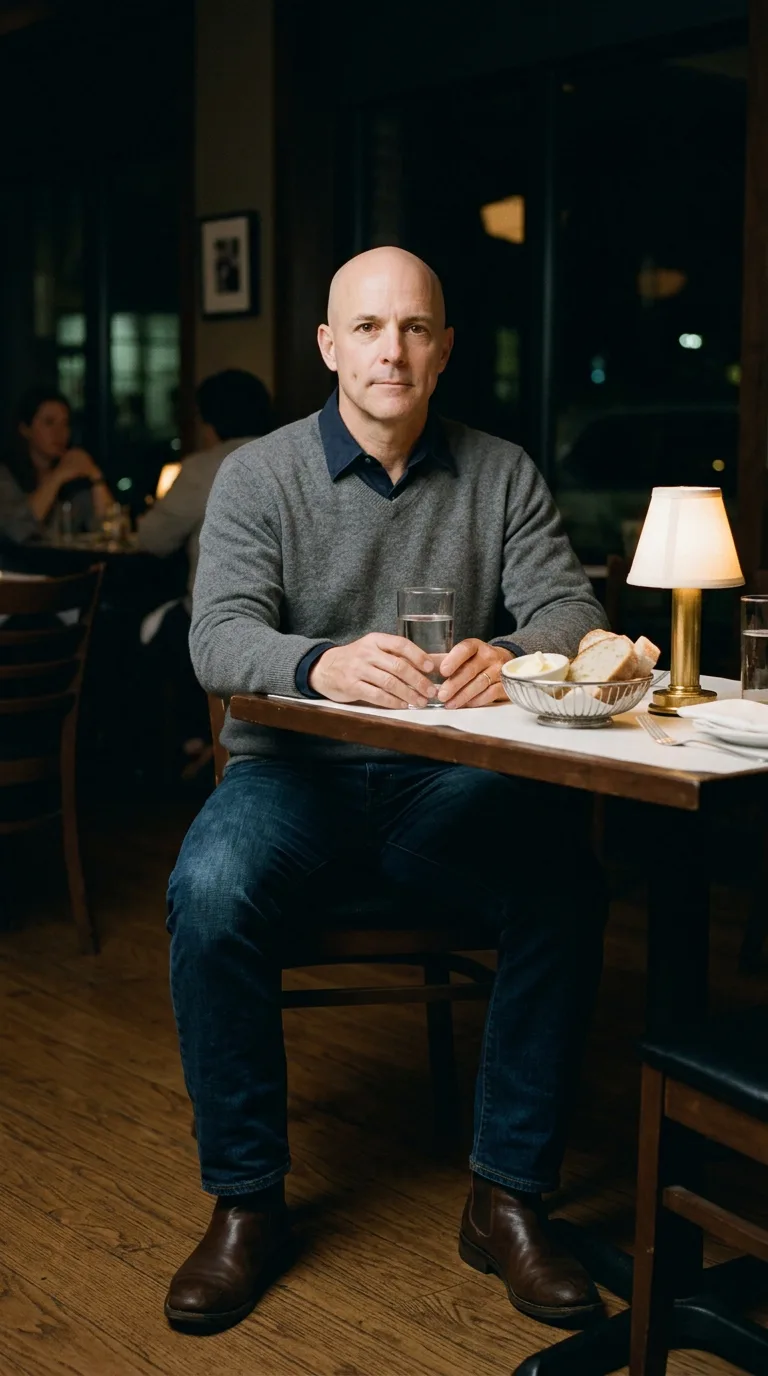
Rarest thing about him: On a first date, going badly — uncommon, 1 in 125
Season 1seed 667455203 · engine v11
Character card
lineage 2NZHHJ
His body-swap story
@colin.hasbrook, wearing Ethan Marchetti, rolled the wheel on and woke up as Gerald Muncaster, spent under a minute in him, then spun the wheel and woke up as Walter Kosinski
Ethan Marchetti's barracks room smells like gun oil and the cheap candle his last girlfriend left behind, and you have been sitting on the edge of his bunk for fifty-nine minutes not doing anything, because there is nothing here worth doing. Twenty-three years old, hazel eyes, a beauty mark you keep catching in the mirror like it belongs to somebody more interesting than it does. He drills at 0500. He has push-ups in his arms he hasn't used yet and a whole life ahead of him that isn't yours and never will be, no matter how long you sit in it. That's the trouble with the young ones. Everything about them is coiled and unspent and it makes you restless in a way you can't name, a hunger that has nothing to do with him and everything to do with the number sitting behind your eyes: eight hundred eighty-nine. You didn't come back tonight because Ethan failed you. You came back because he hadn't done anything yet, and doing nothing, in a body this alive, feels like waste. You open the laptop. The wheel is already loaded, already spinning before you've decided anything, the way it always is once you've opened the page.
It lands on a bread basket.
You are mid-sentence, and the sentence is not one you started. "—shouldn't have said that, I'm sorry, that was—" and your voice is not the voice you expected, lower, warmer at the edges, carrying two tables over before you can stop it, and a woman across from you who is not looking at you with any kindness left in her face. Your hand is on a water glass. You turn it a quarter turn on the tablecloth without meaning to and then you stop, glass sweating under your fingers, and the fingers are short and blunt and not yours, were never yours, and something in your chest that isn't panic, isn't quite panic, opens up like a held breath finally let go.
The glass is cold and real under your palm and that's the first thing that comes through — not a thought, a feeling, someone else's relief at cold water on a night that has gone on too long — and then the tablecloth under your other hand, and starch and bleach and a hundred other dinners come up through it, potlucks, anniversaries, one specific anniversary with flowers that wilted before the check came because she wanted to talk about custody instead of talking about them. That one you don't get to keep for long. It flickers and moves on the way they do, because you are not being told his life, you are being handed pieces of it through whatever he happens to be holding, and he is holding a water glass and a napkin and forty years of dinners like this one.
The sweater is next — cashmere, going a little thin at the elbow he doesn't rest on the table, and it remembers a mirror this morning, or what was morning here, still the ordinary end of a Thursday for the body but nowhere near midnight yet by the clock you left behind in Nashville. Gerald Muncaster, fifty-three, stood in front of that mirror at six-something and pulled this sweater over his head and felt his own bald scalp catch the bathroom light and thought, not for the first time, that he looked exactly like a man who used to be married and now dresses himself for people he is not sure he likes yet. Under the sweater a body that knows things without being asked — how to stand at a lectern for two hours without shifting weight, how to project to the back row without shouting, a lower back that complains on the drive home and never once during the lecture, arms that are stronger than a professor's arms have any right to be because he swims Tuesdays and Sundays, alone, in a municipal pool three blocks from a rowhouse with white marble steps worn soft in the middle by a hundred years of other people's feet before his.
The ring finger gives you the sharpest thing. Not the ring — there is no ring — but the ghost of one, a pale strip of skin his thumb finds without permission, cracking his knuckles one at a time under the table the way he does when he isn't thinking, and each crack brings a splinter of her: a kitchen, a laugh that used to be for him, two kids now grown enough to not need explaining anymore, a signature on a page in a lawyer's office that felt, at the time, like the end of every good thing and turned out, three years on, to be merely the end of one particular thing. He has not worn a ring in three years. He has been on four dates in three years. This is the fourth, and it is going the way the other three went, which is to say it is going like a lecture nobody in the room wanted to attend.
His shoes under the table — good leather, resoled twice, bought the same week as the boots you can feel are not on him tonight — carry a lecture hall floor, chalk dust that isn't chalk anymore but he still calls it that, three hundred empty seats rising up around one man's voice at 8 a.m. on a day he can't place, because that memory doesn't belong to a night, it belongs to every morning he's ever had, and it comes anyway, stacked under this one like sediment.
The woman across from you says something. You don't catch all of it. You are too busy being a man who is dimpled even now, even mid-apology, even doing badly at this — the dimples don't ask permission either, they show up at rest, they showed up at his wedding and at his divorce and they will show up now whether Gerald wants them to or not, and you feel your own — his own — face doing it without your say, a kindness his face performs whether the evening deserves it.
You look down at your hand on the glass. Short fingers. No ring, and the pale line where one was. You turn the hand over slowly, like it might correct itself if you give it the chance.
"I don't think I ever finished my thought," you say, to the woman, to the restaurant, mostly to no one, "and I'm not sure I'm going to."
She doesn't answer. Somewhere behind your ribs, already, faint as a second heartbeat, is the wheel — not urgent, not tonight, but there, the way it always is now, the number one higher than it was an hour ago and no way of knowing which hour it climbs again.