Gary Petrosky
Fictional. Generated by AI — not a real person, and no likeness of one is intended.
55, nurse in Miami · rolled by @colin.hasbrook · card — no film
History
who has worn him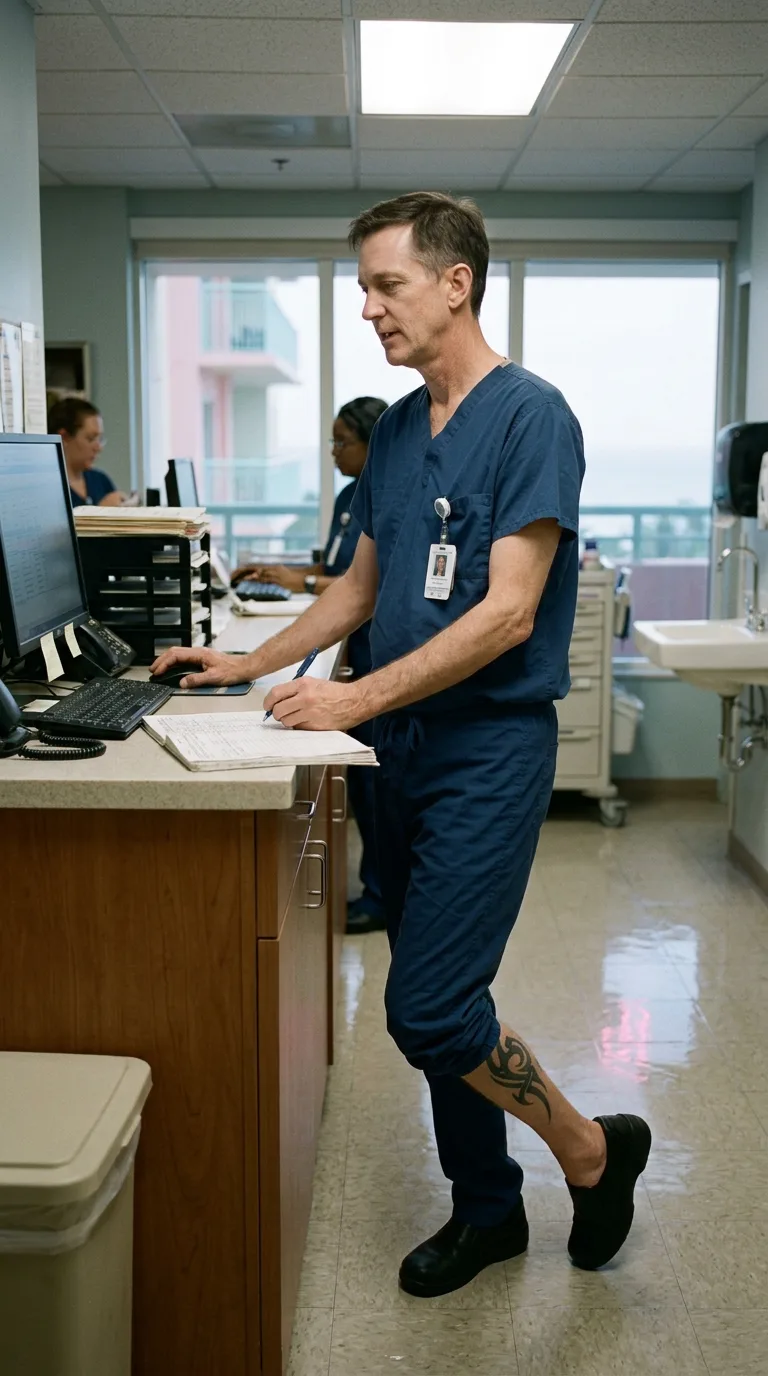
Rarest thing about him: Pulls at his beard — epic, 1 in 208
Season 0seed 2010417026 · engine v10
Character card
lineage 2NZHHJ
His body-swap story
@colin.hasbrook, wearing Douglas Prentice, rolled the wheel on and woke up as Gary Petrosky, spent under a minute in him, then spun the wheel and woke up as Rubén Castellanos
The bus is parked, has been parked for an hour, and Douglas Prentice is sitting in the driver's seat in his own driveway not going inside. His hands are on the wheel he doesn't need anymore, ten and two, an old habit, and the radio is off. Sixty years old, freckled forearms gone spotty in the fluorescent dash light, silver hair flat from the cap he wears eight hours a day. He has been this man for less than a night and he already knows the whole shape of him: the same route since '04, a daughter in Wichita who calls on Sundays only, a knee that clicks on the third step up into the bus every single morning. None of it is his. None of it was ever going to be enough to keep him sitting in a metal box that smells like hot vinyl and pretending it might. He digs the phone out — not Douglas's phone, his own account riding inside a stranger's pocket like a parasite — and the site loads the way it always loads, patient, gray, a wheel drawn in gold like it's something worth being reverent about. Five hundred and five men behind him and he still feels the same itch he felt the first time: not hope exactly. Appetite. He spins it before he can think better of it, the way you flick a light switch in a room you already know is empty.
The chart is open under his pen and the pen is between two fingers that aren't shaking — weren't shaking a half-second ago either, but now the line he's drawing bends where it shouldn't, a small ugly hook in a signature that has been clean for thirty years of nursing. He stops. Redoes it. The next line, careful. The one after, careful. Ten checked motions in a row on a task that quit needing checking sometime around the first Bush administration, and underneath the care, arriving late, is the noticing: the fluorescent light overhead too white, the smell of the unit — bleach, coffee, the ocean coming faint and salt-rotten off the balcony doors at the end of the hall — and a weight in the knees and lower back that Douglas's body never had, a different kind of tired, older in some places and not others. A coworker two feet away says something about the Anderson discharge and doesn't look up. Nobody has noticed yet that the man signing this chart is not entirely who he was thirty seconds ago. He never will let anyone notice, because there will never again be anyone in here to notice.
The badge on its retractable cord swings a half-inch against his chest when he shifts his weight, and that's the first door: a flash of a hospital ID photo taken years ago, a version of this face with both front teeth still in it, and under that, arriving whole, the day he lost the tooth — not a fight, nothing so good a story, just a bike he shouldn't have been riding at forty-eight in an attempt to impress somebody he can't picture anymore, pavement, blood in his mouth tasting like a struck match, and the strange calm of knowing, even as it happened, that he'd get it looked at on Monday because Monday is when the schedule had him back at the hospital anyway. The pen in his fingers gives him something else: the steadiness of ten thousand nights exactly like this one, hands that know the chart better than they know most people, three kids grown and scattered — one in Orlando, one somewhere he doesn't call enough, one still texting him memes at 2 a.m. his time — and an ex-girlfriend from eleven years back whose voice still surfaces sometimes on nothing, on the smell of a certain sunscreen, on a song the radio plays too often. He quit drinking around the time she left, or maybe it was the other way, he's never been sure which caused which, and he's fine with not knowing.
The scrub top, when the memory of putting it on this evening comes — because it's evening here, the shift starting as the light outside the window goes that pink-orange that means the balcony glass down the hall will be doing its neon thing all night against wet tile — comes sleeve first, an act as automatic as breathing: right arm through, left arm through, the badge clipped on last, a glance in the mirror at a face he has stopped being surprised by, gray coming in at the roots he re-dyes every six weeks in his bathroom sink with a box kit because a salon feels like money he'd rather keep. Below the hem of the scrub pants, cool air against skin that's spent decades in this climate, the tattoo on his calf goes taut and slack with the rock of his weight from foot to foot at the counter — black tribal ink, done young, done on a dare, meaning nothing now except that it was once meant to mean everything. The body underneath all of it: skinny-fat, soft where it used to be hard, a lower back that complains on double shifts, a chest that got opened once for something the scan calls resolved now, in remission, a word that still sits differently in him at 2 a.m. than it does at noon. His hand, unwatched, drifts up toward a beard that isn't there tonight, freshly shaved for reasons the memory doesn't bother explaining, and finds nothing, and comes back down, faintly unsatisfied by its own habit.
He sets the pen down. Looks at the hand that held it — his hand, now, for as long as this lasts — turning it palm up under the terrible fluorescent light, seeing the tan line at the wrist, the thin white scar he didn't put there and doesn't remember getting, because it isn't his to remember, not really, only borrowed, the way all of this is borrowed. He looks up, past the monitor, past the coworker still waiting on an answer about the Anderson discharge, toward the window where the balcony haze and the pink building glow are doing exactly what a postcard would do if postcards could sweat.
"Sorry," he says, in a voice with a gap in it where a tooth should be, "long night already."