Gary Muncrief
Fictional. Generated by AI — not a real person, and no likeness of one is intended.
51, chief executive in Small-town Ohio · rolled by @colton.vandermark · card — no film
History
who has worn him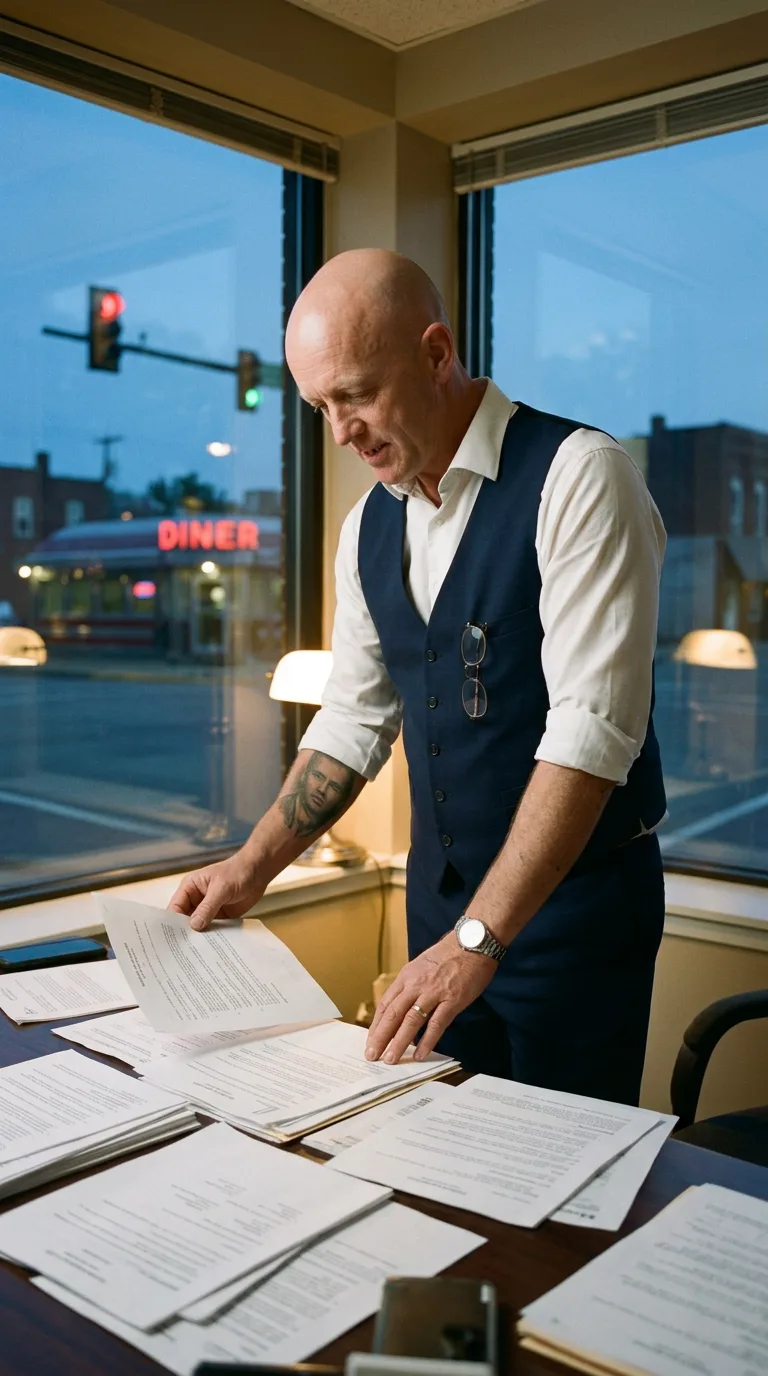
Rarest thing about him: A gap between the front teeth — common, 1 in 25
Season 1seed 1524408738 · engine v11
Character card
lineage PYNCV3
His body-swap story
@colton.vandermark (admin), wearing Owen Radzik, rolled the wheel on and woke up as Gary Muncrief, spent 7 minutes in him, then spun the wheel and woke up as Terrence Whitfield
The projector booth smells like hot dust and rewind oil, and Owen Radzik's hands — your hands, for one more minute — know exactly where the splicer sits without looking. You have been him for a day and six hours. It was fine. It was better than fine, actually, the quiet of it, a man who lived alone with his prints and his silences, nobody waiting on him anywhere. That should have been the appeal. Instead you keep finding the same flat afternoon light through the same booth window and the same reel ticking down, and somewhere under Owen's calm you can feel the old itch starting up, the one that has nothing to do with him and everything to do with you: the wanting that never actually asks whether the last one was good, only whether there might be a better one still on the wheel. You wipe your palms on his slacks, take out your phone, open the site with his thumb. You do not think of it as leaving him. You never do. You think of it as the next spin, already halfway to being the only thing that matters, and you press it before the guilt can catch up.
The wheel turns without weight, without sound, and then it stops turning and you are standing.
You are shorter. That's the first thing — the floor is closer than it was, the ceiling is closer, and the light in the room is the deep gold-blue of evening, not afternoon, striking off glass across a street with one stoplight, red right now, and a diner sign lit up dark behind drawn shades. There is a suit jacket weight on shoulders that are not the shoulders you had a second ago, a vest buttoned snug over a gut that isn't Owen's flat drift of a body, and a sheet of paper caught mid-turn between two fingers that don't yet know they're yours. The motion breaks. The page folds wrong, corner catching corner, and the hand — his hand — stops, backs up, does it again, slow, correct. Then it does the next one the same way, checked, deliberate, a competence with a hitch put back into it, like a man double-checking work he has not needed to double-check in years.
The shirt is against your back first, and that's where he comes in — not all at once, a seam at a time. Cotton, ironed with too much starch by a dry cleaner on the north side of the square who has done his shirts eleven years running. The sleeves are rolled to the forearm, and the rolling itself arrives as a memory: this morning, in the bathroom mirror over the sink, cuffs folded twice, precise, the same as always, because there is a photograph from the year he made partner where his sleeves were sloppy and his wife teased him about it for a decade after, so now he checks. Gary. The name comes with the shirt, easy as breathing, the way his own name always does. Gary Muncrief, and the vest is his father's habit more than his own — the old man wore three-piece suits to a job that didn't need them, right up until the mill let him go, and Gary kept the shape of it going out of something that isn't quite defiance and isn't quite grief either.
The tattoo on the arm is warm under the rolled sleeve where the evening sun still catches it through the window, and touching that — even just the fabric brushing it as the arm moves — brings back a whole year in one long pull: his father's face, done in black and gray, inked eight months after the funeral by a woman two towns over who cried a little while she worked, because Gary had cried a little while he sat for it, three sessions, teeth gritted, telling himself it didn't hurt more than watching the man shrink in a hospital bed had hurt. He keeps the sleeve down at the office out of habit more than shame. His wife likes it. His son thinks it's the coolest thing about him, which is a strange thing for an eighteen-year-old to think about his father, and it lands, unbidden, with a warmth that isn't yours.
The ring is next, plain gold on the left hand, and it opens wider than the tattoo did — a whole marriage in the time it takes the light to change outside. Renee, twenty-six years, a wedding in a church with bad air conditioning in July, the two of them sweating through the vows and laughing about it after because what else do you do. The heavy drinking lives in there too, not hidden, just present, the way his hand automatically wants a glass at this hour, the low steady hum of a habit older than the marriage, older than the company, something Renee stopped fighting him on around year fifteen. Catholic on his mother's insistence, lapsed enough that he only really prays when the plane is landing rough, but the guilt of the faith sits under everything he does, including — maybe especially — the drink.
The papers under his fingers are payroll adjustments, a plant staffing sheet, the reason he's still here past six with the diner across the street dark and closed for two years now, ever since the highway bypass took the traffic elsewhere. He is the last real employer left on this stretch of Main, and he knows it, and it sits on him like the vest does — an inherited weight, not chosen, not entirely wanted, but worn anyway because someone has to and it turned out to be him. The glasses hooked in his breast pocket are for close work; he's needed them two years and still resents it, still touches his own jaw instead of reaching for them half the time, an old unconscious habit, fingers finding the smooth freshly shaved line of it, checking it's still there, still him — a tell his wife pointed out once and he's never been able to unlearn.
There is a gap in his front teeth that his tongue finds without meaning to, that gap present in every school photo, every handshake, every toast — Renee once said she fell for him at the gap before she fell for anything else about him, and something in that memory arrives soft, almost embarrassed, the way a fifty-one-year-old man is embarrassed by still being pleased about it.
You feel the height now too — five-seven, planted, no give to it, the body compact and used to being underestimated in rooms with taller men across a table, and used to winning those rooms anyway. Feet inside good shoes that pinch a little at the end of a long day, the ache sitting exactly where it always sits, familiar to him and strange to you, new information about a life you did not live arriving as if it were an old bruise.
You look down. The hand on the papers is his — thick-fingered, a working man's hand wearing a rich man's watch, the ring catching the last of the window light, and it does not feel like yours yet, not the way the last one eventually did, not the way none of the forty-seven before that ever quite finished doing either.
You look up, out through the glass, past your own reflection to the dead stoplight and the dark diner, and you say, to no one, in his voice, thick with something that isn't quite his relief and isn't quite your own:
"Well. Here we go again."