Terrence Whitfield
Fictional. Generated by AI — not a real person, and no likeness of one is intended.
47, bus driver in Denver · rolled by @colton.vandermark · card — no film
History
who has worn him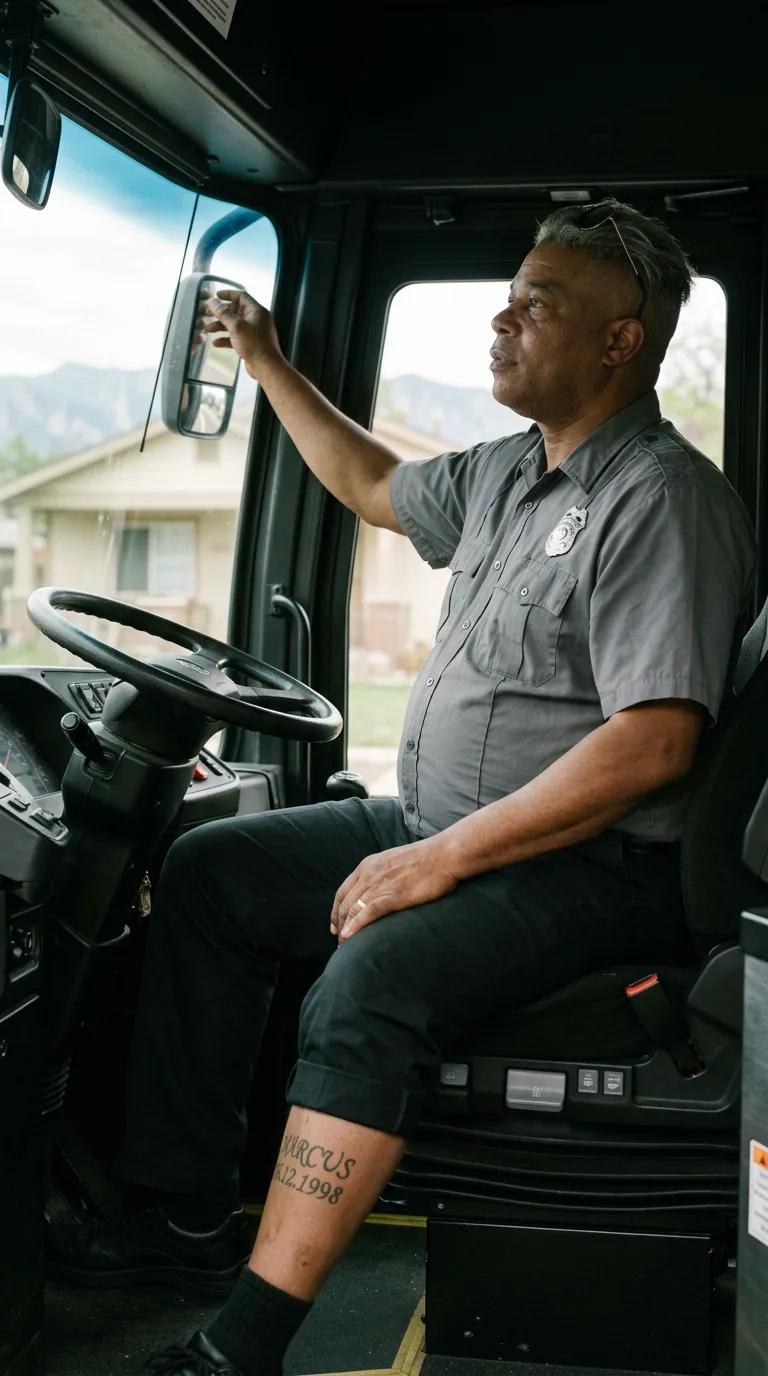
Rarest thing about him: Leg — common, 1 in 54
Season 1seed 1881707 · engine v11
Character card
lineage PYNCV3
His body-swap story
@colton.vandermark (admin), wearing Gary Muncrief, rolled the wheel on and woke up as Terrence Whitfield, spent 4 minutes in him, then spun the wheel and woke up as Danny Kesselman
Gary Muncrief's office chair does not fit right. That is the thought you keep having, sitting in it, six minutes into being a bald fifty-one-year-old with a gap in his front teeth and a company that makes precision valve fittings in a town you couldn't find on a map an hour ago. The desk is real walnut. The window looks out on a parking lot with his name on a reserved spot. You should feel like you won something.
Instead your foot — his foot — taps against the base of the chair, once, twice, an inherited tic you didn't ask for and can't place, and you realize the wanting is already back, already restless, already bored of a body that has everything and gives you nothing to do with your hands. Forty-eight men behind you and every single one of them, eventually, turns into this: a chair that doesn't fit, a life you didn't earn feeling like a coat two sizes off. You open the laptop. The site is already in your bookmarks, of course it is, top of the list, vessel.cards, plain as a bank login. You do not think about it as a decision. You think about it as scratching something. You spin.
—
The wheel stops turning inside a mirror the size of a coffee can, angled out over a bus's front tire, and your hand — his hand, dark-skinned, a little swollen at the knuckles — is already on it, adjusting it two degrees left, the exact motion he's made ten thousand times, except this time it happens wrong, thumb catching the frame instead of the housing, and you feel the correction happen before you understand you're the one making it. You do it again. Slow. Right. The mirror locks. Behind the wheel of the bus you can feel a whole body arranged around a driver's seat like it was poured there — heavier through the middle than the one you left, shorter, gray hair pushing out from under sunglasses parked on top of his head, one knee already bouncing against the underside of the dash without permission, engine idling, the smell of hot vinyl and coffee gone cold in a cupholder.
Ten more small motions come out of you checked — mirror, mirror, blinker stalk, the parking brake he already knows blind — each one run through consciously because his hands used to do this without you.
The shirt is what opens first. Gray-blue, breast pocket with a badge over it, the fabric worn soft at the elbows from a thousand identical mornings, and touching it gives you the shape of one particular morning: him standing in front of a closet in a bungalow that used to have two names on the mailbox and now only has his, buttoning this shirt from the bottom up because that's the order his fingers learned it in thirty years ago, sunglasses already pushed up into his hair before he's even out the bedroom door, keys jingling in his left hand because his right is for the coffee. Terrence Whitfield. The name arrives with the shirt collar, unasked, the way his own name always does, worn in like a callus.
The wheel under your palm gives you more — years of it, mornings and afternoons of it, the particular ache that lives in his lower back by 2 PM and the particular pleasure of the mountains showing up behind the rooflines on the return leg of the route, Denver doing that thing it does in the afternoon light. You are wearing a man on a swing shift, out here now while somewhere across a time zone a version of you just closed a laptop at the end of a workday, and the two clocks don't line up and neither did his marriage.
The tattoo on his calf gives you that, tucked under a sock you can't see but somehow still feel, like a scar you remember getting. Marcus. 06.12.1998. A son, birth year putting him near thirty now, and a daughter two years behind him, both grown, both fine, both calling less than he'd like. The ex-wife left a pale stripe on his ring finger and a silence in the bungalow that isn't unhappy so much as unfilled — she kept the good couch, he kept the porch, and some Wednesdays he still catches himself setting two mugs out before he remembers.
He quit smoking the year Marcus was born and still, twenty-six years later, his hand sometimes drifts toward a shirt pocket that has never once held a pack. He drinks socially, a couple beers with the guys after a long route, nothing that follows him home. He doesn't pray. He never has. He believes in his mirrors, his checklist, the exact hour the 12 route is supposed to hit Colfax, and not much else, and that has mostly worked out fine.
His body under your hands is heavier at the middle than you're used to and stronger through the forearms than it looks, a dad bod that still throws a duffel bag onto a top shelf without thinking twice, a nose slightly crooked from a fight he had at twenty-two over nothing worth remembering, knees that complain on the third stair and never on the first two. The seat under him is molded to exactly his weight after years of exactly this route. His leg bounces against the frame of the bus, has been bouncing this whole time, an idle motor he's never once managed to switch off, and you let it keep going because stopping it would be the first thing about him you changed.
You lift your hands off the wheel and look at them — broader than the ones you had six minutes ago, a paler band across the ring finger where something used to sit and doesn't anymore, knuckles a little swollen, a life's worth of steering written into the calluses at the base of each finger. You turn them over once, like you're checking they're real, and something in you that has done this forty-nine times now still isn't sure why it keeps needing to.
You look up into the long mirror over the windshield, into your own eyes, and past them, out at Denver going by, mountains sitting patient behind the rooflines like they've got nowhere else to be.
"Route's not gonna drive itself," you say, to nobody, in his voice, and put both hands back on the wheel like you've done this ten thousand times, because you have — for six minutes now, and however long after that turns out to be.