Farid Azadi
Fictional. Generated by AI — not a real person, and no likeness of one is intended.
61, surgeon in Nashville · rolled by @colin.hasbrook · card — no film
History
who has worn him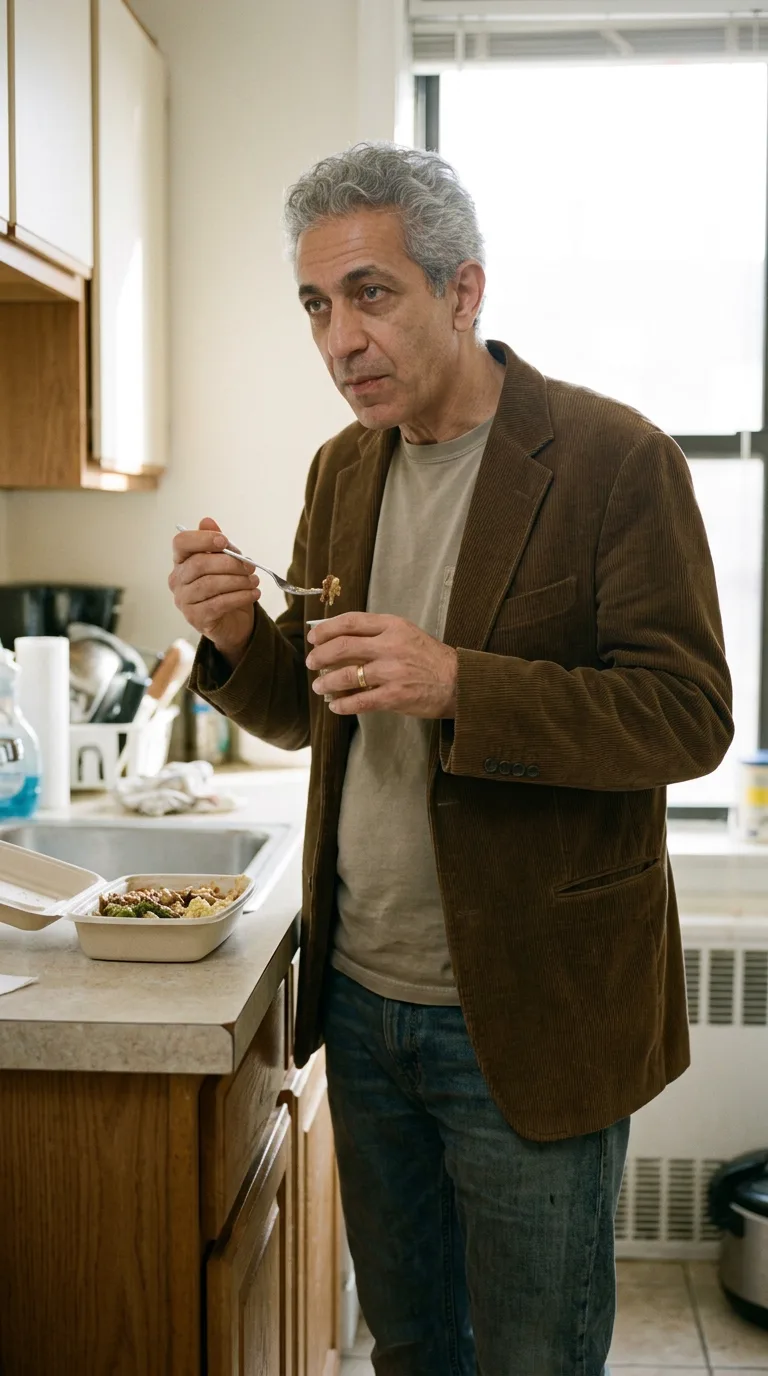
Rarest thing about him: Rich beyond the room — $10M to $50M — legendary, 1 in 611
Season 1seed 1014717421 · engine v11
Character card
lineage 2NZHHJ
His body-swap story
@colin.hasbrook, wearing Douglas Meffert, rolled the wheel on and woke up as Farid Azadi, spent under a minute in him, then spun the wheel and woke up as Declan Ferriter
---
Douglas Meffert's feet ache before the shift even starts, and that is the thing that decides it.
You have been him less than a minute, standing in the stockroom off the casino floor where he takes his break, apron still tied, a case of ranch dressing balanced on one hip because someone told him to restock the walk-in before the breakfast rush. Six-five and built soft everywhere, the once-broken nose still tender if he presses it, thirty-one years old and stuck this way forever now — no. Forty-six. Forty-six and he will always be forty-six, because there is nothing left in there to keep counting past it. His knees are bad already. His feet are worse. Somewhere behind his ribs there's a landlord problem and a woman named Denise who hasn't called back and a body that was, before you took it, already tired of being looked at by tourists who tip in quarters. You didn't even want him for long. You wanted him for the ninety seconds it takes to remember why you always come back to the same gray page with the wheel on it.
You set the ranch down. You take out the phone that isn't yours anymore, that is simply the phone in this pocket, and you open vessel.cards, and you pay, and you spin.
The fork is halfway to your mouth.
It stops there, a forkful of rice and something braised gone cool, and comes back down, and sets itself on the counter with a small definite click, the way a man sets something down when he has decided, mid-bite, that he isn't hungry the way he thought he was. The coat — heavy corduroy, brown, a little too warm for indoors — slides off narrow shoulders in one motion, and you sit, because sitting is what the body wants and you let it, and you finish the container in even mouthful after even mouthful, looking at nothing in a window gone white with morning glare. Outside, a Nashville Thursday is well underway. Somewhere close a pedal steel guitar is being packed into a car by a man who played until 4 a.m. and slept through breakfast. In here, at whatever late, backward hour this body has decided lunch is, you are eating leftover ghormeh sabzi with a plastic fork in a kitchen that smells like dish soap and old coffee grounds, and you don't know that yet, not with words, only with the smell of it climbing up through the sinuses before it has a name.
The fork is what starts it. Ridged plastic handle, warm from his hand, and touching it gives you the container itself — Persian stew, his mother's recipe filtered forty years through his own bad cooking, made too much of on purpose because leftovers mean not having to decide anything on the nights he comes home like this, unbuttoning nothing, still in his coat, too wrung out to sit at the table like an adult. You feel the specific exhaustion of it — not sleepy, past sleepy, the kind that lives in the eye sockets. One eye. It drifts. You feel it drift now, doing it on its own the way it always has, a wandering he stopped fighting decades ago, something a med school proctor once made a comment about that he has never fully forgiven.
The coat gives you more. Corduroy under your palm, the good coat, the one he wears when he isn't wearing scrubs, and under it — sleeve by sleeve, an hour ago that is also a thousand hours ago — the memory of putting it on this morning in the dark of a bedroom, his wife still asleep, one arm and then the other, buttons he doesn't bother with anymore because he's sixty-one and long past dressing for anyone's approval but his own. The wedding band on the left hand is next, small and plain and worn thin at the inside curve, and it opens a marriage whole: thirty years of it, a woman named Roya who long ago stopped waiting up and started sleeping easier for it, a marriage gone quiet and steady the way a well-set bone goes quiet, not thrilling, not broken, just healed into shape. Underneath that, briefly, guiltily, an old ex — Leyla, a name that still has a taste to it, a version of himself at twenty-six that got left in Chicago along with a lot of promises he didn't keep, and he thinks of her maybe once a year, always in this same unbidden way, always gone again in a second.
The countertop under your other hand gives you the kitchen itself — not fancy, not what ten million dollars looks like, because he never bothered to spend it that way, this is a rental he's had for six years because moving felt like a project and he had no time for projects. The dish rack is full. The blinds are the cheap kind. None of it matches what his hands are worth, and that contradiction is its own small permanent joke he tells no one.
Deeper down, further back, the scrub top from this morning's memory — not this shirt but the twin of it, hanging in his locker at the hospital, and through it a whole life of operating rooms, the particular blue light of them, the doors swinging shut behind him at the end of a case with that pneumatic sigh, the mask pulled down off his face, the feeling of having done, again, a thing very few hands on earth can do. His hands know it without him thinking about it — the weight of an instrument, the specific give of tissue, muscle memory laid down over three decades that no forgetting could touch, because it was never in words to begin with. And underneath that, when there's nothing surgical to hold, his hands do something else entirely: flip a lighter, though he's never smoked a day in his life, just likes the small click and catch of it, an old habit from a roommate in residency, outlived the roommate by twenty years.
His son comes through last, thin and quick, gone before you can hold him — a young man's face at some dinner table, an old argument about medical school that resolved itself into something gentler than either of them expected, a text message unanswered on a phone somewhere in this apartment right now.
You are sixty-one and skinny fat and your knees don't complain the way Douglas Meffert's did, and something in the chest is quieter too, steadier, a body that has never once been asked to carry a tray of drinks across a casino floor.
The last bite is gone. The container's empty. Your left hand comes up in the white window light, and you turn it over slowly, the ring catching, the eye drifting off toward the corner of the room on its own the way it always will now, whether you want it to or not.
"Whose kitchen is this," you say to the glass, not really asking, already knowing, already wondering how long you'll bother finding out.