Farhan Qureshi
Fictional. Generated by AI — not a real person, and no likeness of one is intended.
49, butcher in Phoenix · rolled by @marco.villagrana · card — no film
History
who has worn him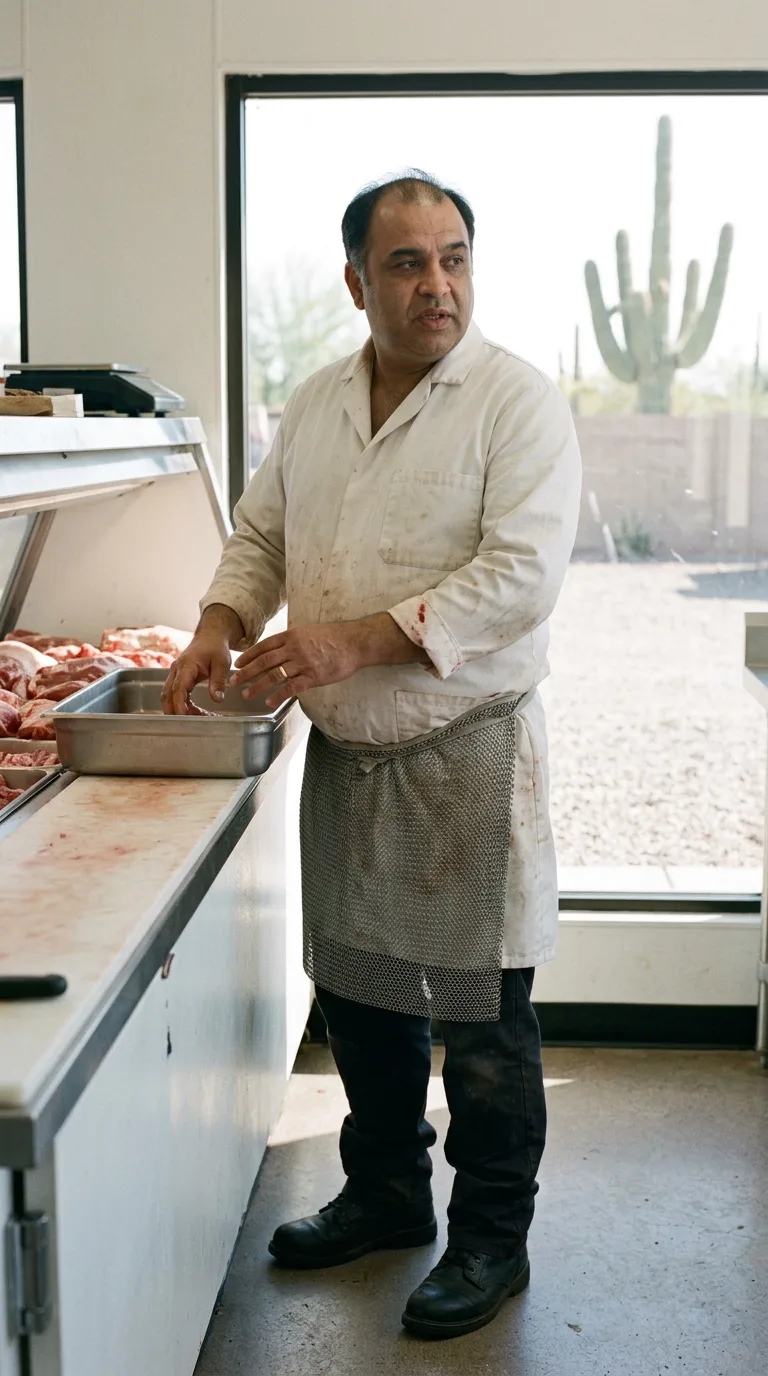
Rarest thing about him: Smokes and vapes — epic, 1 in 50
Season 0seed 61878961 · engine v10
Character card
lineage LJL8SV
His body-swap story
@marco.villagrana, wearing Kenji Osako, rolled the wheel on and woke up as Farhan Qureshi, spent 3 minutes in him, then spun the wheel and woke up as Rolando Cepeda
You had been Kenji Osako for a hundred and twenty seconds, and already the cab of his rig felt like a coffin somebody built to your exact, wrong measurements. Skinny fat, 5'8", the seat pushed back as far as it goes and your knees still against the wheel. Somewhere behind his sternum there was a diner he liked in Ohio and a daughter he texted twice a week, and you didn't want either of those things, you wanted out, because the wheel is a door and you have never once stood in a doorway without wondering what's past it. Friday evening in New York, the dash clock glowing, the site loading slow on his cracked phone screen the way it always does right before it gives you somebody. You spun before the truck stop lights finished their long blink from red to green.
The saw has just gone quiet. That's the first thing — not a sound but the absence of one, a machine settling, and your hand is inside a tray of trimmings with the fingers already curled the way his were curled, mid-sort, and the motion that should happen next doesn't happen. It happens wrong. You feel it happen wrong the way you'd feel a stair that isn't where your foot expects it — some small correct violence of the wrist that isn't yours, redone now slow and deliberate, like a man checking his own signature. Afternoon light is coming through the window behind you white and flat, and there's a saguaro out there holding its arms up at nothing, and none of it is New York, none of it is evening, and for a second that whiplash is the loudest thing in the room — his Friday two in the afternoon, yours going down into dark, both of you standing in the same body pretending to agree on what time it is.
The apron is the first thing that talks. Chainmail, heavier than you expect, sitting low on a belly that has never once been a source of shame to him — you get that clean, unbothered, a settled fact like weather. Under it, memory comes up through the mesh in a texture, not a scene: mornings, hundreds of them, tying this same knot at the hip without looking. Then the coat. Cotton gone soft with washing, a old bloom of someone else's blood on the cuff that never quite came out, and through the sleeve, sudden and whole, a morning — his hands buttoning this exact shirt in a bedroom with the blinds already hot at the edges, his wife asleep on her side of the bed, the ring cold for half a second before his hand warmed it. He'd stood at the mirror and pushed at the hair on both sides like it might reconsider its retreat. It never has. He'd smiled anyway — gap in his front teeth catching the light, a thing that used to embarrass him at nineteen and that his wife once told him she'd have missed if it weren't there, so now he doesn't mind it, doesn't mind much of anything about his own face anymore.
The counter under your other hand gives you years. Not this shop only — an earlier one, smaller, where he learned to break down a lamb with his father's voice over his shoulder correcting the angle of the blade; a fight with his first wife about money that ended their marriage slower than either of them wanted, conducted mostly in this same low patient tone he uses on customers; the two kids, older now, one of them texting him dumb videos he half-watches on breaks; the second wife, later, easier, who doesn't ask him to explain the shop's hours or why he still smells like it after a shower. Somewhere in there a doctor saying blood pressure a little sharper than Farhan wanted to hear it, and Farhan nodding like a man filing a receipt he intends to lose.
His body holds all of it plainly. Forty-nine and it shows in the knees more than anywhere, a low ache from standing on concrete since he was younger than either of his kids are now. The boots are worn into a shape that isn't quite yours yet but knows exactly where it's going. There's a vape in his coat pocket you can feel the shape of without touching it, and a pack of cigarettes he tells his wife he quit, and his fingers, even now, mid-arrival, want to drum against the steel edge of the tray — a rhythm with no song attached, just a habit as old as his hands.
You lift them. Turn them over in the flat white desert light, blood at the cuff, wedding band loose enough to spin if you wanted to spin it, and something in you — the you that is still, underneath forty-eight bodies deep, the one who keeps doing this — goes quiet and almost reverent, the way you never let yourself be about Kenji, about any of them, until right this second.
"Hijo de," you start, and stop, because that isn't his language and it isn't yours either, it's just the noise a mouth makes when it's surprised to be a mouth again.
You settle instead, out loud, to no one, to the cactus and the empty counter and the trays going warm under the window: "Okay. Okay — let's see how long you last."