Rolando Cepeda
Fictional. Generated by AI — not a real person, and no likeness of one is intended.
53, barista in New York · rolled by @marco.villagrana · card — no film
History
who has worn him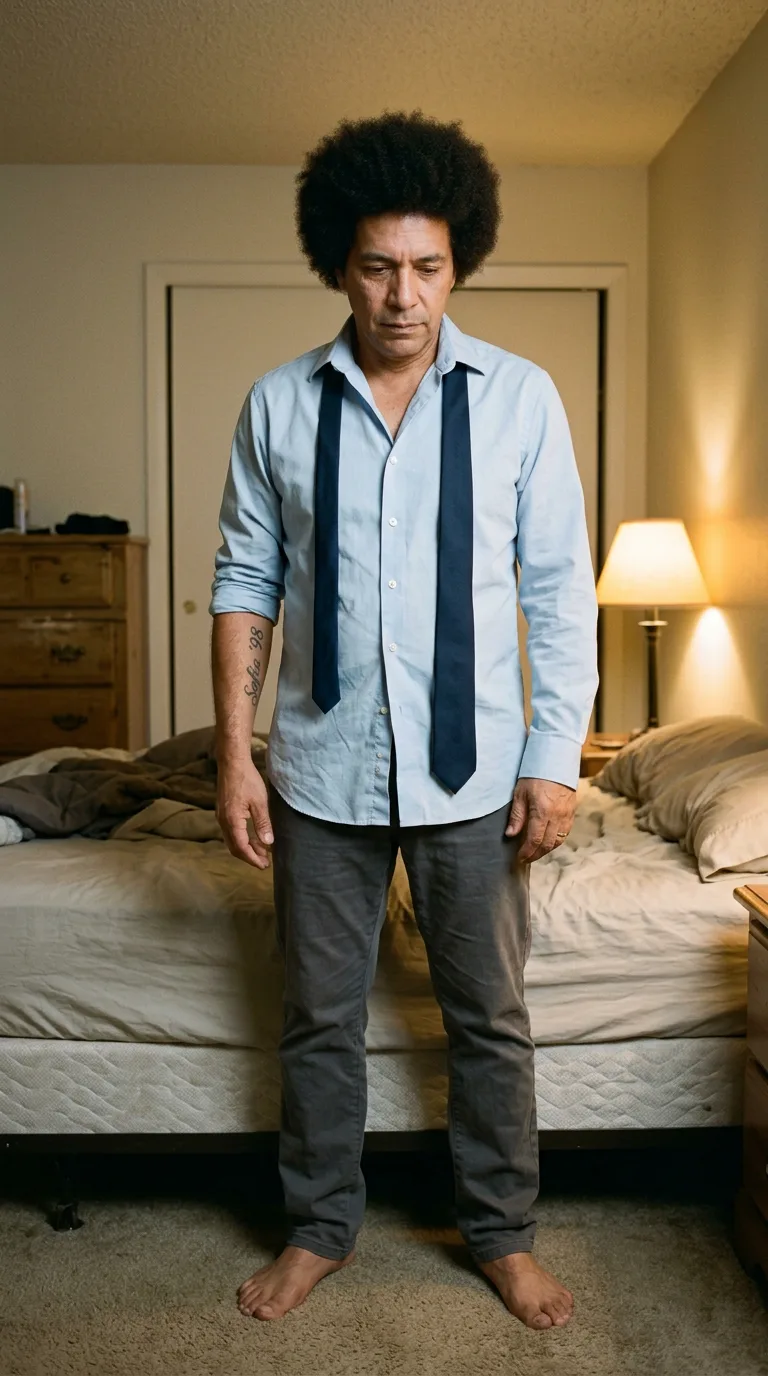
Rarest thing about him: Afro — rare, 1 in 170
Season 0seed 883371564 · engine v10
Character card
lineage LJL8SV
His body-swap story
@marco.villagrana, wearing Farhan Qureshi, rolled the wheel on and woke up as Rolando Cepeda, spent 3 minutes in him, then spun the wheel and woke up as Jaylen Osei
Farhan Qureshi's apartment smells like cumin and cardboard boxes nobody has unpacked in a year, and the body you're wearing has been standing in the kitchen doorway for two minutes now, gum-free, chewing on nothing, because the habit isn't his. It's yours. It travels. Ninety bodies and you've never once put down the chewing, even when the mouth wasn't built for it, even when the last man's dentures clicked with it.
Farhan had been you for two minutes and eleven seconds when the thought arrived, whole and simple: this one is fine, and fine is the problem. The butcher's hands know their work without being told — you felt that already, cutting nothing, just standing near the block, muscle memory not yours humming under the skin like a motor left running. A wife in the next room you haven't met yet. Kids' height marks on a doorframe you haven't seen. A whole life laid out like a shop before opening, and you are already bored of the idea of walking through it. Ninety times you have felt this exact itch: the fear that if you stay anywhere too long you'll start wanting to.
So you go back to the site with his phone, thumb — his thumb, still learning its own prints — tapping in the account. The wheel loads slow on his cracked screen. You spin.
The kitchen doesn't fade. It simply isn't there anymore.
You are barefoot on carpet that's cheaper and older than anything in Farhan's building, half-bent, one hand flat against a ribcage that is not the one you had a second ago — narrower, harder at the sternum, a body fifty-three years lived-in. Fingers are already moving on shirt buttons, undoing them, and you feel that instant, animal certainty: wrong hole, wrong side, before your mind has a name for either. The tie hangs loose and cheap-silky against your collarbones. A lamp is on. Somewhere behind you a bed is unmade in the specific way of someone who got up in a hurry and never came back to fix it.
The buttons re-close themselves under your fingers, correctly this time, and you didn't decide that — his hands did, or muscle memory did, or something that isn't quite you and isn't quite gone either, doing what it's done six mornings a week for thirty years.
Then the shirt gives you the first flash: sleeve going on, right arm first, always right arm first, a habit from a mother's voice decades dead — mijo, so the shirt doesn't fight you — and you're not deciding to remember Rolando's mother, you just are, briefly, standing in a kitchen in another decade while a woman in curlers buttons a boy's church shirt too fast.
The tattoo on the forearm burns into meaning as your eyes pass over it: Sofía '98. Not a girlfriend's name, not what you'd guess. A daughter, first one, born in a hospital in Sunset Park at 4 a.m. while machines beeped and he cried in the hallway because nobody had told him it would look that much like relief and terror wearing the same face. He got the ink four days later, hand still shaking in the chair. Twenty-six years old then. Twenty-seven now — Sofía, not the tattoo — grown, gone to Albany for a nursing degree, calling on Sundays.
The wedding band gives you more, and gives it warm: a woman named Marisol who laughs with her whole chest, who still, after twenty-nine years, steals sips of his espresso and complains it's too strong every single time. You feel — his feeling, not yours, arriving secondhand and enormous — the specific ordinary joy of her elbow against his side at the counter this morning, her voice saying don't forget the Ortegas want the anniversary order by noon, and the answering warmth that isn't romance exactly anymore, is bigger and slower than that, is just decades.
The apron isn't on him yet but the memory of it is close enough to touch: steam wand shriek, the particular ache low in his back by three o'clock, forearms that know the weight of a pitcher without thinking, second son Mateo who wants to be an engineer and doesn't call enough. A shop two men from the block helped him open when he was thirty-eight, mortgaged against nothing but nerve. Mass on Sundays when Marisol can drag him. A beer most nights, sometimes two, on the stoop with a neighbor, never a cigarette — tried one once at nineteen and it did nothing for him and he never understood the people who needed it.
This body: five-five, which he has made peace with the way short men do, joking about it before anyone else can. Average weight sitting easy on a compact frame. Fifty-three and the knees complain on the subway stairs and the lower back complains behind the counter and neither complaint has ever once stopped him from getting up at 5 a.m. The afro is grayer at the temples than the mirror wants to admit, and his hands — broad, sure, a burn scar on the left thumb from a portafilter three years back that isn't a fact you were given and so isn't there, just steadiness, just competence, just a body good at exactly one specific kind of gentle labor.
The knot of the tie is wrong under your fingers now, some other pattern, something this closet has never seen tied into that navy silk, and you feel him — not you, him, whatever residue lives in the wanting to fix a crooked collar — almost surface in the confusion of it, and then not.
You look down. The hand at the end of your arm turns over, palm up, and there's a wedding band catching lamp light, and a name in script that a photograph never told you the size of.
"Sofía," you say, out loud, to the empty room, just to hear it land in a voice that isn't yours yet and already is.
Ninety times now. You don't know yet if this is the one where you stay through breakfast.