Ernesto Villagómez
Fictional. Generated by AI — not a real person, and no likeness of one is intended.
43, film projectionist in Los Angeles · rolled by @colin.tarwater · card — no film
History
who has worn him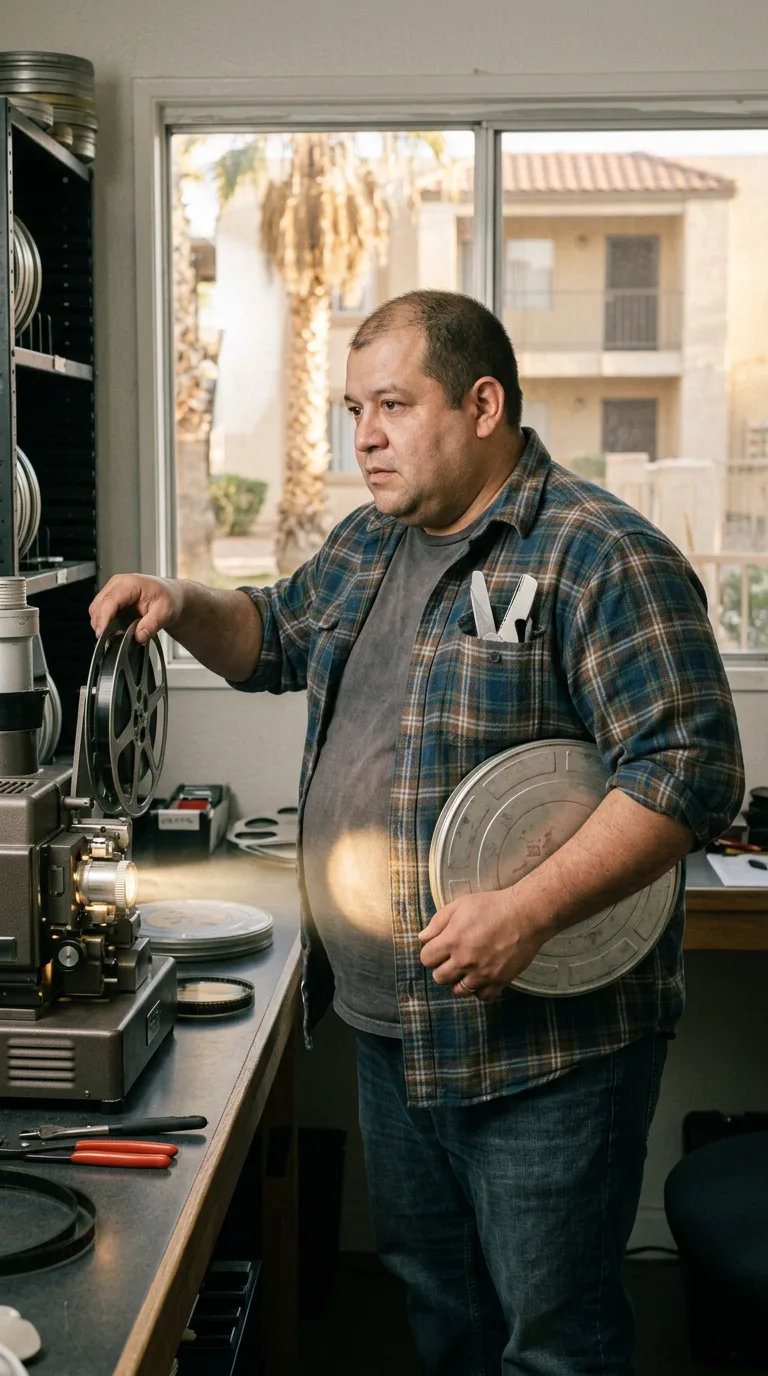
Rarest thing about him: Dip or chew — rare, 1 in 40
Season 0seed 1358428578 · engine v10
Character card
lineage COEU7T
His body-swap story
@colin.tarwater, wearing Nathan Bhatt, rolled the wheel on and woke up as Ernesto Villagómez, spent 1 minute in him, then spun the wheel and woke up as Adrián Pacheco
Nathan Bhatt's hands smell like the inside of a truck that never fully airs out, and you have been him for less than a minute when you already know you are done with him. The gloves are still on. The hopper is still grinding somewhere behind you, chewing a mattress someone left at the curb, and the smell of it — hot rubber, wet cardboard, the specific rot of a Tuesday's trash — is the whole reason your thumb is already moving toward your phone. Thirty-three years old and skinny fat and the cleft in this chin doesn't even feel like yours yet, and it won't, because you're not staying to learn it. You caught the truck's side mirror a second ago and saw the hazel eyes look almost embarrassed, like the body itself knew you'd be gone before it finished its shift. You open the site with a glove still half-on. You don't think about Nathan. You never really do, after. You spin.
The half-second is a stutter in a man's wrist. His hand is on a reel, easing it off the spindle, a motion so old it happens below thought — and then it happens wrong, the reel tips, catches the flange, and he corrects it slow, deliberate, like a man reading his own hands' instructions back to himself for the first time in twenty years. Ten more reels come off after that, and every one of them gets checked. He does not know why. He is heavy in a way Nathan never was — real heavy, settled-in heavy, a gut that has a shirt fitted around it rather than the other way — and the booth is hot and smells of hot bulb-glass and dust burning off the lamphouse, and through the port the light goes out steady into a room you cannot see, throwing something onto a screen for people who have no idea a man's whole self just emptied out up here.
The flannel is what opens first. Not the shirt itself — the collar, damp at the back of the neck with booth heat, and under it a memory arrives sleeve first: standing in a bedroom with gray morning light through blinds, a woman still asleep with her arm over her eyes, this same shirt coming off a hanger because it was the one that didn't need ironing, buttoning it one-handed while the other hand found the toothpick jar on the dresser out of habit, out of thirty years of habit, mouth already working one before the first button was done. Ernesto Villagómez has wanted a cigarette maybe four times in his life and never once let himself have it — he chews instead, always has, since his father's chew tin got passed down along with everything else that man never said out loud — and the wanting for that is in the jaw now, low and constant, a small motor that runs under everything else he is.
The film can under his arm gives more: decades of them, actually — cans stacked to the ceiling of a garage that used to be a car's, before this became a library nobody but him understood, before three kids stopped asking what he did all day because none of them wanted to follow him up here. He loves it anyway. Loved. Loves. The love doesn't check its own tense. Thirty-one years in booths across this city, some of them torn down now, one of them a parking structure, and every single one of them had that same smell — hot dust, hot metal, popcorn butter drifting up from below like weather from a country he only visits by smell.
The wedding band gives the most, because it's touching skin the whole time, has been for nineteen years: Marisol at a cousin's quinceañera, before either of them had a plan, and later a hallway with three cribs in a room that should've held one, and later than that, this morning, her hand flat on his chest before he left, not even a word, just the hand, because after nineteen years the hand says the whole thing. High blood pressure sits behind his sternum like a low hum he's stopped hearing, a pill bottle on the bathroom sink he half-remembers taking and half-remembers forgetting, the doctor's voice saying *cut the salt* and Marisol saying it louder and more often. His knees ache faintly, standing knees, decades of standing knees. His hands are thick and sure and already reaching for the next reel before he tells them to, because that's what thirty-one years buys you — hands that know the job better than the man carrying them does.
The toothpick is between his back teeth right now, has been the whole shift, and the jaw works it slow, unconscious, the last thing that's fully still his own.
You look down at the hand on the reel — thick fingers, a plain gold band, a half-moon of grease under one nail that will never quite come out — and you turn it over once, like checking it's real, like checking it's yours.
Then you look up, past the projector beam, toward the little glass port where the light goes out into the dark where the people are, and you say, low, around the toothpick still caught in your teeth:
"Whole reel's out of order. Been out of order for years, and nobody up here to fix it but me."