Dwight Muncaster
Fictional. Generated by AI — not a real person, and no likeness of one is intended.
38, stay-at-home dad in Rural Texas · rolled by @colin.hasbrook · card — no film
History
who has worn him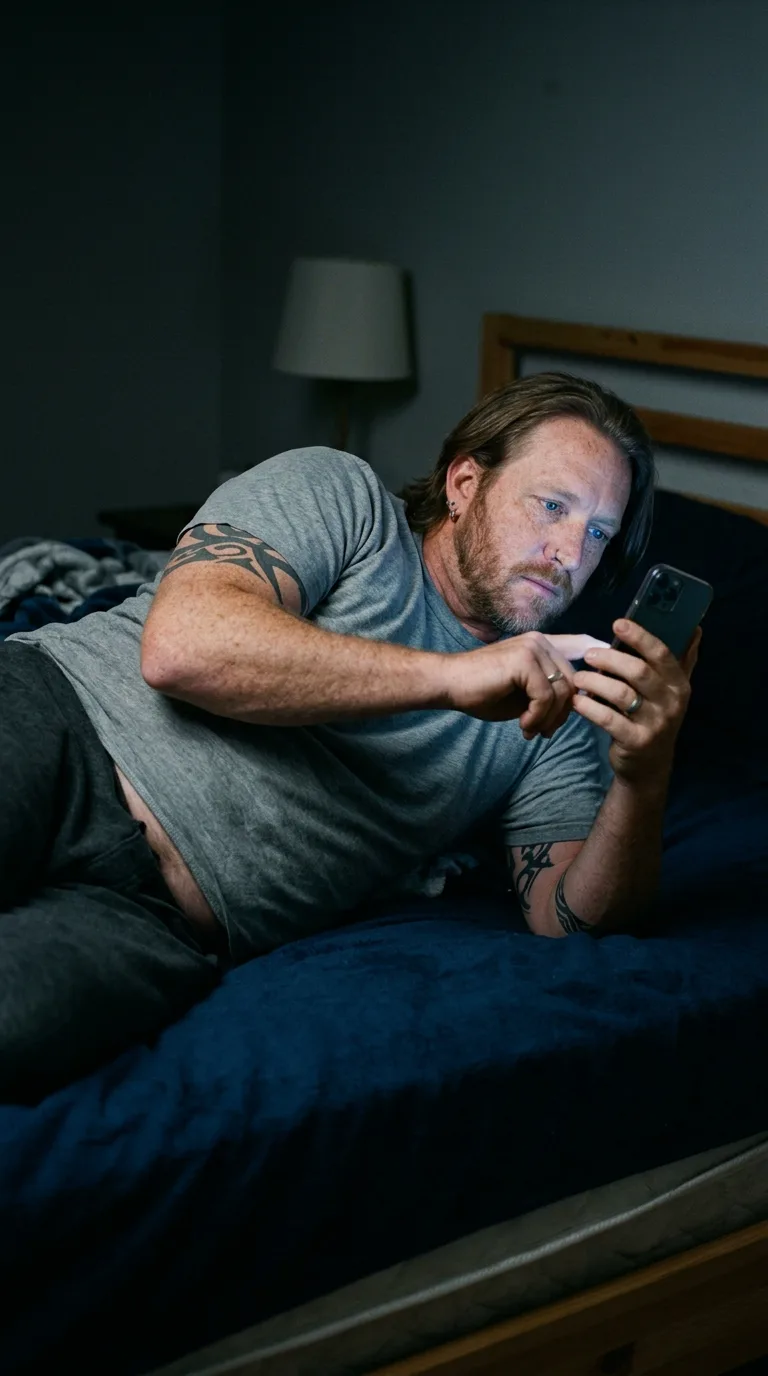
Rarest thing about him: Several — uncommon, 1 in 121
Season 1seed 161006936 · engine v11
Character card
lineage 2NZHHJ
His body-swap story
@colin.hasbrook, wearing Kyle Beringer, rolled the wheel on and woke up as Dwight Muncaster, spent under a minute in him, then spun the wheel and woke up as Francis Delvecchio
Kyle Beringer's apartment is quiet at this hour, the kind of quiet that comes after eleven at night in a city that never fully commits to sleeping. You are standing in his kitchen — his skinny arms, his lazy eye drifting a half-degree off true no matter how hard you try to aim it — and you have been him for maybe forty seconds. Not even enough time to check what's in his fridge. You spun into a physical therapist with a soft handshake and gentle patient-voice muscle memory already sitting in his forearms, and you took one look at the life waiting behind his eyes — evening runs, a subscription meditation app, a mother who calls on Sundays — and felt nothing. Not disgust. Just the flatness of a room you've already toured. Less than a minute in, and your thumb is already moving toward the laptop, toward the site, because forty seconds ago you were somebody else's brother, and some door in you did not finish closing.
You go back to vessel.cards out of a specific itch: five spins back you wore a bald little professor named Gerald, and while you were him you sat across a table from a man who called him "Ger" and refused to let a silence sit uncorrected, who filled every gap in the conversation like it was his job, and you left that dinner without ever getting to be the other man in it. Curiosity, mostly. Maybe something meaner underneath. You pay. You spin.
The wheel turns and stops on weight — real weight, a body with give to it — and you arrive already leaning forward, already mid-thumb-flick, a phone six inches off your nose in the dark. The screen light holds too steady on your face; the blinking has stopped being a reflex and started being a decision, though there is no one around to notice. Your thumb keeps moving through a feed he had already stopped scrolling, faster now, more sure, a stranger's rhythm laid over his hand. Outside this room it is early evening in a place with a water tower on the skyline; inside it, it might as well be any hour, because he was alone with it either way.
The mattress under you announces itself first — the give of it, a low spot worn into his side by years of the same sleeping position — and it brings a flash of an argument, gone before you can hold it, something about money and a co-pay. Then the t-shirt. Cotton, soft from a hundred washes, a faint chemical ghost of dryer sheets, and it opens all at once: a boy — no, a man, this morning, pulling this exact shirt over his head in a bathroom with the fan broken and humming anyway, catching his own reflection and not really looking at it, the way you stop looking at your own face somewhere around thirty-five. Gray sweatpants next, elastic soft with wear, and under them a body that is not lean anymore and does not apologize for it — a belly that has absorbed a decade of easier dinners, shoulders still thick from the years before that, a low ache in the left knee that has been there so long it reads as part of the joint rather than an injury.
The nose ring catches light when he — when you — tilt your head, and it drags up a whole year: a younger version of these arms getting the first tribal piece done in a shop that smelled like antiseptic and cigarettes he'd already quit, a girl he was trying to impress who is not the woman he married. The wedding band is warmer than the rest of your hand, worn smooth on the inside, and it gives you her — Renae, hanging laundry, saying his name in the specific tired-fond voice reserved for husbands — and then it gives you the wedding itself, outdoors, humid, his mother crying into a paper fan.
The kids' shoes by a door that isn't in this room yet but is somewhere close in his mind — small sneakers, one with a broken velcro strap he keeps meaning to fix — and a whole morning comes with it: breakfast dishes stacked wet in the rack, a laundry basket riding his hip, a backpack with a cartoon bear on it dangling from two fingers, a boy yelling that he can't find his other shoe, and him, patient in a way he had to learn on purpose, saying *it's under the couch, it's always under the couch.* This is the job. Has been for years. Nobody at the feed store believes him when he says it's harder than the one he used to have, and he has stopped explaining it.
The leg starts bouncing before you tell it to — his leg, an old habit with no owner but him, going since he was a teenager waiting outside a principal's office — and something in you settles into the rhythm of it like sitting down in a chair shaped for you. His jaw carries the memory of a laugh that isn't yours yet but will be, if you stay. The freckles across the nose, when you finally catch them in the phone's black mirror of a screen, don't look like anything. They just look like a face that has been out in this particular sun a long time.
You look at your hand — thick-knuckled, a tattoo curling out from under a rolled t-shirt sleeve, the ring catching the last of the screen's light — and you turn it over once, like checking it's real.
"Huh," you say, to the empty room, in a voice that isn't the therapist's and isn't quite yours either. "Okay."
The phone goes dark in your palm. Somewhere down the hall a kid is asleep, and somewhere behind you a wife is not, and the wheel is still sitting open on a screen in a city four hundred miles and one hour away, waiting on nothing, for however long you decide that is.