Dustin Kowalczyk
Fictional. Generated by AI — not a real person, and no likeness of one is intended.
20, warehouse picker in Anchorage · rolled by @colin.hasbrook · card — no film
History
who has worn him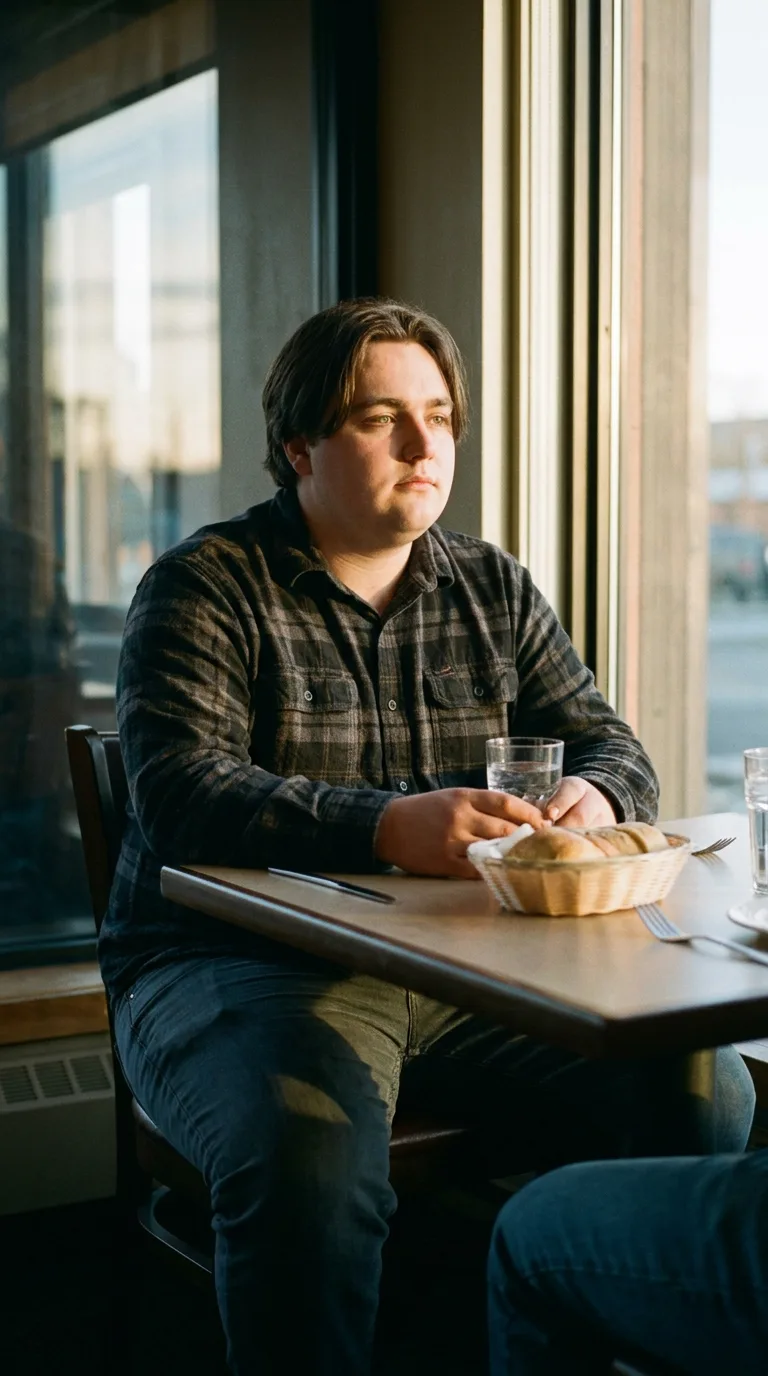
Rarest thing about him: On a first date, going badly — uncommon, 1 in 125
Season 1seed 1307111548 · engine v11
Character card
lineage 2NZHHJ
His body-swap story
@colin.hasbrook, wearing Kai Alameida, rolled the wheel on and woke up as Dustin Kowalczyk, spent under a minute in him, then spun the wheel and woke up as Danny Otsuka
---
The dimples are the last thing you notice about Kai Alameida, and you notice them now the way you'd notice a stranger's face in a mirror you forgot you were standing in front of. Seven minutes. That's all it's been. The landscaper's truck is idling somewhere down the hill, blades of grass still clinging to a forearm you didn't grow, and the Honolulu sun is doing that thing where it turns the back of your neck to syrup, and you feel — nothing wrong, exactly. Just early. You spun this one an hour ago by his clock and you're already reaching for your phone with his hand, already thinking about the wheel the way you think about a door you know is unlocked. Kai is fine. Kai is *strong*, dimpled, twenty-five and built like something that carries lumber for fun. There's no reason. That's almost the whole reason. Eight hundred and fifty-eight men behind you and the only thing that's ever scared you is a body you can't find a complaint about, because a body with nothing wrong is a body you can leave without grief. You open the site on the cracked screen a stranger's thumbprints have worn smooth. The wheel loads. You spin it not because you're bored of Kai but because you've learned, eight hundred and fifty-eight times, that wanting doesn't wait for a reason good enough to say out loud.
—
The water glass is warm under your fingers, which is the first wrong thing, and then the weight of you is the second, because you are wide in the chest and heavy through the middle in a way that Kai never was, and the light coming through the glass beside you is going amber-orange instead of tropical-white, and there is a bread basket, untouched, and a woman across the table whose face is arranged into the particular patience of someone who has stopped being angry and started being tired. Your mouth is already moving. You didn't start the sentence. You just arrive inside its second half, his voice — a voice you've never used — carrying the last few words of an apology out over the next table, too loud, cracking slightly on *fault*, and the glass turns a quarter-inch under your hand and stops.
—
The flannel comes first, because it's already on you, sleeves rolled once at the cuff, and it gives you the morning: him standing in front of a particleboard closet in gray light that never really commits to being daylight this far into November, choosing this shirt over the navy one because the navy one still smelled like the warehouse, like cardboard dust and the machine oil off the pallet jack, and he wanted tonight to smell like nothing, like a clean start. His hands did the buttons without watching them — thick fingers, quick despite their size, a body that has spent two years learning a warehouse's rhythm until the rhythm became involuntary. You feel the ghost-ache in his lower back that isn't pain yet, just a debt, ten hours a day of reaching and stooping and the beeping of a forklift that never quite left his ears even at home. You feel how strong his arms are without being asked to be — carrying totes, hauling cases, a strength nobody compliments because it doesn't look like the kind people compliment.
The chair under you gives you the restaurant: a place his girlfriend picked because it had good reviews and he'd agreed too fast, the way he agrees to things he hasn't thought about, and then spent the drive over rehearsing something he wanted to say and losing it twice. The bread basket gives you nothing — he never touched it, that was the trouble, he sat across from her for twenty minutes and didn't take a single roll because his stomach had closed up sometime around the second silence, and this, you understand suddenly and completely, is a boy who eats when he's fine and stops eating when he isn't, and hasn't eaten since noon.
The glass gives you her name — Sam, short for Samantha, a coworker's cousin, a setup that felt promising over text and has felt like a slow leak ever since they sat down — and gives you the shape of the whole evening leading here: a joke that landed wrong, a question about his job that he answered too defensively, a silence he kept trying to fill and kept filling badly. He likes her. That's the part that's making his chest tight under your borrowed sternum — not dislike, not boredom, just the particular helplessness of a heavy, quiet twenty-year-old who has never been good at rescuing a conversation once it starts to sink, and knows, even now, even mid-sentence, that he is watching himself sink it further.
The vest isn't on him now but you feel where it usually sits anyway, worn into his shoulders like a second collarbone, and with it comes the warehouse whole and complete — the smell of it, cold concrete and cardboard, the particular ache of a scan gun's strap against his wrist, the small pride he takes in being fast, faster than guys twice his seniority, a competence that never once translates into words when it would help him most, like now, like every silence at this table he doesn't know how to fill. You feel the walk to his truck after every shift, the snowmobile under its blue tarp in the side yard that he hasn't ridden since March and keeps meaning to, the particleboard walls of a place that is his and small and his alone, no one waiting in it, nothing waiting in it but a bed and a door he locks out of habit rather than fear.
There's a version of him — you feel it arrive last, quietest — that wanted this date to be the thing that changes the shape of his evenings. That wanted, badly, to be a person someone stays for. It sits in your chest like a weight you didn't ask to carry, twenty years old and heavier than his body.
—
You look down at the hand still closed around the glass — thick-fingered, pale from a winter that has barely started, a small white scar of dry skin at the knuckle from the cold and nothing else, no ring, no ink, nothing that was ever his choice to put there — and you turn it over slowly the way you always do, the way that never stops being the strangest part, feeling a stranger's tendons answer to a want that isn't his anymore.
Sam is still watching you, waiting for whatever comes after *I'm sorry*, and you lift Dustin Kowalczyk's green eyes off his own hand and into hers, and you say, in his voice, carrying too far again, "I don't actually know what I was apologizing for."
You don't know yet if that's true for a night or for good. Nobody at this table does.