Danny Otsuka
Fictional. Generated by AI — not a real person, and no likeness of one is intended.
33, merchant mariner in Small-town Ohio · rolled by @colin.hasbrook · card — no film
History
who has worn him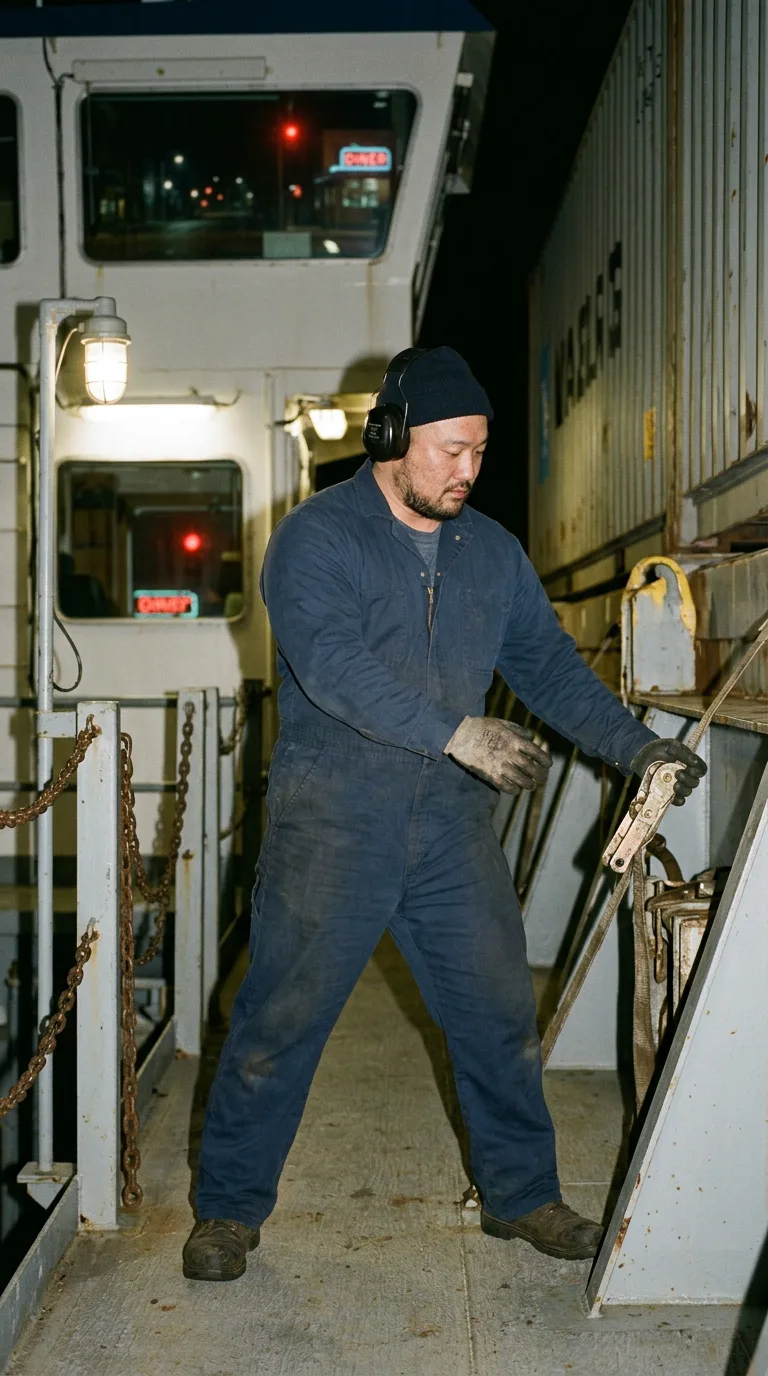
Rarest thing about him: Merchant mariner — uncommon, 1 in 2,434
Season 1seed 1946137096 · engine v11
Character card
lineage 2NZHHJ
His body-swap story
@colin.hasbrook, wearing Dustin Kowalczyk, rolled the wheel on and woke up as Danny Otsuka, spent under a minute in him, then spun the wheel and woke up as Corey Vantassel
The picker line at the Anchorage warehouse is dead for the night, but you make Dustin Kowalczyk stand there in the break room anyway, twenty years old and heavy in a body that aches in ways twenty shouldn't, green eyes flat under the fluorescent hum. You've had him less than a minute and you already know what he is: a kid who clocks in, clocks out, whose whole flavor is exhaustion and a girl who left six months back that he still checks on online. There's nothing wrong with him. That's the problem. He is a body with no texture to bite into, and eight hundred and fifty-nine men behind you have taught you that boredom is its own kind of hunger, sharper than any of the others. Your leg is bouncing — his leg, now, but the tic came with you somehow, riding through bodies like a stowaway — and you take out your phone with his thick fingers and open the site because it is Thursday and there is nothing else to do with a Thursday.
The wheel spins. It always spins the same, slow and then not.
You are bent at the waist over a container lashing, wind coming off black water, and your hand — not the hand you had two seconds ago, a shorter thicker hand in a stiff canvas glove — is turning a lever bar the wrong way. You feel the error before you understand it, some old animal alarm going off in muscle that isn't yours yet, and you stop, and you do it again, slow, correct. Cold that has weight to it. A headlamp somewhere behind you throwing your shadow long across corrugated steel. Ten more lashings ahead in a line and your body — his body — already leaning into the next one before you've caught up to who you are.
The glove is what opens first. Stiff at the knuckles, worn soft in the palm, and it gives you an afternoon on this same deck two winters ago, teaching a nineteen-year-old deckhand how to seat a turnbuckle without losing a finger to it, the pride of it, small and real. Then the coverall against your back, the collar of it, and that's the morning — this morning, hours ago now in whatever hour this body keeps — pulling it on in a bedroom with the shade still down, Mai already up and moving somewhere in the house, the kids' voices coming muffled through the wall, a fight about socks. He'd stood in front of the mirror a second longer than usual because the crown of his head had thinned again, he could see more scalp than he wanted to, thirty-three and going early like his uncle did, and he'd put the beanie on before he even had his boots laced, over hair he was quietly, privately unhappy with, over a beard that had never once in fifteen years of trying come in the way he wanted it to. Small vanity. Nobody's business.
The boots come next, underfoot, the give in the left sole that means new ones are three months overdue and he keeps saying next check, next check. And under the boots, the deck itself, cold through them, and that opens something larger and slower: years of decks, dozens of them, container ships and one bulk carrier he hated, months at sea that felt like being erased a little at a time, and the specific ache of missing a birthday over satellite phone, his daughter's voice too bright and too careful, performing happiness for him down a bad connection. He loves this work and it has cost him in a currency he never lets himself add up. He is not rich for it. He will never be rich for it. There is a number in his head — never enough of one — that he does math on some nights with a second beer in hand, the drink that is never quite a problem and never quite not one, Mai asleep already, the diner in town closed again this year and the stoplight outside blinking red to an empty Main Street he can picture from four thousand miles of water away.
And under all of it, the body: thick through the middle in a way that has nothing to do with softness, forearms that know a winch handle without being told, a knee that's been wrong since a fall on ice three years back, breath already a little short from the cold and the work and being thirty-three and built like a man who has done this exact motion, hands over hands, since he was nineteen. His weight sits different than the kid's did — lower, denser, a leg that bounces on its own when he's sitting but stands rock-still when he's working, because working is the one place his body has never once betrayed him.
You straighten up. You look at the glove, the hand inside it, turning it front to back the way a man checks a tool he's not sure is his.
"—the hell," you say, to the wind, to nobody, in a voice pitched lower than the one you walked in with, and then you go quiet, because the next lashing is already waiting, and somewhere back in Anchorage a kid's phone is lying face-up on a break room table with the wheel still glowing on the screen, spun and paid for and already forgotten.