Douglas Petrakis
Fictional. Generated by AI — not a real person, and no likeness of one is intended.
59, electrician in San Francisco · rolled by @colin.hasbrook · card — no film
History
who has worn him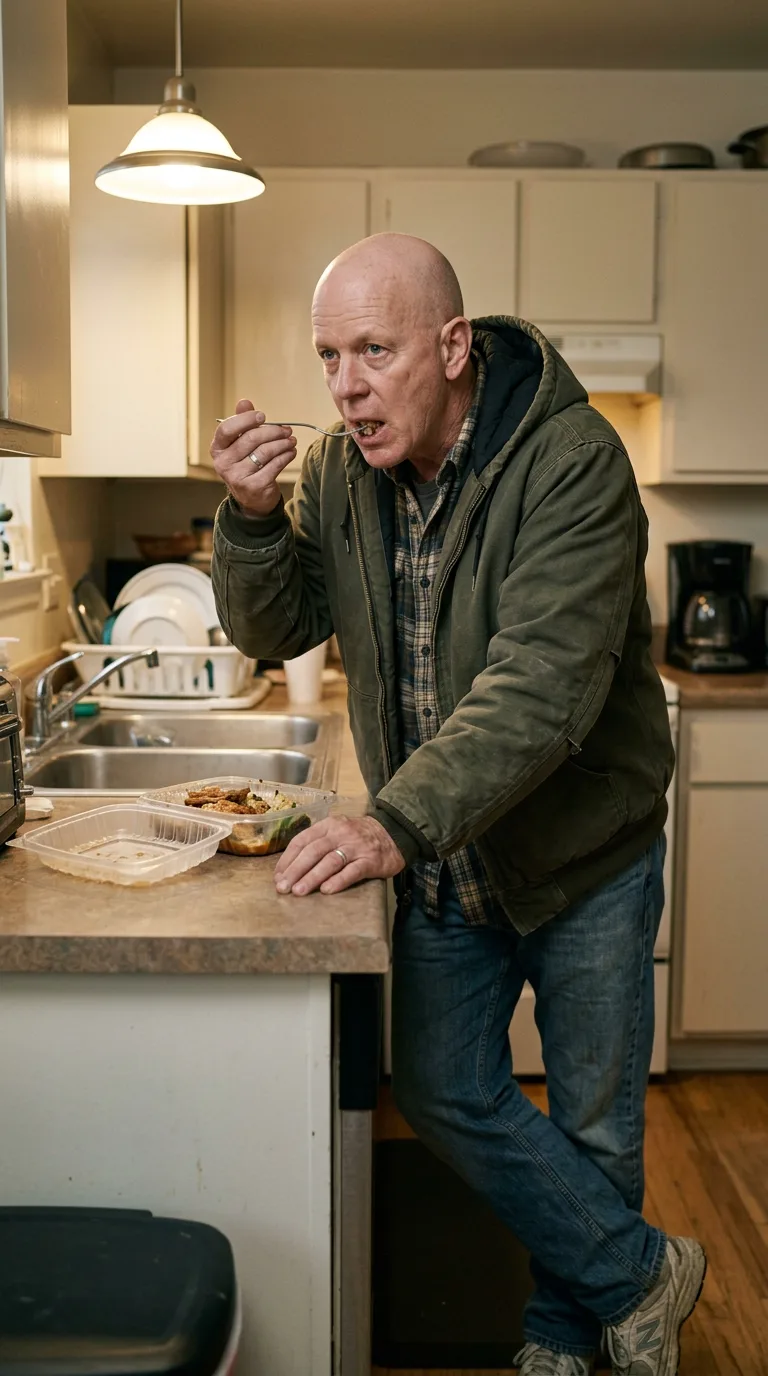
Rarest thing about him: Kidney stones — rare, 1 in 78
Season 0seed 956246948 · engine v10
Character card
lineage 2NZHHJ
His body-swap story
@colin.hasbrook, wearing Paul Kittredge, rolled the wheel on and woke up as Douglas Petrakis, spent under a minute in him, then spun the wheel and woke up as Francis Halloran
Paul Kittredge's knees ache from a crawlspace in Bath he does not remember choosing to fix, and the freckles on the back of this hand are catching the last light through a kitchen window that is not his, in a house that is not his, at the tail end of a Monday that has already given him everything it's going to give him. Forty-six years old, gray hair gone silver at the temples, green eyes, a gut that thickens the flannel shirt in a way he has stopped fighting. He has been Paul less than a minute and already knows the compressor smell under his nails and the particular tiredness in his lower back, and none of it is his, and none of it is enough. He wants out of this one already — not because anything is wrong with it, but because it is only ever the next one that feels like anything. He finds the site on the phone still warm in Paul's coat pocket, thumbs the wheel with a hand that has done this two hundred and fourteen times before, and lets it spin.
The fork is between the counter and an open mouth, held there by a hand with a plain wedding band on it, and then the hand is yours and it sets the fork down on its own, gently, like it had already decided to before you arrived. You are standing at a counter with dishes stacked in a drying rack, a coat still zipped around a body that is shorter than the one you left, denser through the middle, bald under the cold light of a hanging fixture. Afternoon light, though the window over the sink is dark with fog, San Francisco doing what San Francisco does at two in the afternoon in winter. You shrug the coat off one shoulder and then the other, an old motion that isn't yours yet but the shoulders know it, and you sit at the little table because the body wants to sit, and you pick the fork back up and finish the container in the same even mouthfuls it was already making, looking at nothing in the glass.
The coat, going, gives you the drive home first — a white van with ARTHUR E. ELECTRIC stenciled faded on the door, a ceiling in Noe Valley half-open with conduit run through the joists like ribs, four hours of it today, on your knees, a headlamp, a client asking are you almost done in a voice that assumed yes. The tool belt on the chair back, when your eyes land on it, gives you the callus at the base of the third finger of the right hand, worn there by twenty years of pliers, and the particular ache low in the back that isn't the knees, that's the stones, that's been building since Thursday and that you've been pretending isn't. The fork in your hand gives you almost nothing — it's a fork — but the container does: your daughter Renata dropped this off Sunday because she worries, because you eat standing up too often, because Carol works the four-to-midnight at the hospital lab three nights a week now and somebody has to be a person about dinner and it usually isn't you.
Carol. The wedding band does that one, cool brass under stove light, thirty-one years, a courthouse thing because neither family had money for more, two kids then and a third later who wasn't planned and turned out to be the easiest of the three. You love her the plain way you love a thing you built with your hands over decades, not the way you loved Denise, who left San Francisco in 1994 for a man with a boat and a better zip code, and who you still think about sometimes on the Bay Bridge at the exact spot where you first kissed her, twenty-five years old and certain the whole rest of your life was going to feel like that. It didn't. It felt like this instead — three kids, a mortgage on a house with the garage cut into the hillside so steep the driveway ices in the rare cold snap, a shaved head because the hair was going anyway and you got tired of watching it, a drink most nights around eight because the work never leaves your knees before then.
The flannel under the coat gives you this morning: sleeve, sleeve, buttons done wrong once and redone, the smell of Carol's shampoo still on the collar from where she'd hugged you goodbye at the door before her own early shift, coffee in a to-go cup you left on the roof of the van and didn't notice until the first job site. Your hands, when you're not using them for anything, go to your mouth — you've bitten your nails since before Carol, since before Denise, since some boyhood you don't chase down — and they do it now, between forkfuls, a small ugly habit thirty-one years of marriage never broke.
You look down at the hand doing it. Turn it over. Wedding band, bitten nails, a burn scar you don't remember from a panel box in 2011, all of it thoroughly somebody's, thoroughly Arthur's, and you are wearing it like a room you've just walked into with the lights already on.
"Two hundred and fifteen," you say, to the dark window, not sure if you mean it as a boast or a confession, and you don't know which one it would be either.