Douglas Fenneman
Fictional. Generated by AI — not a real person, and no likeness of one is intended.
54, office clerk in New York · rolled by @colin.hasbrook · card — no film
History
who has worn him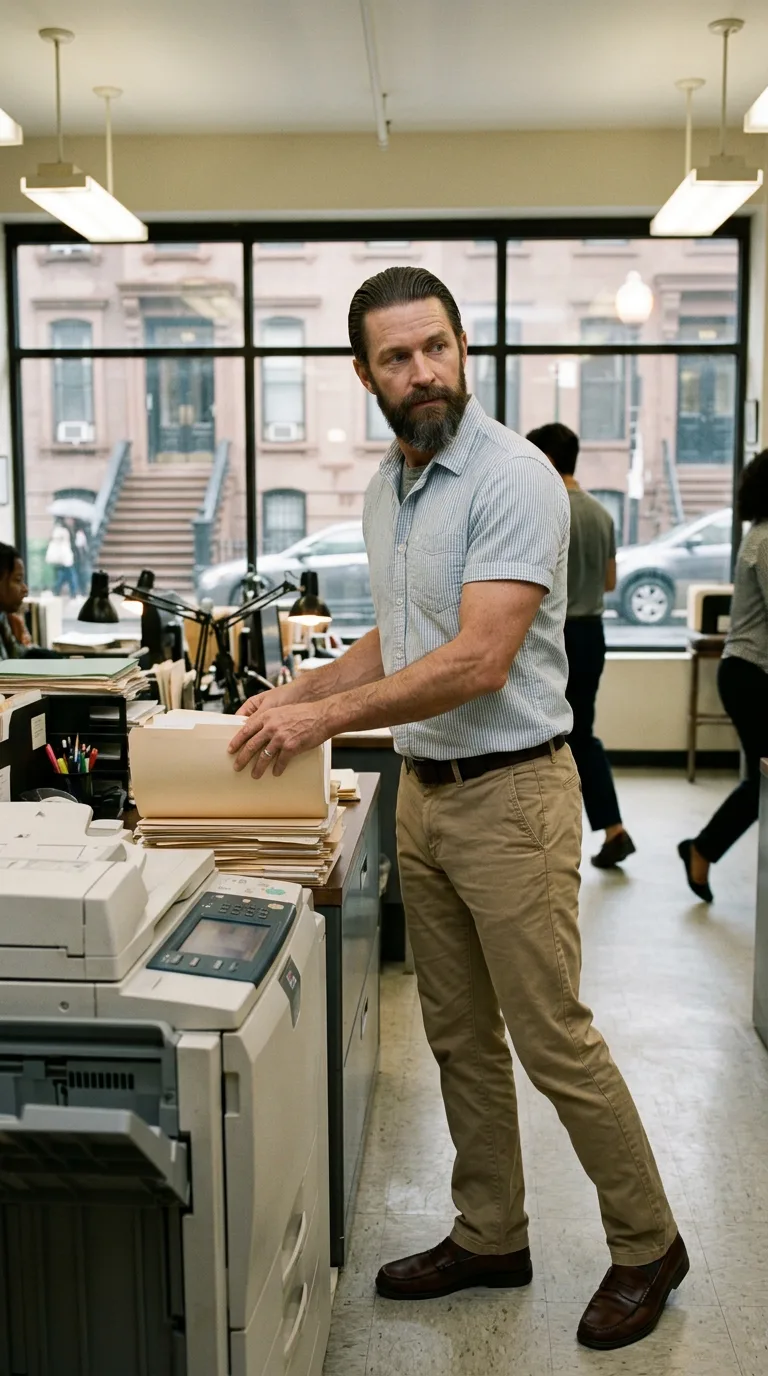
Rarest thing about him: Office clerk — common, 1 in 322
Season 1seed 1850478400 · engine v11
Character card
lineage 2NZHHJ
His body-swap story
@colin.hasbrook, wearing Warren Castellano, rolled the wheel on and woke up as Douglas Fenneman, spent under a minute in him, then spun the wheel and woke up as Cody Fenwick
You are sitting in a dentist's chair that is not occupied, in a mouth that is not open, in the middle of a Thursday morning that belongs to Warren Castellano, and you already know you are going to spin again before the drill even touches down. It is the boredom of a body that keeps its promises — Warren's hip aches on schedule, his patients' mouths smell the same each time, the hygienist calls you Dr. Castellano in a voice that has stopped expecting anything from him. Fifty-eight years in that skin and less than a minute of it has been yours, and already the smallness of it is unbearable: the framed diploma, the country radio in the waiting room, a wife on the phone asking if you'll be home by six for something you don't remember agreeing to. You set down the mirror and the pick. You tell the hygienist you need five minutes. You go to the little bathroom off the hallway, you take out your phone, you open the page with the wheel on it, and Warren Castellano's hand — soft, dentist's hand, a hand that has held nothing heavier than a scaler in years — taps the screen and pays and spins.
The rhythm breaks. A folder that has gone onto this shelf ten thousand times goes on wrong, corner catching, and the hand — not soft now, not Warren's — pulls it back and sets it again, slow, deliberate, like a man reading his own handwriting for the first time in a foreign language. The next ten folders go on checked. Corner, corner, spine out, checked. Somewhere behind that checking a copier is warming up with a sound like a throat clearing, and through the window is glass and brick and a woman walking fast under a sky that has been raining and isn't anymore, and none of it means anything yet, because you have not caught up to where you are.
The shirt does it first — thin cotton, blue and white stripe, damp under the arms already, and it gives you a bathroom mirror at twenty past six, buttons going up one-handed while the other hand held a mug of coffee going cold on the sink edge, and Carla's voice from the bedroom saying something about Danny's permission slip, and you — he — answering around a mouthful of toothpaste foam, not really listening, the way a man doesn't really listen to the eleventh thousandth version of a sentence he already knows the shape of. The belt gives you nothing. The pants give you a fitting room three years ago, a clerk saying these run big, and irritation, mild and forgotten before it left the store. The shoes — brown loafers, worn soft at the crease — give you the walk to the subway, six blocks, the specific give of a manhole cover under the left one that you step around without looking, every single morning, because you learned it in a wet October and never unlearned it.
The folder in your hand gives you more than all of it. Paper, cool and a little damp from the copier's breath, and under that — years. A front desk that used to be somebody else's front desk. A boss, Meyer, who is dead now, who trained him on this exact filing system and told him nobody notices a clerk until something's missing, so be the reason nothing's ever missing. Twenty-two years of that. A retirement dinner nobody threw because nobody thinks a filing clerk retires, he just eventually isn't there. A daughter — the oldest, Renata — calling from Albany last week to say she's pregnant, and him standing in this same spot by this same copier not telling anyone yet because he wanted to hold it a minute longer, just his. Two younger ones still at home, one of them failing algebra, one of them fine, both of them loud in a way the apartment holds onto after they've left the room. Carla's laugh, which he married mostly for, twenty-six years ago in a hall in Sunset Park that smelled like the caterer's chicken, her in a dress the color of a good afternoon, him sober because he mostly always is now, three drinks a year and this wasn't going to be one of the three. The cigarettes he quit the year the first kid was born and still misses on the F train platform some mornings for no reason he can explain to anyone including himself. Nothing dramatic in any of it. A life built entirely out of paper handled correctly, four people who need him to keep doing that, a body that at fifty-four still does what he tells it — shoulders wide, drum-tight through the forearms from twenty years of the same lift, hip a little stiff going up stairs, no complaints filed, none expected.
You look down at the hand holding the folder. It is not Warren's hand — no softness in it, a plain gold band worn thin at the bottom from two decades of that same lift and set — and for a second you just watch it hold the paper the way it's always held paper, correctly, out of habit older than you are in it.
"I'm fine," you say, to the hygienist who isn't there, to the woman at the next desk who glanced over, to nobody — the sentence that has come out of this mouth a thousand mornings when nothing was wrong and nothing needed saying, and you let it be the only thing you say, because underneath it, already, quietly, is the next wheel.