Cody Fenwick
Fictional. Generated by AI — not a real person, and no likeness of one is intended.
30, construction laborer in Small-town Ohio · rolled by @colin.hasbrook · card — no film
History
who has worn him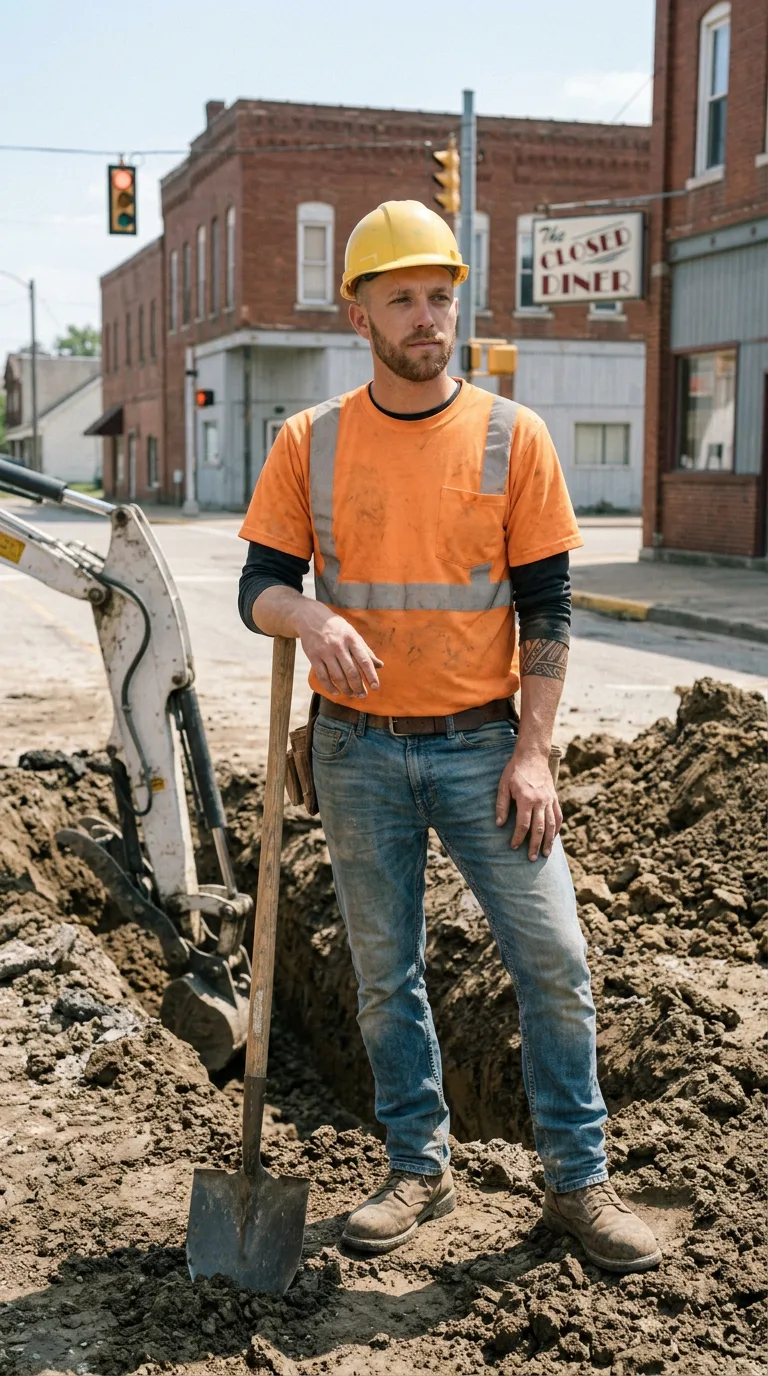
Rarest thing about him: 6'2" — common, 1 in 29
Season 1seed 1053554738 · engine v11
Character card
lineage 2NZHHJ
His body-swap story
@colin.hasbrook, wearing Douglas Fenneman, rolled the wheel on and woke up as Cody Fenwick, spent under a minute in him, then spun the wheel and woke up as Vincent Halloran
Douglas Fenneman's hand is on the mouse, and it has been on the mouse for eleven months, and it is a good hand — soft, manicured on his dime once a month, a hand that has never dug a trench or thrown a punch — and you hate it a little more every day you wear it. You are fifty-four in this one, athletic, blue eyes, a beard he grows because he thinks it makes the jaw look less like a filing cabinet, and you have made this hand sign for lunch orders and forge initials on packages and once, memorably, slap a coworker's shoulder too hard at a retirement party because you still hadn't learned your own strength in him. Eleven months is long for you. You get itchy around month nine. The itch today has a specific shape: a meeting in four minutes, a man named Greg who corrects your grammar in emails cc'ing your boss, and the dull, total certainty that nothing that happens in this office today, or any day, will ever cost you anything or give you anything either. You minimize the spreadsheet. You open the other tab, the one that's always open behind everything else, blue felt and a brass wheel and the little cursor hovering where it always hovers. You don't decide, exactly. You just notice your finger is already moving, the way his hand it's driving already knows the route to the coffee machine without you.
You click. You pay. You spin.
The trench smells like wet clay and diesel and your own sweat, and your arm is already coming down with the shovel before you understand the arm is not the one you had a half-second ago — heavier, longer, a stranger's calluses meeting the wood at exactly the grip they've met it ten thousand times before, except this time the grip is wrong for a beat, wrong by a fraction, blade biting the spoil pile at a bad angle and skittering off instead of cutting in. You correct. You do it again, slow, deliberate, watching your own forearm do it like you're grading yourself. Ten more scoops come out checked — each one a conscious decision, elbow, wrist, hip, throw — on a body that has not needed to think about a shovel since it was nineteen years old. Sun overhead, too high and too bright for the hour your last body kept. A stoplight cycles red to green over an empty intersection behind you. Nobody's driving through it. Somewhere close a diner sign says CLOSED and has said it for longer than you've been alive in anyone.
The hard hat is the first thing that talks back to you — a itch along the brow band, sweat-salted, and under it a flash: a woman's voice saying *you'll give yourself skin cancer, Cody, wear the thing right* — not unkind, teasing, a kitchen, coffee going cold. Gone. Then the gloves are off, tucked in the tool belt, and the belt itself is heavier on the left hip than the right and your body already leans to compensate without asking you to, and that's him too, that's Cody's spine having learned this fifteen years of mornings before you ever showed up in it.
The orange shirt against your back is damp through in a shape like a hand pressed flat between the shoulder blades, and it gives you a morning — his morning, hours before whatever hour this actually is, dark still, a room with a mattress on a frame he built himself out of two-by-fours because the bed frame that came with the apartment cracked. Pulling this exact shirt over his head, the collar catching on the crew cut he keeps because a helmet doesn't sit right on anything longer, a decision made once in a barber's chair in Zanesville for a girl he was seeing then, kept ever since out of pure inertia. The shirt smells like the drawer it came out of, and the drawer smells like the whole apartment, which smells like a candle his girlfriend Danielle bought that she calls sandalwood and he calls "the thing that makes the place not smell like me." A flash of her, asleep on his side of a shared bed this morning, one arm thrown over where he'd been. He kissed the arm, not her face, so as not to wake her. Small thing. He does it most mornings.
The tribal band on the inner forearm — black lines, sharp-edged, done nine years ago in a shop in Columbus with a guy he's never seen since — comes with heat, not memory exactly, more like the ghost of the needle's rhythm, and underneath that a year: turning twenty-one, a fight with his father about nothing that was actually about everything, leaving the house, the tattoo three weeks later as a kind of signature on the leaving. His father is two years dead now and the fight was never finished, just outlived.
The belt buckle under your palm as you shift the shovel to your other hand gives you a woman who is not Danielle — Erin, five years back, the one who left for a nursing program in Cincinnati and asked him to come and he didn't, couldn't say why beyond a fear shaped like this exact town, this exact stoplight, and he has run that non-decision through his head at least once a week since, usually at 2 a.m., usually with nothing to do about it. There is a kid in this — Erin's, or theirs, you can't tell from the touch alone, only the fact of one, six years old now, seen every other weekend, a car seat still installed crooked in the back of his truck because he never learned to do it right and is too proud to look it up.
The excavator's diesel smell, close by, gives you the job itself: eleven years of trenches, water lines mostly, a foreman named Pruitt who yells but means nothing by it, the particular boredom of doing something with your hands that your hands no longer need your mind for — until today, until this last hour where every motion has needed checking, like the body forgot itself and had to relearn its own trade in real time, and Cody, wherever the last of him is, would have found that the strangest ten seconds of his whole ordinary life, if there'd been anyone left inside to notice it.
You look at your hands. Broad, sun-browned to the wrist and pale above it where the gloves usually sit, dirt worked into the creases of the knuckles like it lives there now. You turn the right one over, shovel dangling loose from the other, and something in the shoulder — not sore, just present, thirty years old and honest about it in a way Douglas Fenneman's desk-softened arm never was.
"Huh," you say, to the empty street, to the dead stoplight, to nobody, and your voice comes out lower than you expect and settles into your own ears like it's always been yours, which — for now — it is.