Donald Petrik
Fictional. Generated by AI — not a real person, and no likeness of one is intended.
61, bouncer in High-desert Nevada · rolled by @colin.tarwater · card — no film
History
who has worn him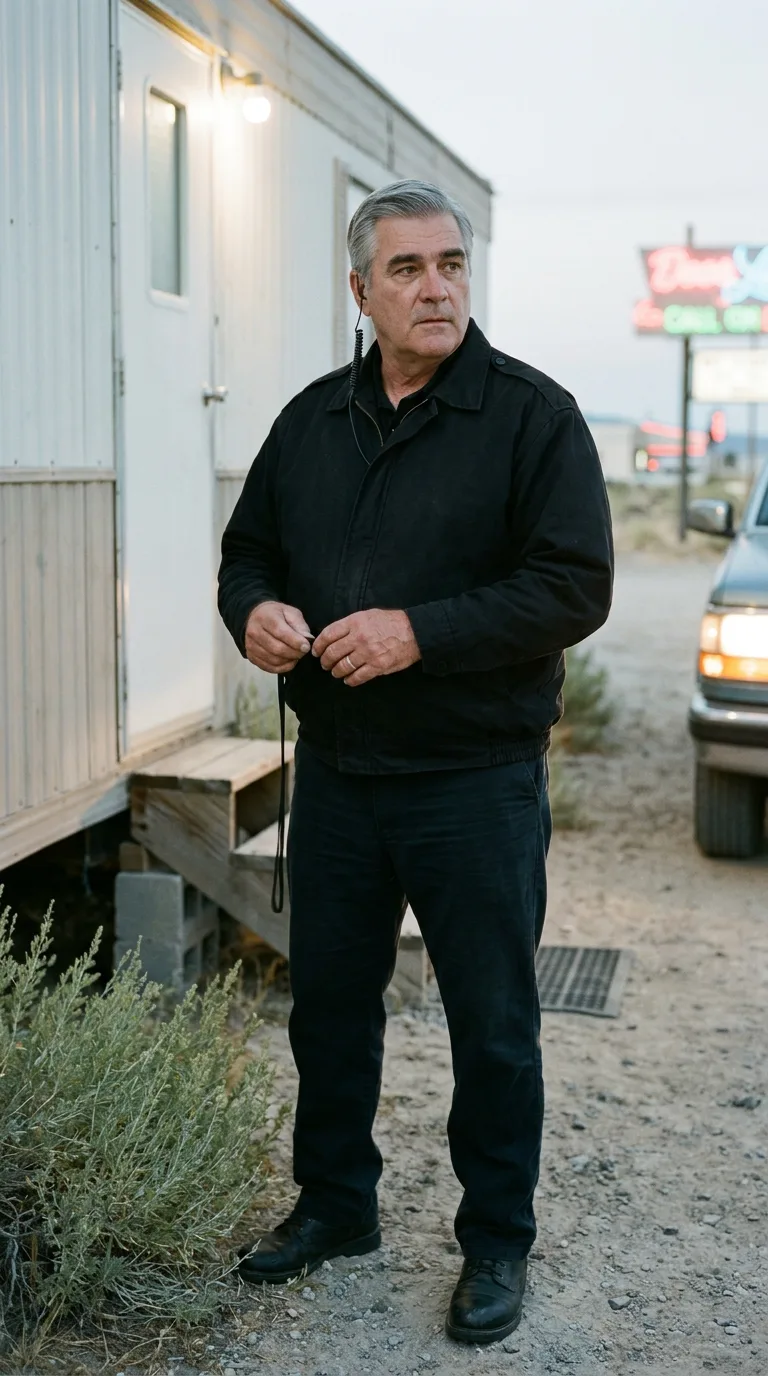
Rarest thing about him: Bouncer — uncommon, 1 in 87
Season 0seed 826403318 · engine v10
Character card
lineage COEU7T
His body-swap story
@colin.tarwater, wearing Bryan Kaminski, rolled the wheel on and woke up as Donald Petrik, spent under a minute in him, then spun the wheel and woke up as Reginald Boatwright
You are sitting at Bryan Kaminski's kitchen table in Houston, and the coffee has gone cold in his mug, and you are not thinking about the case files stacked by his elbow, the home visit he has to write up by nine tomorrow, the dimples that appear when this man — the man whose face you are wearing, the man whose mortgage this is — smiles at his own daughter's photo on the fridge. You are thinking that you have been him for exactly one minute and that one minute has already told you everything there is to know. Bryan Kaminski is kind and tired and underpaid and he cries sometimes in his car in the parking garage and none of that interests you. You did not come here for tired. You laptop is already open on the table, vessel.cards glowing under his good hand, the cursor already on the wheel. You are careful about this, methodically ungreedy, telling yourself each time that this is the last one, and each time knowing by now that it is not, that the thing you're actually chasing is the half-second of the arrival itself, the drop, the door opening onto a life you didn't have to live to get. You spin.
Halfway across the country and two hours into its own evening, a big gray-haired man is standing outside a single-wide trailer with a lanyard whistle in his hands, working the cord between his thick fingers the way he does every night before a shift, checking that it isn't tangled, an old habit that has outlived needing it. Behind him a screen door hangs. In front of him a truck idles, headlights catching the sage. And then, in the middle of that ordinary threading of cord through his fingers — a motion he has done ten thousand times without looking — his hands go wrong. They fumble the lanyard. He does it again, slow, correct, like a man relearning his own knot. He does not know why. He never will.
You are behind his eyes now, and the eyes are heavier than Bryan's, everything is heavier, wider, the shoulders carrying a weight you didn't have a second ago, sixty-one years of gravity settled into a gut and a low back that complains when you shift. The whistle cord is rough between fingers that are not yours yet, and that roughness is the first key. It opens on a hallway smell — antiseptic, adrenaline — a hospital thirty years back, him standing exactly this way, working a cord between his fingers because his new wife is behind a door and he cannot go in yet. Cheryl. Her name arrives with the memory, unbidden, the way a name arrives when you press on an old bruise. Two kids came out of those years — Danny and Reesa — and there is a whole life folded into the jacket you're wearing, this same black jacket, the collar worn soft at the seam. You feel it settle onto shoulders that have worn it every night for eleven years at this same rope, outside this same low building forty minutes down the highway, checking IDs under a buzzing sign while the desert goes purple and then black behind him.
The jacket gives you the mornings — reaching for it off the hook by the door of the trailer at four in the afternoon, this man's whole day inverted, sleeping through the blue-white heat with a machine humming by the bed because his throat closes up on him in his sleep and has for years, waking at three, four, into an evening that isn't evening for anyone but him. Cheryl used to set the AC low for him before she left, before the divorce, before whatever it was that wore itself thin between two working schedules that never touched. The tan line is under this same cuff — you feel it without looking, feel the finger where the ring isn't, the ghost of weight that stayed for six years after the metal came off. He doesn't touch that finger. He never touches that finger. His hands, when they're idle at the rope, go instead to his nails, worrying them down to nothing, an old boy's habit that never left the man.
The boots under you know the gravel, know exactly how many steps to the trailer door, how many to the truck. Your knees — his knees — ache faintly from standing eleven years of one-in-the-mornings. Somewhere in the wide flat chest is a church he goes to on the Sundays he isn't dead asleep, a pastor who knows his name, a folding chair he sits in near the back because standing that long hurts by the third hymn. He believes, plainly, unfussily, the way he does most things. He has never had a drink in his life. He has never smoked. He has stood at ropes outside a hundred versions of this same club and put his big flat hand on the chests of men twice his size and never once needed to raise his voice.
The whistle cord is still between your fingers. His last thought, the one interrupted, was whether Danny would call this week.
You look down at his hands — the wide knuckles, the bitten nails, the pale ring of skin where something used to sit — and you turn one of them over slowly, the way you always do, the way you did with Bryan's dimpled hand and the ten before that. You lift your eyes off it, into the last of the light going hard blue over the sagebrush, and you say, in his voice, rough with a life that isn't yours yet but is starting to feel like it:
"Cheryl?"