Devontae Mosley
Fictional. Generated by AI — not a real person, and no likeness of one is intended.
28, call center agent in Western Kansas · rolled by @colin.hasbrook · card — no film
History
who has worn him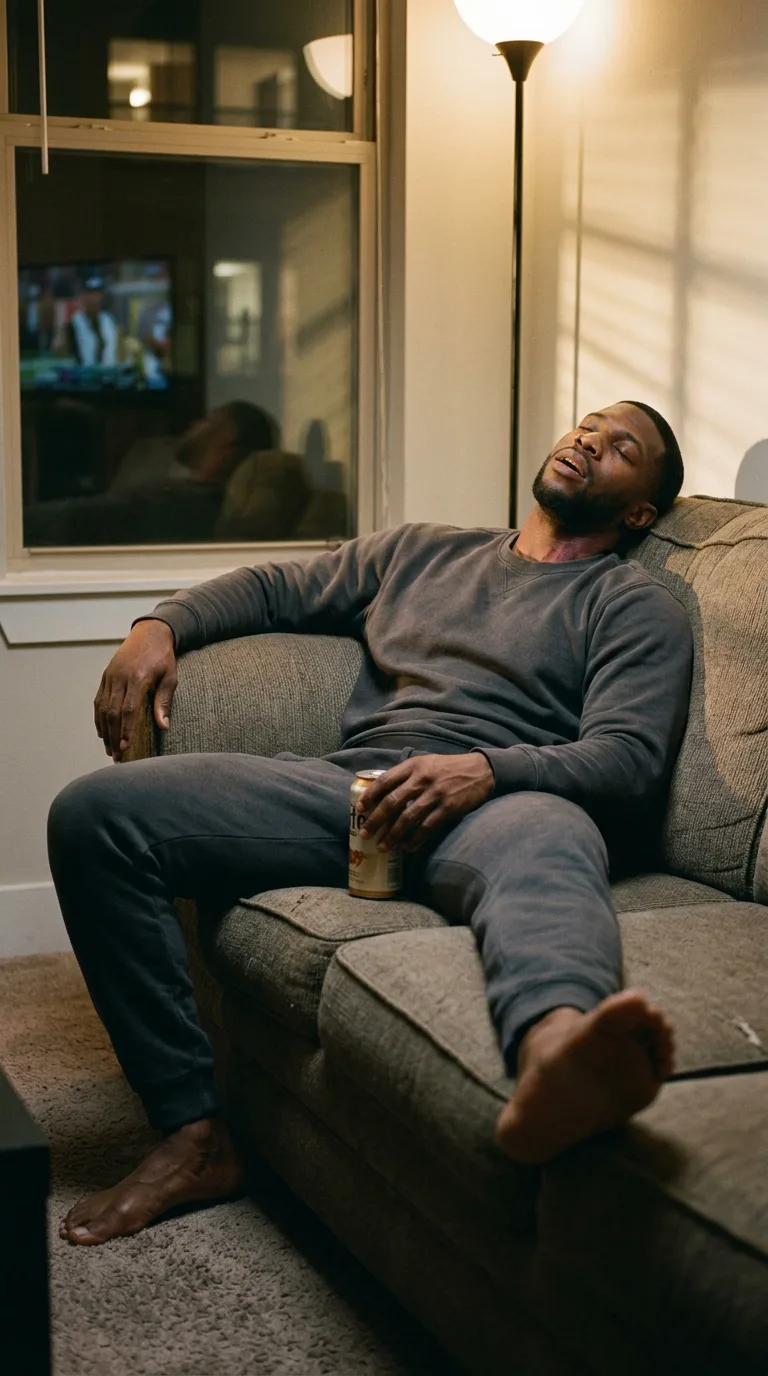
Rarest thing about him: A birthmark on the face — uncommon, 1 in 99
Season 1seed 807813183 · engine v11
Character card
lineage 2NZHHJ
His body-swap story
@colin.hasbrook, wearing Nikhil Bhatt, rolled the wheel on and woke up as Devontae Mosley, spent under a minute in him, then spun the wheel and woke up as Gary Thistlewood
---
The headset is still looped around your neck when you decide to do it again.
You are Nikhil Bhatt, forty-four, standing in a Houston kitchen with the overhead light throwing your bald head's reflection back at you off the microwave door, and it has been less than a minute since you became him. The card feels wrong already — not bad, just borrowed, the way a rental car is fine until you reach for a blinker that isn't where your hands expect it. Somewhere under the beard that isn't yours yet in any way that matters, there's a low, specific itch, the kind that seven hundred and some bodies teach you to recognize: this one, whoever he is, was already someone else's for years before you got him. Civil engineer. A life with drawings in it, calculations, a wife maybe, kids maybe — you haven't gone looking. That's the itch. Somebody else's furniture, still warm.
You don't hate him. You just don't want to sit in a stranger's finished house tonight. You want the part that's still happening, the part where nothing has been decided yet. You go to the laptop on the counter — his counter, his laptop, muscle memory typing the password before you've thought it — and you pull up vessel.cards, and you spin.
—
The couch takes your weight before you've finished arriving in it.
There's a can, sweat-warm, loose in a hand that is shorter and thicker-fingered than the one you left, wrapped in fingers that already know the exact give of aluminum before it splits. Your head is tipped back against a cushion smelling of somebody's hair oil and old beer, mouth open, a game running blue and gray across your closed eyelids like weather. On the screen — you can feel it through the lids, the pitch of the crowd noise — a ball is in the air. You are not watching it. You are asleep for exactly the length of one goal, and then you're not, sitting forward on the second replay with a thumb that finds the volume rocker at the base of a remote with a precision no man three beers deep should have, and you watch the ball go in again, slower, and something in your chest — his chest, low and wide and warm from the couch's static — says *there it is* before you've caught up to whose relief that is.
Then the room comes in through everything you're touching.
The remote first: cheap plastic, a crack along one edge from being sat on. Devontae. The name arrives with the crack, unbidden, the way his hand always favors the left side of it because the right buttons stick. Behind that, a whole apartment — one bedroom, Garden City, Kansas, rent that eats a third of a call center check and a landlord who takes two weeks to fix anything — comes up like water finding the low points of a field.
The sweatshirt against your back: gray, soft from a hundred washes, and it brings the morning with it, because mornings and this shirt are the same thing to him. Not this morning — a morning, generic and recent, six-something and dark outside even in summer because his shift starts at seven and the drive is short but the dread is long. He pulled this exact shirt off the chair where it lives permanently now, worked his head through it half-asleep, felt the fabric drag over the beard he keeps close and neat because his mother used to say a ragged beard on a man says nobody's checking on him. The birthmark on his neck went under the collar the way it always does, and he didn't think about it, the way you stop thinking about a thing everyone else looks at first.
The couch under you, secondhand, bought off a woman moving to Wichita, brings back three years of a cubicle at a debt-collection call center off Fulton — the good ones and the bad ones both. A supervisor named Deb who isn't unkind. A customer who cried once, actually cried, over four hundred dollars, and how Devontae muted himself and said a thing his own mother would've said and then unmuted and read the script anyway because the script is the job. The headset ghost-weight is still there at his ears even off the clock, a phantom pressure like a hat you wore too long. His hands ache faintly at the knuckles from typing, a young ache, not old, just used.
The can in his hand: a big night, twice a month kind of night, and this is one, though a small one — the kind where the second beer goes warm because the game's better than the drink. He doesn't smoke, never did, his older brother did and it took something from their father that Devontae watched happen too closely to ever want it for himself. Church on the Sundays his shift allows, his grandmother's voice more than his own belief, but he goes, and something in that going still steadies him even now, half-asleep, alone, a thousand miles from anyone who'd know to check on him tonight.
The thumb ring — no, the nose ring, small, steel, a decision made at twenty-three that his mother still hasn't fully forgiven — sits light and forgotten on his face, and touching near it brings up the whole afternoon he got it, a shop in Wichita, a friend laughing in the waiting chair, the sting lasting less than the friend's laughter did.
Single. No one waiting on this couch but him. An ex two years gone who he doesn't reach for anymore, not out of peace exactly, more like a room he stopped walking into. No kids. Just this — the wheat cut down flat for miles outside a window he can't see from here, a thunderhead he half-noticed on the drive home stacking up black in a yellowing sky, the kind of sky his grandmother used to call *a warning if you're smart enough to take it.*
He wasn't. He came home and sat down and let the game and the beer take him under, thumb still finding volume in his sleep like a man who trusts his own hands more than his own eyes.
You look down at those hands now. Thick-fingered, nails a little ragged at the cuticle where he picks at them without knowing — you can feel the impulse rising in them right now, small and restless, wanting something to worry at. You turn one over in the lamp light, and it isn't Nikhil's hand, isn't any of the eight hundred and forty-five hands before it, and for a second that's the whole feeling: not fear, not guilt, just the strange clean shock of a new house with all its lights still on.
You say, out loud, to no one, in a voice that isn't the one you walked in with an hour ago in Houston:
"Whose game was I even watching."