Nikhil Bhatt
Fictional. Generated by AI — not a real person, and no likeness of one is intended.
44, civil engineer in Houston · rolled by @colin.hasbrook · card — no film
History
who has worn him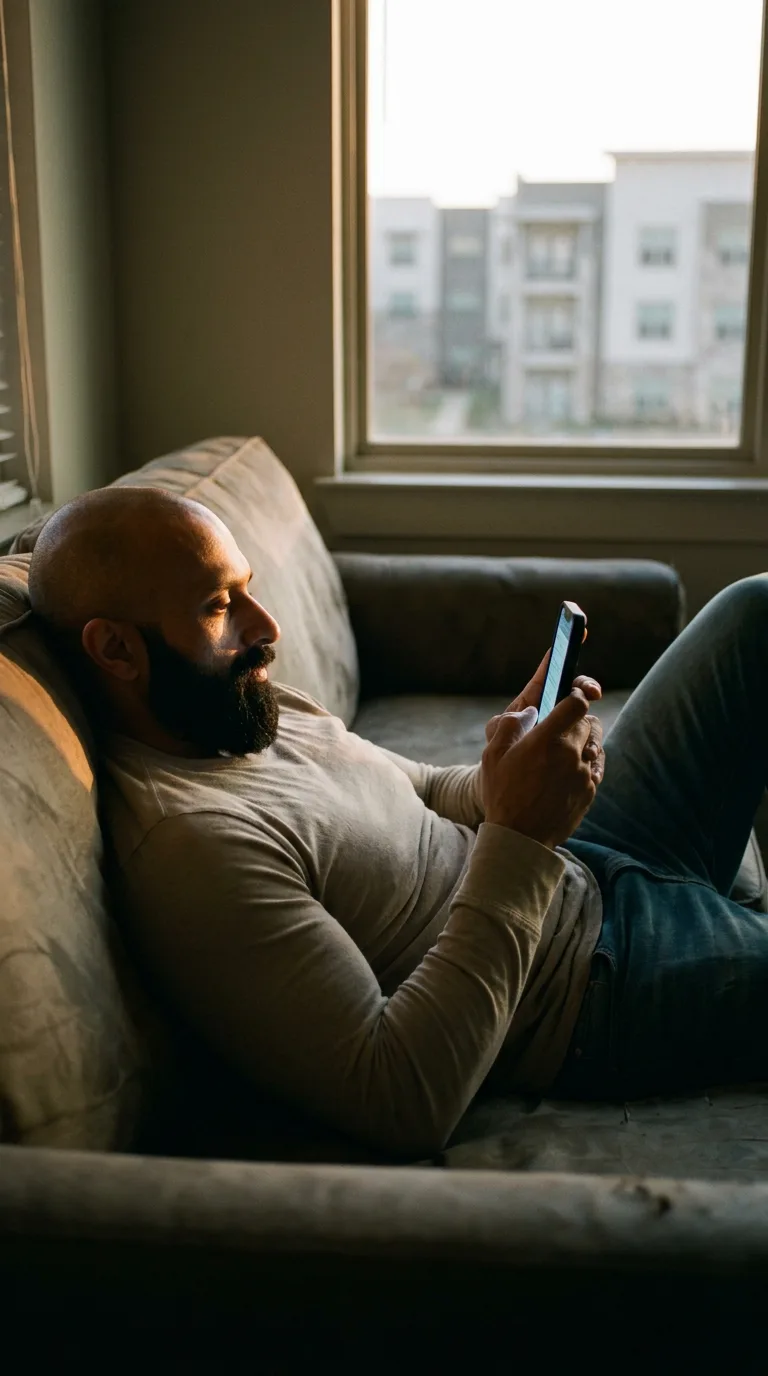
Rarest thing about him: Civil engineer — common, 1 in 210
Season 1seed 795816416 · engine v11
Character card
lineage 2NZHHJ
His body-swap story
@colin.hasbrook, wearing Gary Ostrowski, rolled the wheel on and woke up as Nikhil Bhatt, spent under a minute in him, then spun the wheel and woke up as Devontae Mosley
Gary Ostrowski's hand is on the arm of his own couch, and it has been there for eleven seconds while his heart does something Gary would call fine if anyone asked him, which nobody has, because Gary lives alone and it is a Thursday afternoon in Phoenix and the light through the blinds is doing the flat white thing it does at three o'clock, no mercy in it. You spun the wheel less than a minute ago and got him — got this, the soft weight under the ribs, the beard that comes in patchy on the left cheek, the particular tiredness of being fifty-four and skinny-fat and a mid-level manager whose calendar is other people's calendars stacked on top of his own. You have been him for less than a minute and you already know you are done with him. Not because anything happened. Because nothing did. You opened his email on his laptop out of old habit — some habits you keep no matter whose hands they're in — and there was a message from someone named Denise about Q3 headcount, and you felt, all the way down in a chest that isn't yours to keep, the specific flatness of a man who has never once in his life been the most interesting thing in a room. You didn't spin again out of hate. You spun again the way you reach for a second drink you didn't need the first one to want. The site was still open in the other tab. The wheel was still spinning from last time, slowing down on its own, and you nudged it before it stopped.
The scroll keeps going a half-second after you arrive, his thumb still obedient to a motion that isn't his anymore, flicking past a video, past another, past a face that isn't yours either, and the room announces itself in pieces: the window full of somebody else's balconies going grey-gold at the edges, the couch cushion warm along one whole side of him where he's been lying on it for twenty minutes, the phone six inches from a face that has stopped blinking on schedule. His weight settles into you all at once, more of it than Gary ever had — thicker through the shoulder, denser everywhere, a body that has been doing something with its hands all day and knows it. The beard is real against your own forearm where it's tucked. Your thumb — his thumb — keeps moving on the glass, faster now, steadier, because whatever was slowing him down before is gone.
The shirt is what opens first. Thin, worn-soft, long-sleeved despite the Houston heat because the AC in this apartment runs cold enough to argue with the window — and under that, folded into the fabric like something ironed in, the morning: him standing in front of a mirror that has a crack in the corner he keeps meaning to replace, pulling this exact shirt off a hanger, checking the collar for the salt-stain a hard hat leaves after ten hours, deciding it'll do for tomorrow too. His hands doing the buttons without looking, because his eyes are already on his phone, already reading the deck drawings for the pour schedule, rebar mat lengths running through his head like a song he can't turn off even at home. That's this man, you understand, before you understand anything else about him — the job doesn't clock out when he does. You feel it in the forearms, in a soreness set into the muscle that isn't pain exactly, just information: fourteen hours on a bridge deck under a sun that doesn't quit, walking rebar mats laid out in their grid like a crossword he's solved a thousand times and still checks twice, because a girder doesn't care how many times you've gotten it right before.
The couch gives you the rest of the evening he had planned, which was nothing, which was this — lying on his side scrolling because the apartment is quiet in a way he still hasn't decided if he minds. No wife's key in that door tonight or any night; there was someone, once, briefly, and it ended without wreckage, which is its own kind of ending, the kind that doesn't leave a scar so much as a habit of sleeping on one side of the bed out of a mattress that's the same width all the way across. No kids' noise. Just a beer he had with dinner sweating a ring into a coaster he'll wipe up eventually, one of two he lets himself have most nights and never a third, a rule he made for no one and keeps for no one, out of something closer to order than discipline. The engineering came from a father who built things in a country Nikhil visited twice as a boy and remembers mostly as heat and grandmother's hands and a bridge over a river that his father pointed at once, proud, like it was a photograph of himself. Houston came later, on its own steam — a scholarship, a firm, a decade of being the guy who checks the numbers twice because the guy who checked them once is dead in some story everyone in the field knows and nobody tells straight. He likes the smell of wet concrete more than he'd ever admit at a bar. He has never told anyone that the sound rebar makes when it's dropped from height, that ring, still catches somewhere behind his sternum, pleasant, almost.
None of that is dramatic. All of it is his, entire, unbothered by an audience, and it keeps coming in pieces off the couch fabric and the phone case and the elastic give of the waistband at his hip — a whole life lived carefully by a man who was never once, in forty-four years, the story anyone else was telling.
The thumb stops. You bring the hand up in front of the face — his face, wide and dark-bearded and lit blue from below — and turn it, palm up, palm down, watching the calluses catch the window light, a groove worn into the second finger where a pen sits every day of his working life. Something in the chest underneath is still running warm from the beer, from the quiet, from a day that ended clean on a bridge that didn't fall down. You feel the good of that, second-hand, before you decide what to do with it.
"Okay," you say, out loud, to the empty apartment, in a voice lower than Gary's, rounder, a voice that has never once had to explain itself to anyone in this room. "Okay."