Desmond Okafor
Fictional. Generated by AI — not a real person, and no likeness of one is intended.
38, boxing trainer in Boston · rolled by @colin.hasbrook · card — no film
History
who has worn him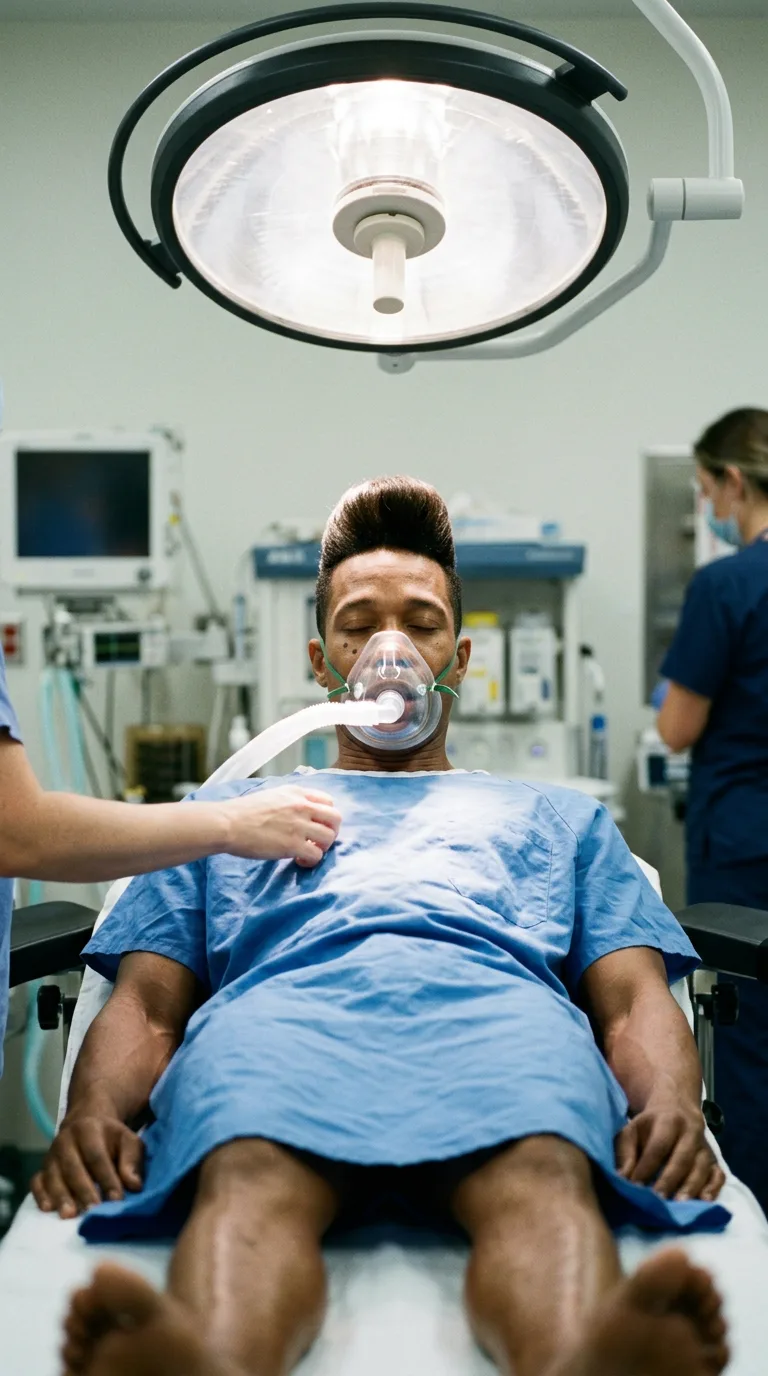
Rarest thing about him: Under anaesthetic — rare, 1 in 133
Season 0seed 395964557 · engine v10
Character card
lineage 2NZHHJ
His body-swap story
@colin.hasbrook, wearing Marcus Deveraux, rolled the wheel on and woke up as Desmond Okafor, spent under a minute in him, then spun the wheel and woke up as Gary Holcomb
You are standing at the bottom of Marcus Deveraux's porch steps, keys in his hand, a delivery still warm in the passenger seat of a car that isn't going anywhere today. He's been you for fifty-one seconds. Fifty-one seconds of the ache in the lower back, the ache that never really left, the way his knees complain going down four steps, and you already know: not this one. Not the freckles catching the gray afternoon light, not the smell of somebody else's takeout on the seat, not the whole soft tiredness of a body that clocks in and clocks out and calls that a life. You didn't spin to end up standing on a Dorchester porch holding a bag of somebody's General Tso's chicken. You want out of him the way you want out of a coat that fits wrong in the shoulders. So before the storm door even swings shut behind you, before you've decided anything else, you take the phone from his pocket — his phone, not yours, none of it is yours — and you open the site, and you spin.
The lamp is the first thing: a ring of white so total it has no shadow, hanging over you like a held breath. There's a mask fogging with your own air, a strap catching at the back of your skull where the hair is swept up into something architectural and stiff with product. Someone's fingers rest light against your sternum through blue cotton. A voice is counting — *seven* — and it stops there, stopped by you arriving in the middle of it, and under the anesthesia the body does the only two things it can do without asking permission: the eyes track once, left to right, behind closed lids, and the hand on the table opens, closes, opens, closes, testing fingers that are shorter and darker and don't ache in the knees at all.
It is Sunday afternoon where Marcus stood on that porch. It is some other hour here, some hour where a man goes under the knife on a Sunday because that's when the OR had an opening, because his gym closes Sundays, because he told his girlfriend he'd be out by dinner and didn't want to lose more than one day of the week the bags stay quiet. You don't know that yet. You know it in about four seconds, the way you know everything now — through what's touching him.
The gown is the first door. Thin blue cotton against skin that's leaner than the body you left, tighter through the shoulders, and it opens onto a locker room an hour before this, him folding his own clothes into a gym bag because he wouldn't let his girlfriend drive him, wanted to walk in on his own legs even though the surgeon said the knee's been bone on bone for two years now and today's the day they finally scope it. Flash: lacing a boxer's gloves at the ropes, the smell of the bag's leather, a swinging heavy bag settling after a combination, his voice calling out numbers — *one-two, one-two-slip* — while somewhere behind him a phone buzzes with a text from his ex that he still, for reasons he wouldn't say out loud, opens first.
The strap of the mask against his ears gives you the drive over, his hands on a wheel gripping too tight, a lighter turning end over end between two fingers on the gearshift though he quit nine years ago and never once lit one, just flips it, flips it, a tell his trainer's trainer once told him to lose before a fight and he never did. The oxygen tube gives you his mother's rosary, black beads worn smooth, tucked in the gym bag's side pocket though he hasn't been to Mass since Easter and still wouldn't leave the house without it. The paper under his heels gives you two kids' names, said the way a man says them when he's tired and it's the last good thing in the day — a boy who wants boxing gloves for Christmas and a girl who doesn't yet, who might. Gives you the number in his head that he does math on at 2 a.m., what the gym owes, what he owes, a hole that gets a little deeper every season and a girlfriend who doesn't know how deep, and an ex who used to know exactly how deep and left partly because of it. Gives you insulin in a case zipped into that same gym bag, a discipline he's stricter about than his own cornermen are about their diets, because he has seen what happens to men who aren't.
The hand on the table — his hand, now yours, testing itself — remembers wrapping another man's knuckles an hour before this thought crossed his mind, remembers the particular give of old leather worn to the shape of forty years of other men's fists, remembers his own fists at twenty, at thirty, the ring he never quite made it far enough in, the ring he built instead, out of ropes and other people's kids.
The monitor beside you keeps its long, sleeping rhythm, patient, indifferent to who is answering it now.
You open your hand. Close it. Fingers shorter than Marcus's, a mole riding high on a cheek you can't see but can feel, the itch of it under the mask's strap. A nurse's hand rests light on your chest to steady you, mistaking whatever just crossed your face for the ordinary drift of anesthesia loosening its hold too soon.
You open your eyes the rest of the way, past the fog on the mask, into the light, and your voice comes out muffled and certain around the plastic:
"Not done yet."