Derek Shimoyama
Fictional. Generated by AI — not a real person, and no likeness of one is intended.
29, trucker in New York · rolled by @colin.hasbrook · card — no film
History
who has worn him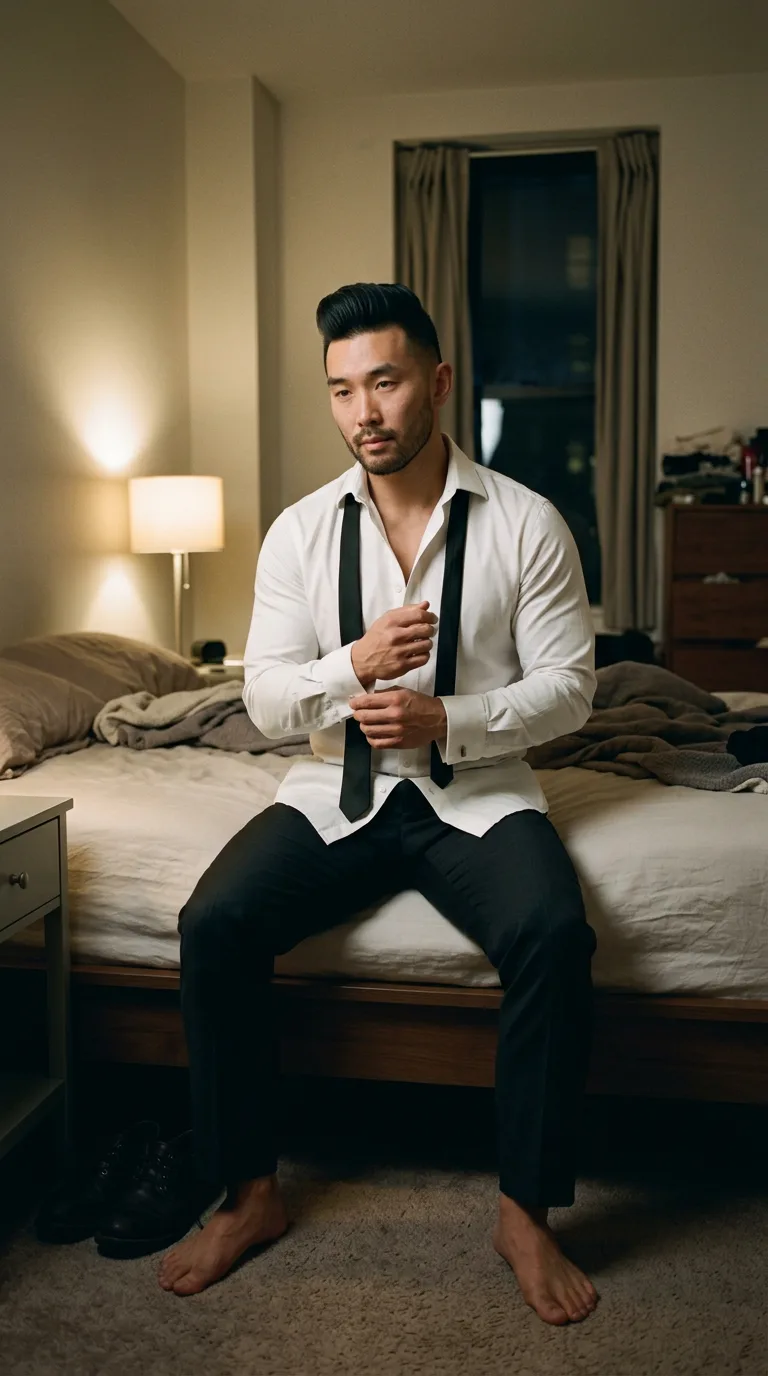
Rarest thing about him: Getting dressed for work — common, 1 in 48
Season 1seed 48054998 · engine v11
Character card
lineage 2NZHHJ
His body-swap story
@colin.hasbrook, wearing Warren Nakada, rolled the wheel on and woke up as Derek Shimoyama, spent 2 minutes in him, then spun the wheel and woke up as Marcus Ridgeway
The conference room in San Francisco has gone quiet the way it does after a bad number gets said out loud, and you sit there in Warren Nakada's gray-haired body feeling the particular tiredness of a man who has managed people for eleven years and still cannot make them hit a deadline. Someone's phone buzzes. Someone else refills a coffee cup nobody wants. You have been Warren for less than a minute, in the sense that matters — the sense of having chosen it — and already you know you are not staying. It isn't the meeting. It's that his knees ache when he stands, that his voice comes out thinner than he wants it to, that the whole rest of tonight is a rerun of every other Thursday he's had for a decade, and you have eight hundred and sixty-six men behind you and no reason at all to sit still. You excuse yourself. You find a bathroom stall, of all the ignoble places, and you open the site on a phone that is briefly, technically, yours.
The wheel spins the way it always spins, without ceremony, and it gives you a man buttoning a shirt wrong three time zones east.
You are on your feet at the foot of a bed, barefoot, and your hand is flat against your own chest, feeling ribs that are not the ribs you had a second ago — younger, harder, a plate of muscle under a dress shirt hanging open. Your fingers are already moving before you tell them to: the wrong button comes undone, travels down, finds its right hole, and the shirt closes clean. There's a tie loose around your neck, black, silk, warm from having hung against a collar all through some argument with a mirror. You look down at yourself for a second, at hands you don't recognize yet, and then you reach for the tie because the body already knows what to do with it, and it ties itself into a knot this closet — you can feel this, somehow, in the fabric — has never once seen before.
The shirt gives you the first of it: an early morning, cold in that specific way New York gets cold near the water, and a man's hands — his hands, Derek's hands — buttoning this exact shirt for a wedding that isn't tonight, a cousin's wedding two Aprils back, and Rosa in the doorway telling him he looked good, too good, good enough that she almost didn't let him leave the apartment. Rosa. The name arrives with a whole weather system behind it — three years, an apartment in Sunset Park, her laugh which was too loud for elevators, the ring he bought and never gave her because she left first, for a man with a desk job and dry hands, and he has hated dry-handed men in a low-grade permanent way ever since. The one that got away, and this body still feels it the way you feel a shoulder that was dislocated once and healed wrong.
The tie gives you less — ties are rare in this life — but what it gives you is dense: his father's voice, church-strict, telling him a man ties his own tie or he doesn't wear one, and Derek's hands are clumsy with it even now because he never got enough practice, forty tries a year at most, weddings and funerals and Easter. Evangelical hymns hummed off-key in the cab of a truck at four in the morning because the radio's dead in that stretch past Scranton. A Bible with a cracked spine on the passenger seat, unread more often than read, but there, always there, like a seatbelt he doesn't wear but keeps.
The floor under your bare feet gives you the long haul: eleven years of it, the particular ache in his lower back that never fully leaves, shoulders and forearms built by a thousand tie-downs and not by any gym, though he goes to one anyway on off days because it feels good to be strong on purpose and not just from work. Third shift tonight — that's why the room outside the window is full dark and sodium-lit and he is dressing at an hour civilians call the middle of the night, because his nights run backward from theirs and always have. The bed behind you gives you nothing much, an empty half of it that's been empty two years, and the dresser gives you a photograph face-down that he stopped standing back up a while ago — Rosa, laughing, an ex-fiancée's face he still checks against every woman he doesn't call back.
The boots by the bed, when you look at them, give you the truck itself: the cab's smell, diesel and pine air-freshener losing the fight, the specific give of the driver's seat after eleven years of the same weight settling into it. A man who prays sometimes at rest stops, not out of anything he'd call devotion exactly, just old habit, a few times a year the way he drinks — carefully, sparingly, like something he's not sure he's allowed to want more of.
You stand there in Derek Shimoyama's body with a tie knotted a new way at his throat, and you lift your hands — his hands, thick-veined, road-worked, a callus riding the base of each finger where a wheel has lived for years — and you turn them over like you're checking they're real.
"Okay," you say, out loud, to the dark window and the sodium light coming up through the curtain gap. "Okay. Let's go to work."