David Kwon
Fictional. Generated by AI — not a real person, and no likeness of one is intended.
52, barista in New York · rolled by @colin.hasbrook · card — no film
History
who has worn him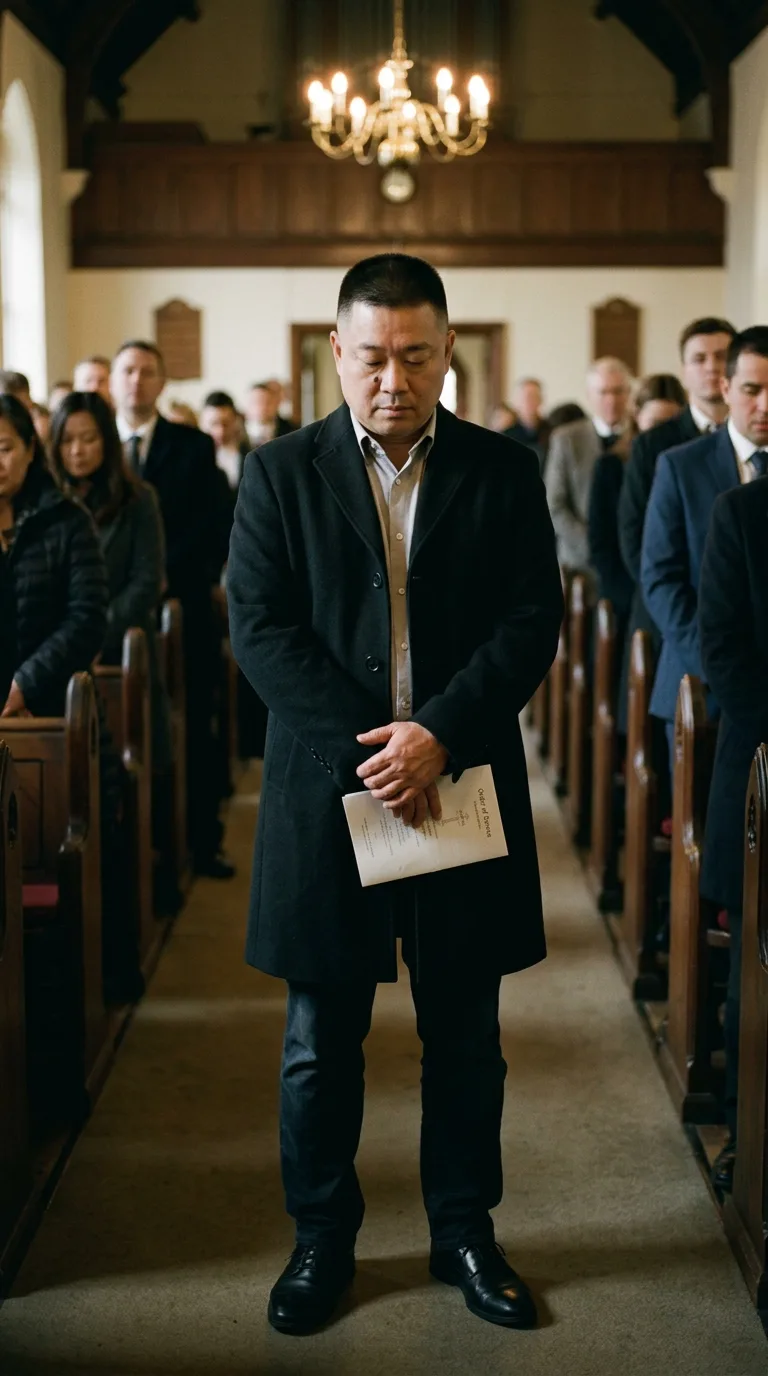
Rarest thing about him: At a funeral, at the back — rare, 1 in 99
Season 0seed 1518037649 · engine v10
Character card
lineage 2NZHHJ
His body-swap story
@colin.hasbrook, wearing Sam Nassour, rolled the wheel on and woke up as David Kwon, spent under a minute in him, then spun the wheel and woke up as Nico Sarnowski
The knife is still in your hand, or rather Sam Nassour's hand, which is the same thing now, and it has been the same thing for less than a minute and already you are done with it. The walk-in door behind you breathes cold onto your neck. Sam's knees ache the particular ache of a man who has stood on rubber mats over concrete for thirty years, and you have known that ache for less than a minute and you already hate it more than you thought you would. The shop is closing. Ohio is doing its slow gray Monday-evening thing outside the window, the kind of light that makes every town look like it's apologizing for something. You liked Sam fine. He was thick-fingered and slow to anger and good at his one thing. But a minute is a minute, and you have had two hundred and twenty-four men before him, and the itch that sends you back to the wheel doesn't care what a body is like. It only cares that it's still a body, and there are more of them. You set the knife down careful, the way his hands want to, and you take out your phone with his thumbprint and you open vessel.cards, and you spin.
The organ stops.
You come up a half-beat behind three hundred people standing, and your body — his body, yours now — is already mid-motion, rising out of a pew crouch that isn't a crouch, coat settling around a torso softer and shorter than the one you just left, knees that ache in an entirely different key: not the flat exhausted burn of standing all day but something higher, in the hip, older. There's a folded paper in one hand. Order of service. You don't yet know whose. The chandelier throws gold light down a wood-paneled aisle full of black coats and lowered heads and none of them, not one, looks back at the man in the fourth row from the door. Your hands — his hands — go to the coat and smooth it down the front, slow, like they're relearning the buttons, because in a way they are.
The coat is wool, borrowed, a size loose in the shoulder, and touching it gives you the loan of it before it gives you anything else: a closet that isn't this man's, a hanger with a dry-cleaning tag still looped through the top button, a woman's voice — a cousin's, Rachel's — saying *just take it, you don't own a black coat, David, who owns a black coat.* David. The name arrives like that, sideways, from someone else's mouth in a memory that isn't yours. David Kwon. Fifty-two years behind eyes that have been lowered through an entire service without once lifting to see the casket.
The order of service in his fingers is thin cardstock, and it gives up its own small flood: a name printed on it that isn't his, a man named Feldman who ran the diner two doors down from David's café for eleven years and fought David for street parking every winter and once, only once, helped him mop four inches of storm water out of the back room at two in the morning without being asked and without ever mentioning it again. That's the whole friendship, really. Parking fights and one flood. David did not expect to cry at this and has not cried at this, but his chest has been tight through the whole service in a way that has nothing to do with grief exactly and everything to do with knowing there will be fewer and fewer people left who remember him before the crew cut went from black to whatever it's going to go next.
The shirt under the coat is what really opens it — cotton gone soft at the collar, and the memory of this morning comes up sleeve first, the left arm first because that's how he always does it, weight settling into the shoulder that clicks faintly when it's cold, which it was, on the walk from the subway. He'd stood in his apartment in Brooklyn in his boxers with the radiator complaining and put this shirt on slow because slow is the only speed his lower back allows before the second cup of coffee, and he'd looked at the mole in the bathroom mirror the way he does every single morning without meaning to, a small dark habit older than the mole deserves. He is not vain. He simply always looks.
He is not married and was never going to be, not for lack of anyone asking around him but for lack of anyone he asked back; there was a woman four years ago, Grace, who wanted the café to become a bigger café, and he wanted it to stay exactly the size it was, and that turned out to be the whole disagreement, the whole relationship, in the end. No children, and mostly no regret about it, except at exactly this kind of gathering, where the room is full of people's kids in their thirties crying properly and he is standing at the back in a coat that isn't his, childless, friendless in the specific way of a man who is close with a hundred regulars and intimate with almost none of them.
His body under all of it: shorter than it feels from the inside, heavier through the middle than the black t-shirts ever let on, forearms corded from steam wands and stubborn portafilters, a lower back that has quietly decided, over twenty years, that mornings cost something now. Synagogue twice a year, more out of habit than belief, a scotch on a good Saturday night once or twice a month and nothing stronger, no cigarettes ever, not once, not even the year everyone he knew was doing it. His hands know the weight of a tamper and the angle of a pour better than they know almost anything else about themselves.
The organ has gone quiet. People are sitting again, coats rustling, a low murmuring settling over the pews like dust. Nobody in four hundred people has turned around.
You look down at his hands — small, blunt-fingered, a callus riding the side of his right index finger from something that isn't a knife, isn't a cash register, is a steam wand, you'll learn, you'll feel it later at a counter that isn't here — and you turn them over slowly in the dim gold light, the order of service still folded in the left one.
Then you lift your eyes off them, past the coffin, up into the empty air above the last pew where a phone might be, might not be, and you say, quiet enough that only the man beside you half-turns:
"I don't even know whose funeral this is."
Somewhere in Ohio, a knife sits on a cutting board next to a body nobody is driving anymore. Somewhere on a page called vessel.cards, a wheel has already gone still, waiting to be asked again — not today, maybe, not for a while — but the asking was never the hard part.