Danny Okamura
Fictional. Generated by AI — not a real person, and no likeness of one is intended.
45, chimney sweep in Houston · rolled by @colin.hasbrook · card — no film
History
who has worn him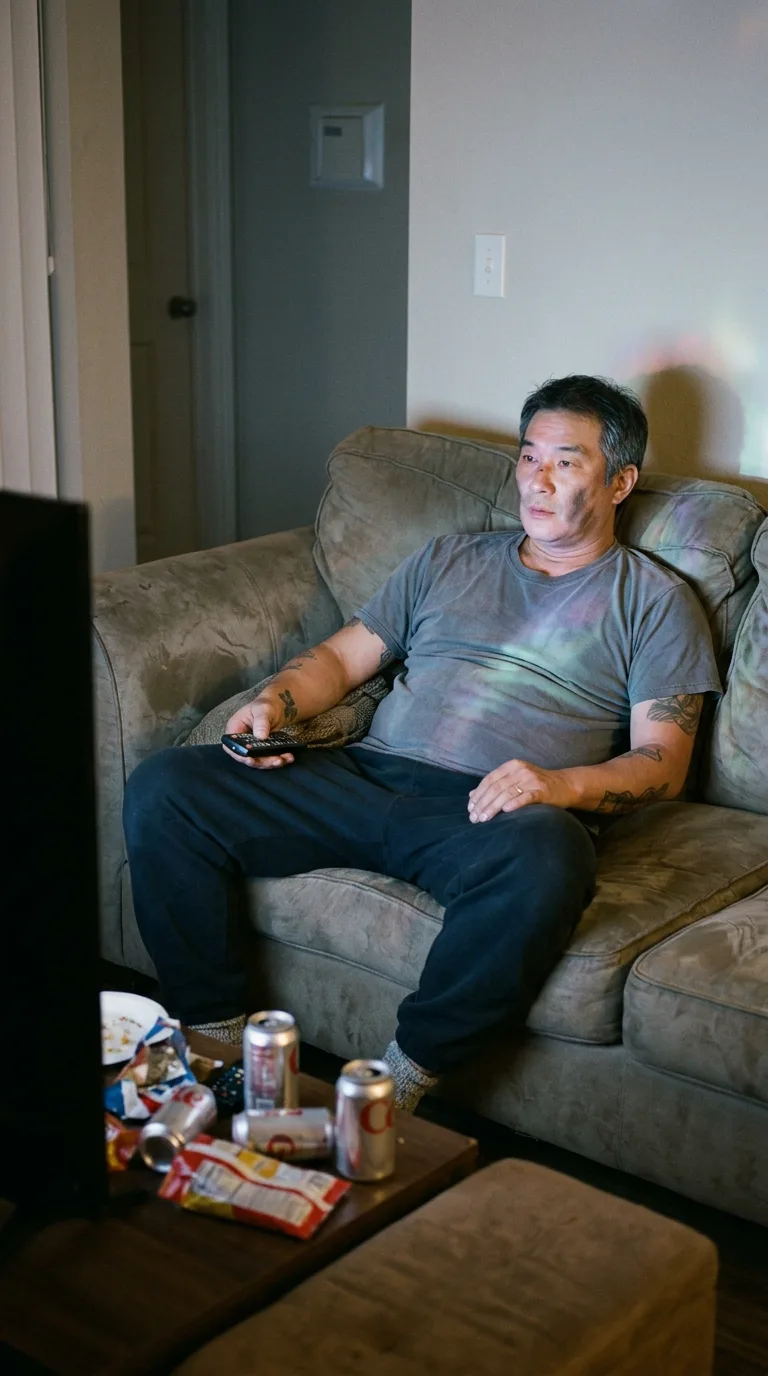
Rarest thing about him: Kidney stones — rare, 1 in 99
Season 0seed 38523653 · engine v10
Character card
lineage 2NZHHJ
His body-swap story
@colin.hasbrook, wearing Marcus Delacroix-Bell, rolled the wheel on and woke up as Danny Okamura, spent under a minute in him, then spun the wheel and woke up as Danny Osaki
You are standing in Elias Park's kitchen — no, you were standing in it, thirty seconds ago, running your thumb over the scar in his eyebrow in the bathroom mirror like it belonged to you, because for three minutes it did. Twenty-nine, green eyes, that easy runner's body that doesn't ache anywhere when it wakes up. A teacher. A good apartment with the ocean smell coming through the screen. You had three minutes of him and you spent every one of them not sitting still: turned the shower on and off just to feel the water pressure, opened his closet, ran through the muscle memory of a jump shot he must take at the gym on Tuesdays, felt his tongue find a chip in a molar he'd been meaning to get looked at. It was the best body you've wanted in forty-six spins and you know exactly why you're already walking back to the site with his phone still warm from a text he'll never answer: because good doesn't hold your attention, it just proves there's better, and the only way to find out is to spin again with him still standing there unfinished. You didn't even say goodbye to him. There was no him left to say it to.
The wheel turns and lands and you are sitting up very straight on a couch that is not the one you were picturing.
The room is dim, curtains pulled against Houston daylight, a television throwing colored light across a coffee table drowned in Coke cans and a plate with something dried on it. Your body — his body — is heavier than the one you just left, softer through the middle, and the first thing you feel is gravity being a different negotiation, knees you'd call late-forties, a low dull throb low in your back that isn't going anywhere. Your hand sets a remote down on the couch arm, not because you decided to, but because the moment demanded it and your new hand already knew how.
The remote is the first key. It is warm from his palm and it gives you a flash — him working a night crew off Beltway 8 the week before last, coming home at 6 a.m. and calling this the evening — and then it opens wider, an ache of a schedule that never lines up with sunlight, sleep eaten in jagged afternoon pieces, a body that has forgotten what regular means. That's why the house is dark at midday. That's why the television is on. This is his night.
The couch under you gives you more — years of it, actually, the cushion gone slack in the shape of a man who sits here most days he isn't up a flue. Your back against it remembers a marriage that ended two years ago over something slower and sadder than an affair, just two people who stopped reaching. Your ring finger — you feel it now, a pale stripe of skin cooler than the rest, a phantom weight — remembers a hand there for eleven years and then not. A daughter's voice on a Sunday call, thirteen, careful with you the way kids get careful with a parent who's still finding his feet. You love her uncomplicatedly and it costs you every time you hang up.
Your shirt is next, plain and gray, worn soft, and it gives you a whole morning: standing in a bedroom that's too quiet since the divorce, working buttons that his fingers do without watching, a body that already knows the weight of coveralls waiting on a hook by the door, black with old soot no wash gets all the way out. Your hands — thick-knuckled, a burn scar you don't yet know the story of stinging faint at the memory of it — know rope and rod joints and the particular grunt of driving a brush up a flue that hasn't been cleaned in three years. You are strong in a specific, unglamorous way: forearms that can work overhead for an hour, a low back that complains by four every job. There's a stone moving somewhere in you right now, a dull grinding pressure on the right side you've learned to read like weather.
Your nose — you feel it as a small permanent wrongness in the air passing through it, crooked, broken once — gives you a bar in your twenties, a fight you didn't start and didn't win, and Mai laughing about it years later before she was your ex, saying it gave you character, before character stopped being enough for either of you.
You sit inside forty-five years of him not laughing at the joke that used to make him laugh, and you understand, distantly, that something already changed the second you sat up straight, before you knew there was anything to change.
You lift your hand off the armrest and look at it — soft palm, thick fingers, that pale ghost-band on the ring finger — and turn it slow in the blue TV light like it's a tool you haven't used yet.
"Okay," you say, to the empty room, to nobody, already thinking about strip malls and wheels and how long is generous this time. "Let's see what you're for."