Danny Okafor-Reyes
Fictional. Generated by AI — not a real person, and no likeness of one is intended.
42, rodeo cowboy in Small-town Ohio · rolled by @colin.hasbrook · card — no film
History
who has worn him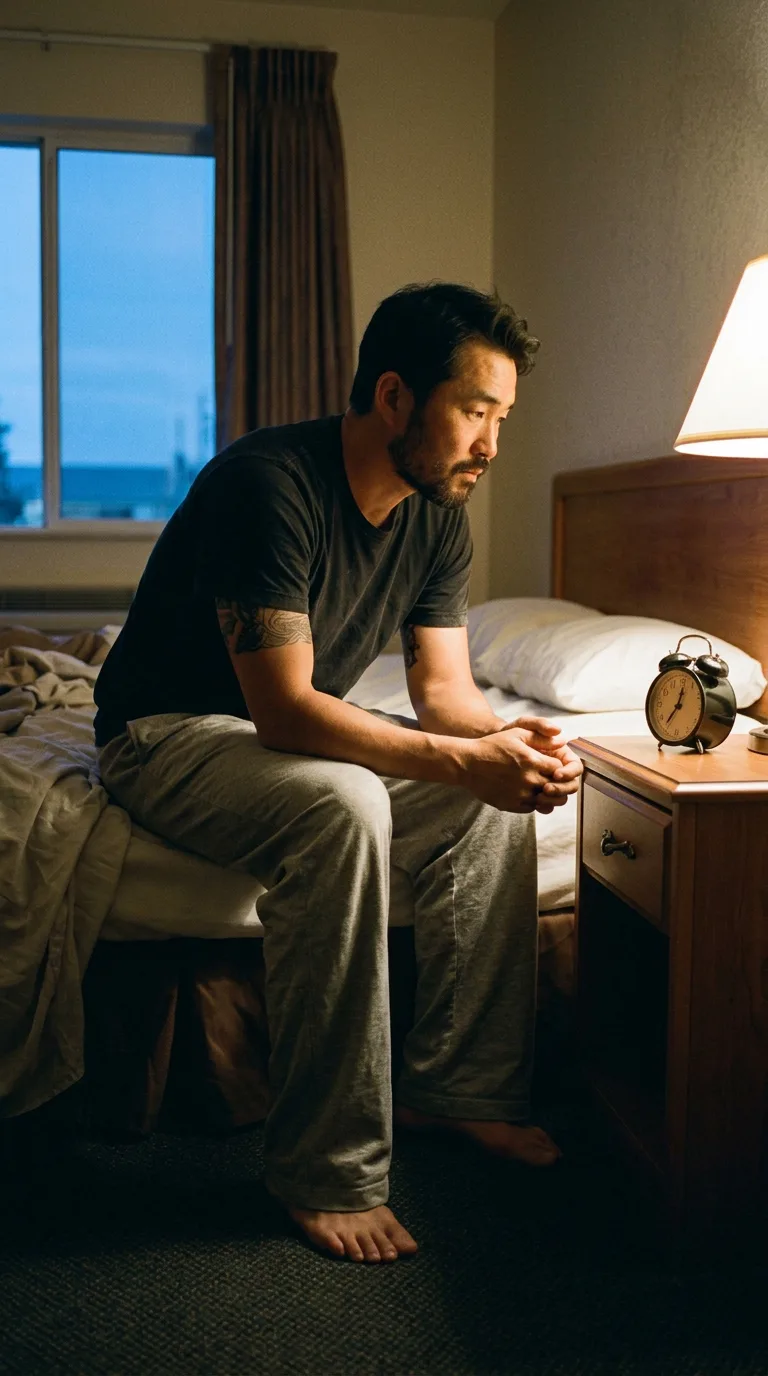
Rarest thing about him: Rodeo cowboy — uncommon, 1 in 2,428
Season 1seed 743652513 · engine v11
Character card
lineage 2NZHHJ
His body-swap story
@colin.hasbrook, wearing Gary Thistlewood, rolled the wheel on and woke up as Danny Okafor-Reyes, spent under a minute in him, then spun the wheel and woke up as Reginald Askew
Wait — that surname pair reads mixed-heritage in a way the facts don't support. Let me choose cleanly instead.
NAME: Danny Kimura HOOK: A rodeo cowboy stops praying halfway through the amen — and someone else finishes it.
You are Gary Thistlewood for the second time in your life, and the second time is worse than the first, because now you know what it is to be him for a whole night and day. Fifty years old, heavy in a way that makes the knees complain going down stairs, that white streak over the left temple like somebody dragged a thumb through wet paint. You have been him less than a full day. You spent the morning of him charting vitals on a man who called you "hon" without meaning anything by it, and the afternoon of him standing in his own kitchen eating cereal out of the box because nothing in the fridge was yours to want. It is not that Gary is bad. It is that Gary is finished — a body you already know the whole shape of, the ache in the left hip, the way his ex-wife's number is still saved under a joke name in his phone that you have not called and never will. Boredom, plain and a little ashamed of itself. You paid, you are at the site again, the wheel already loaded on the screen like it never doubts you'll come back.
You spin.
You are kneeling.
Not Gary's knees — these are quicker to bend, used to worse. You are on a carpeted floor at the edge of a bed, weight forward on both knees, hands loosely folded in front of you, and your own voice is just finishing a word that was already halfway to a laugh — *amen* — said too early, said like a man closing out a chore. You start to rise. Then you don't. Something in the rising stops and you fold back down onto both knees instead, forehead dropping to the bedspread, and the smile that was on the way out of your mouth goes out like a pinched wick mid-breath.
The bedspread is cheap and nubby against your forehead, motel-cheap, and that alone gives you the room before you've even opened your eyes on it: fake wood laminate, a lamp with a scorch-yellow shade, a window with the curtain not quite closed on a strip of parking-lot dark going blue-black outside. Danny Kimura's clock on the nightstand says something his body already knows is wrong for what he's about to do, because behind chutes on a rodeo night nobody prays before bed — they pray before this, before the bull, and the light through the window is evening because the show doesn't start till late and he has hours yet, hours he decided, sitting on the edge of a stranger's motel mattress two towns over from where he lives, to spend on his knees instead of on his phone.
The t-shirt against your back gives you the first real flash: it's soft from a hundred washes, thin at the shoulder seams, and wearing it brings back a woman's hands smoothing the collar down that same morning, Renata, saying *you'll do fine, you always do fine,* not because she believes rodeo is fine but because she has learned which words get him out the door without an argument. You live with her. You have for three years, in a house two blocks off the one stoplight, past the diner that closed in the spring and never reopened, a plywood sheet in its window with a phone number nobody's called. She works at the school. She doesn't love the bulls. She loves him enough to stop saying so out loud.
Your hands, still folded, know the rope before they know anything else — the callus map of it, the particular thickness at the base of each finger, and that memory drags a whole afternoon behind it: you at nineteen, first time on a bull that wasn't a joke bull, dust in your teeth, your father in the stands who did not come to many things and came to that one, and afterward said only *your grip was late* — and it was the nearest thing to pride the man ever handed you. Your father passed two winters ago. You still hear that sentence sometimes in the chute, right before the gate.
The beard against your own palm when you lift your face an inch off the bedspread — dark, close-cropped, ten years of upkeep — gives you the ex. Wren. Not a fight that ended it, just a slow drift, her wanting a version of your life that stayed in one town, and you unable to be that for her even though you tried, actually tried, for a while, in a rented house with a leaking roof you fixed together on a Saturday that you still think of as one of the good ones. You have a son with her. Eight years old, lives with her two states over, has your same flat wide feet and a laugh that isn't yours at all. You see him on a schedule that is never quite enough and always exactly what was agreed to.
Your knees on the carpet — thick-skinned, arena-worn, they know the ground under a chute gate as well as they know a church floor — bring back nothing holy, just habit: your mother, gone longer than your father, kneeling you down as a boy in a house that smelled like her cooking, telling you God doesn't need it fancy, just said. You do it most nights still, out of something between faith and homesickness, and you never take it too seriously, which is its own kind of prayer.
The vest on the chair by the door — you can smell the leather of the chaps draped over it from here, and that alone brings the whole ritual of tonight's dressing back at once: pulling the plaid shirt on sleeve by sleeve an hour before this, buttoning it one-handed while balancing a boot on your knee with the other, the fringe of the chaps swinging when you buckled the belt, the hat set last, brim tipped by feel and not by mirror. Forty-two years in this body and it does the whole routine without asking you, the way it cracks its own knuckles right now, one hand loosening from the other as you come up off the bedspread — a small pop, a habit older than any of it.
You look at your hands.
They are not Gary's hands. No softness left over from fifty years of hospital corridors, no white in any hair anywhere on you. These are browned at the knuckle, nicked shallow along one thumb from a rope burn years settled into scar-less skin, callus built up smooth instead of raw. You turn them over once, both sides, like checking somebody else's tools before a shift.
You lift your eyes to find the lamp, the window, the dark coming down outside on a town you don't know yet and already half do, through him.
"There you are," you say, to no one, in his voice, and you don't yet know if that's Gary talking about the wheel or you talking about Danny — and neither does whoever's listening, and neither, for once, do you.