Daniel Nishikawa
Fictional. Generated by AI — not a real person, and no likeness of one is intended.
40, train conductor in Houston · rolled by @colin.hasbrook · card — no film
History
who has worn him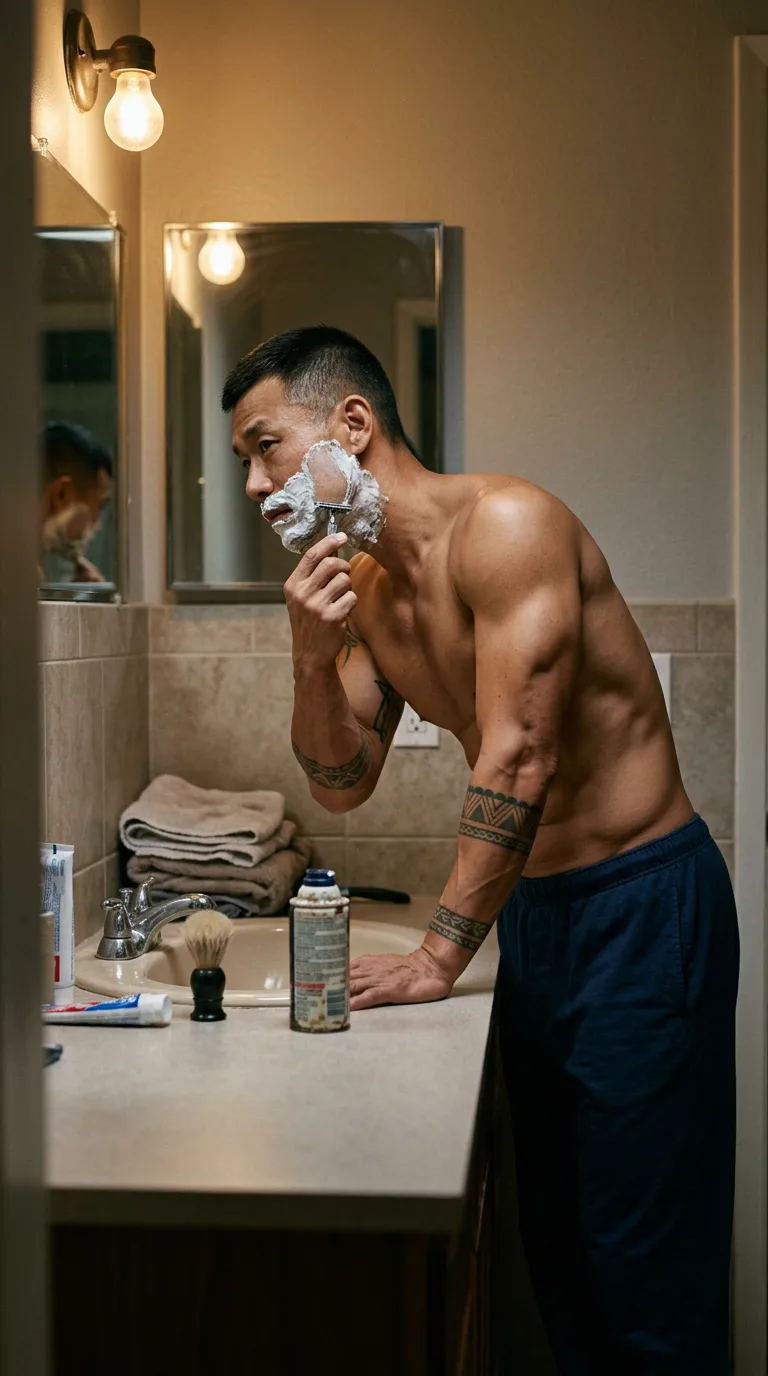
Rarest thing about him: A few, scattered — epic, 1 in 32
Season 0seed 1228170959 · engine v10
Character card
lineage 2NZHHJ
His body-swap story
@colin.hasbrook, wearing Russell Kincaid, rolled the wheel on and woke up as Daniel Nishikawa, spent under a minute in him, then spun the wheel and woke up as Everett Sandoval
You are standing in Russell Kincaid's kitchen and his knees are already complaining about the linoleum.
You have had this body less than a minute. Fifty-six years of it, gone doughy in the middle, blue eyes, a cleft chin some woman probably liked once, thirty years ago. You spun him up, wore him into his own house, and stood at his own counter, and the first thing you learned about Russell Kincaid, riding shotgun behind his face, was that his knee joints ache when the AC kicks on. The second thing was smaller and worse: a text on his phone from a number saved as *Bonnie — cleaning lady*, and a feeling underneath it that was not yours and did not want to be looked at directly. You did not open it. You did not need to. Fifty-six is an age with things filed away in drawers, and you have learned, in five hundred and nineteen men, that the drawers keep opening whether you asked or not. You do not want his drawers. You want out of him fast, before the wanting has a name, and the wheel on the laptop screen is already loading, spinning colors across the dark kitchen window like something underwater.
You pay. You spin. You do not choose.
—
The razor is already moving before you have hands to notice it with — up the jaw, against the grain, no hesitation where a man usually hesitates, at the corner of the mouth, and it finishes the second half of his face faster than he started the first, because you are not stopping to feel anything yet. You are just weight. Six foot two of it, planted over a sink, foam going soft and gray in the basin, steam still fogging the mirror's low corner where an older bulb burns yellow overhead. There is a body under you that knows how to stand this way, hip cocked, elbow up, and for one full second that is all there is — the size of him, the heat of the bathroom, the razor's small cold drag.
Then his hand sets the razor down on the edge of the sink, and that is the first thing you touch on purpose, and Daniel comes up through it like water finding a crack.
The razor handle is worn smooth on one side from being gripped the same way ten thousand mornings, and it gives you a small kitchen apartment fifteen years gone, a bathroom with a busted fan, a girl's voice from the other room — Renata, laughing at something on TV, before she was an ex-girlfriend, before she was the woman he still calls on her birthday and hers alone, the one his current girlfriend has stopped bringing up because it does her no good. You feel where that sits in him: not longing exactly, just a room he still has a key to and doesn't visit. You let it close. There is more.
The sink counter under his palm is the actual counter, this counter, and it gives you this morning — no, not morning, evening, but his evening starts however his shift says it starts, and today it said start at ten p.m., because the Union Pacific yard doesn't care what the sun is doing. He got up at four in the afternoon, Houston sun still murderous through the blinds, and he lay there a minute with his girlfriend's arm heavy across his ribs before easing out from under it, and that is a small thing that comes back warm — her name is Priya, and she doesn't fully wake, just adjusts, the way five years teaches a body to adjust around another one.
The shirt is not on him yet — you are still bare-chested, sweatpants only — but it is folded on the towel rack, and the mere sight of the collar through the fogged mirror opens the uniform anyway: navy wool, brass buttons, the cap with the cracked leather band he keeps meaning to replace, the conductor's punch clipped inside the left pocket that has left a permanent worn oval in the fabric there. Twelve years on this job. The smell of diesel and hot brake dust that never fully leaves the jacket no matter what detergent Priya uses. The particular ache in his lower back from the step box, from bending to set it down platform after platform, town after town between here and Beaumont. He is good at it. He likes being good at it — the whistle, the watch, the small absolute authority of telling four hundred strangers when to move.
His forearms are lit gold under the bathroom bulb, and the tattoos there — black tribal bands, wrist to elbow, one arm and then the other — bring back a tattoo parlor in Pasadena, Texas, nineteen years old, doing it against his mother's wishes and his father's silence, which was worse than the wishes. Mainline Protestant household, a church his family still expects him at on the big Sundays, a father who never said the tattoos were shameful, just never once mentioned them, for nineteen years, which Daniel has decided is its own kind of answer.
The counter edge again, under his knuckles: two kids. A boy, eleven, already taller than his mother, obsessed with trains in the specific ironic way of a kid whose father actually runs one and is unimpressed by it. A girl, seven, who calls to tell him goodnight over speakerphone when he's on a Houston-to-Beaumont run and won't be home before she's asleep. He quit drinking around when she was born — not dramatically, no rock bottom, just a slow drift out of it, the way you drift out of a bar you used to like when it changes owners. He still smokes the cigars, one a week, Sunday afternoons in the driveway, and that is the one thing Priya has stopped fighting him on.
His right leg is bouncing against the cabinet under the sink, has been the whole time, a tic that isn't nerves, just current with nowhere to go, the same leg that used to bounce through Sunday sermons as a boy and got his mother's hand flat on his knee to still it.
You have all of this now, and none of it is yours, and you are aware, distinctly, of the difference — the way you're always aware of it, in the good ones. Russell's drawer stayed shut. This one opened on its own and gave you a marriage that's still working, more or less, two kids who'll notice nothing wrong at dinner tonight because there is nothing wrong to notice. That's the thing about Daniel Nishikawa. There was no reason sitting in him waiting to be found. You picked him blind, the way the wheel always makes you, and what you got was just a decent life mid-shave.
You lift his hand — foam still on two knuckles — and turn it over slowly in the low bathroom light, and it is bigger than any hand you've wanted, thicker through the palm, a scar-less, unremarkable, working hand, and something in you that has been five hundred and nineteen other things sits inside it and, for a second, envies him without deciding to.
Then you look up into the fogged mirror, into his own brown eyes looking back out of it, and you say, to no one in the empty bathroom:
"Alright, Danny."