Daniel Kwon
Fictional. Generated by AI — not a real person, and no likeness of one is intended.
26, accountant in Rural Texas · rolled by @colin.hasbrook · card — no film
History
who has worn him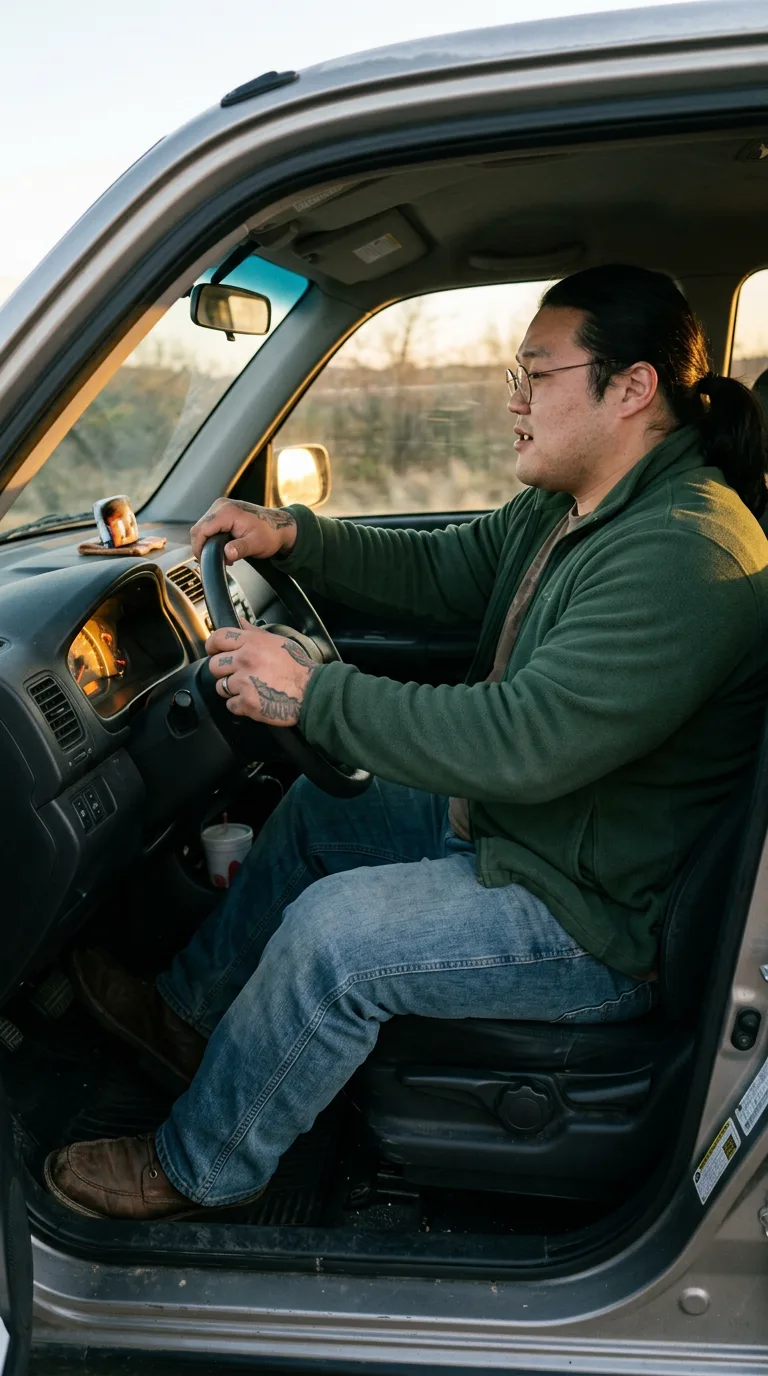
Rarest thing about him: A ponytail — common, 1 in 155
Season 1seed 514066926 · engine v11
Character card
lineage 2NZHHJ
His body-swap story
@colin.hasbrook, wearing Patrick Golembeski, rolled the wheel on and woke up as Daniel Kwon, spent under a minute in him, then spun the wheel and woke up as Travis Oberholt
Patrick Golembeski's apartment smells like the Chinese food he never finished, and his phone is buzzing with a text from a dispatcher he does not want to answer. You have been him for forty seconds. Forty seconds of his skinny knees against a card table, his freckled forearms, the ache already sitting in his lower back from six hours on a bike seat that isn't even his. You know this ache. You have known eight hundred and thirty-two other bodies' version of it, and this one is nothing special — thin wrists, a blue-collar apartment with a broken blind, a life that was, twenty seconds ago, somebody else's entire world and is now a coat you tried on and didn't like. There was no drama in the last body either. There rarely is. You just felt, underneath the ache, the specific flatness of a Thursday that has nothing else coming. So the phone goes face down. The laptop is already open to the site, because it is always already open, and the wheel is already spinning before you have finished deciding, the way it always is, because deciding was never really the hard part.
The gravel crunches for one more second under tires that are no longer under your control in any sense you'd recognize, and then it isn't Patrick's shoulders that settle into the seat — it's wider ones, heavier through the chest, a man's weight distributed differently, low and solid. The wheel is between two hands that are thicker than the hands that were just yours, knuckles broader, and they come off the ten-and-two a half-beat after you arrive, resettle low on the wheel like they're used to driving one-handed with a coffee in the other. The dash light is amber across them. Somewhere behind your borrowed eyes the turn signal clicks on, insistent, green arrow pulsing for an exit that means nothing to you and, you will learn, meant nothing to him either — muscle memory reaching for a turn he doesn't take every night, just some nights, and tonight the body took it before you had a say. Outside, Texas is going the deep blue of a sky with a water tower on the rim of it, and the light in here is dashboard-orange and dying.
The shirt is what gives him to you first — a checked button-down, damp under the arms from a day that started at a desk. Fluorescent light behind your eyes, unbidden: two monitors, a spreadsheet with a formula error you — he — chased for forty minutes before finding the misplaced parenthesis, the small ugly satisfaction of it resolving. Daniel Kwon. The name arrives with the collar, the way names do, printed on nothing but familiar all the same. Twenty-six. An accountant for a co-op forty minutes up the highway, a job he is good at and has stopped being proud of, the way you stop being proud of anything you're good at by year four.
The cardigan you're not wearing right now but remember putting on this morning anyway — the shirt underneath is the same one, and it drags you back to the closet, to buttoning it one-handed while checking his phone with the other, a text from Mara: *don't forget Sunday, mom wants everyone there.* Mara. Girlfriend, two years running, a laugh that comes out through her nose that he loves more than he's ever told her. And under that, quieter, the way an old bruise sits under a new one — Jenny. The ex. Not gone, never quite gone, because there's a kid, four years old, a boy with his gap in his teeth already showing through his baby ones, and Thursday isn't a custody night but Daniel still drove past her street on the way to work this morning, slow, the way you drive past a house you used to live in.
The wheel under these hands knows things his mind barely tracks anymore: the exact pressure to keep this truck from wandering on a road with no shoulder to speak of, the way the water tower on the horizon means three miles, means almost, means the porch light Mara leaves on. His hands ache faintly at the knuckles — an old habit of cracking them during long conference calls, a tell his mother used to swat at when he was twelve, sitting in a church pew in a shirt too stiff at the collar, mainline Protestant quiet, the sermon going on forever, his father's hand landing on his knee to still it. He quit smoking three years ago, on Jenny's insistence, before things ended anyway, and the phantom want for one sits at the back of his throat sometimes on long drives like this — not now. Now there's nothing in his mouth but the tang of the gas station coffee two hours cold in the cupholder.
The body is heavy in a way that isn't soft — solid through the middle, thick through the shoulders, strong in the forearms from nothing more than twenty-six years of using them, unremarkable strength, the kind that opens jars and moves furniture and never gets tested further than that. Glasses press a familiar line into the sides of his nose. The ponytail tugs faintly at his scalp where it's pulled too tight, the way it always is by six p.m., and somewhere in that small discomfort is a whole morning: him at the bathroom mirror, wetting his palm, smoothing his hair back, tying it off, checking the shave was close — it always is, he does it every day out of a habit that started with his first office job and never left — and behind him in the memory, faint, a woman's voice he can't place fully, laughing about something on the radio.
None of it is yours. All of it is right there.
You look down. His hands are on the wheel, low and wide, the turn signal still clicking for a turn that was already made without either of you agreeing to it, gravel giving way under the tires to the smoother stretch that means the driveway is close. The knuckles want cracking. You let them. The sound is small and satisfying in the cab.
"Okay," you say, out loud, in his voice, testing the shape of it in his mouth like a stone. "Okay."
The water tower slides by outside, dark now against a sky gone the color of a bruise healing, and the porch light is just ahead, small and yellow and waiting for a man it has no way of knowing isn't coming home tonight the same as he left.