Patrick Golembeski
Fictional. Generated by AI — not a real person, and no likeness of one is intended.
33, delivery driver in New York · rolled by @colin.hasbrook · card — no film
History
who has worn him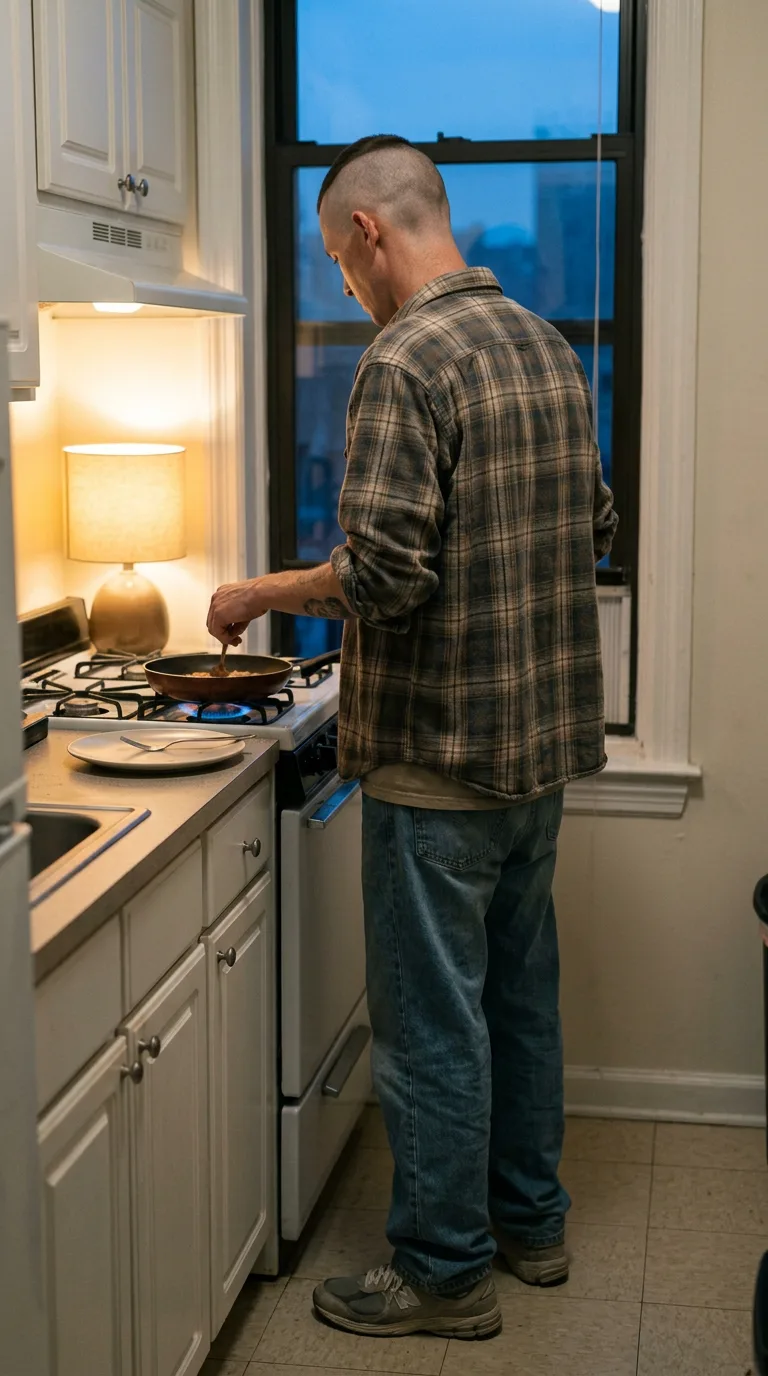
Rarest thing about him: Runs a hand over his scalp — common, 1 in 29
Season 1seed 2022779054 · engine v11
Character card
lineage 2NZHHJ
His body-swap story
@colin.hasbrook, wearing Grant Pelzer, rolled the wheel on and woke up as Patrick Golembeski, spent under a minute in him, then spun the wheel and woke up as Daniel Kwon
The classroom clock in Western Kansas says the day is dying, and you are still Grant Pelzer, still heavy in his gray-bearded skin, two minutes into wearing him and already restless in a way that has nothing to do with him. It isn't dislike. He's fine — soft hands, tired eyes, a man who grades essays and waters one dying plant on the windowsill. But two minutes in and you already know the taste of him, and knowing the taste of a man is the thing that ends him for you every time. Eight hundred and thirty-one others taught you that about yourself. You sit down at his desk chair, which he has not chosen to sit in, and you open the laptop that is already logged into vessel.cards because some part of you — Grant's fingers, your want — never really closed the tab. The wheel is waiting where you left it, patient as a slot machine, dressed up like a roulette table with better lighting. You do not deliberate. You never really do. You spin.
The stirring stops mid-circle. It starts again the other way — your hand, though it doesn't know yet that it's yours, correcting a wooden spoon through onions gone translucent and sweet-smelling in a pan that isn't yours either. The salt shaker is already tipping in your fingers; you shake it once over the pan and do not taste what you've made, because tasting is not the instinct that arrived with the body, only the motion was. You reach up without deciding to and take down a second plate from the cabinet — white, chipped at one edge — and set it down on the counter beside the first one, the way a hand sets a table for a person who used to sit there.
The kitchen is small and yellow-lit against a window gone the deep flat blue of a Brooklyn evening, and you are standing in it thin and light in a way Grant's shoulders never were, weight sitting differently on legs that know how to be on their feet for ten hours without complaint. Freckles — you feel them before you see them, a kind of familiar dust across a nose you haven't looked at yet. The flannel against your back is soft from washing, a little big through the shoulders, and it opens first: a morning, gray light, this same shirt pulled off a hook by the door, one arm through the sleeve while the other hand already reaches for the van keys on the hook beside it — the rhythm of a hundred identical mornings, sleep still in it, the smell of the laundromat two blocks down that does his wash on Sundays for four dollars a load.
Then more, faster, the way water finds every crack in a thing at once. The spoon in your hand: his mother's spoon, wooden, worn pale on one side from decades of stirring, the only object of hers he kept when the apartment got cleared out. The stove: three years in this unit, six-floor walk-up, the landlord who never fixed the buzzer. The barcode scanner holstered at his hip in memory, not present now but ghosted onto his palm anyway — the weight of it, the click, four hundred stops a day, the ache that lives permanently now in the arch of his left foot and the small of his back, a young man's spine already learning an old man's complaints. The tattoo on your forearm burns into feeling last and hardest: her face, black and gray, realism, done two years after she left him, a decision he still isn't sure was for love or spite or just because the artist had a slot open on a Tuesday. Her name doesn't matter anymore. What matters is the two plates. He does this most Thursdays. He tells himself it's habit, muscle memory, nothing. It is not nothing. It is the specific loneliness of a man who cooks for one and cannot make his hands believe it.
He drinks a beer most nights standing at this counter, alone, not unhappily, mostly. He quit smoking four years ago and still reaches for a phantom pack some evenings without noticing. He is thirty-three and single and has, in thirty-three years, accumulated almost nothing — five, ten thousand dollars if you sold everything he owns including the van's tip jar — and somehow none of that reads as failure in him, just weather, just the shape the years came in. His hand, when it isn't doing anything, goes to the back of his skull and runs over the short hard line of hair there, an old tic from when he used to have more of it to smooth down.
You feel all of it arrive and settle like silt.
You look down at your hands — his hands, freckled to the wrist, the tattooed face on the inner forearm catching the stove light — and you turn the wooden spoon over once like you're checking it's real. Then you lift your eyes toward the dark window, where your own reflection is a stranger with a shaved patch of hair and someone else's grief still cooling in a pan.
"Guess I'm still setting a place for you," you say, to no one, to her, to the two plates, and you don't yet know for how long you'll be the one saying it.