Daniel Cho
Fictional. Generated by AI — not a real person, and no likeness of one is intended.
48, cop in Pittsburgh · rolled by @marco.villagrana · card — no film
History
who has worn him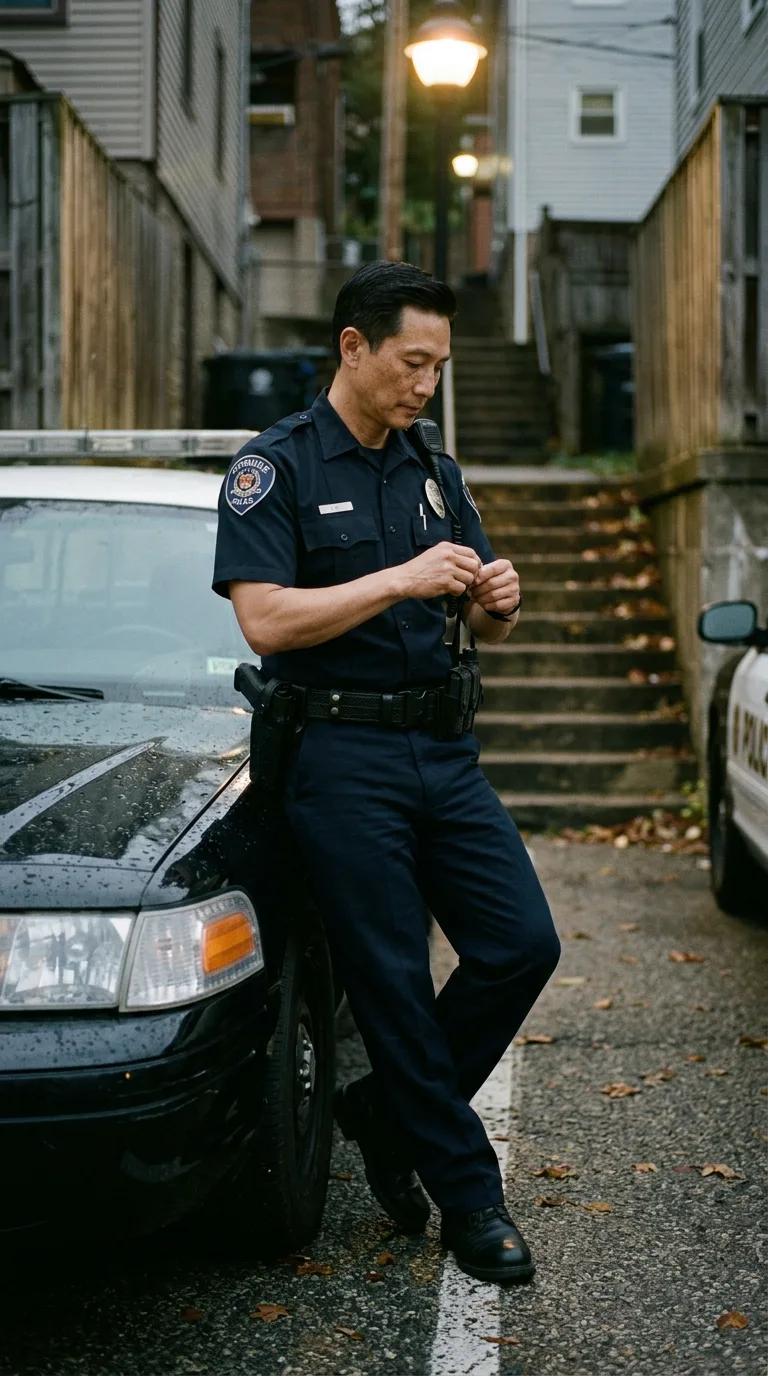
Rarest thing about him: Dyed black — epic, 1 in 60
Season 0seed 1084205775 · engine v10
Character card
lineage LJL8SV
His body-swap story
@marco.villagrana, wearing Vincent Paladino, rolled the wheel on and woke up as Daniel Cho, spent 4 minutes in him, then spun the wheel and woke up as Jaylen Torres
Vincent Paladino's hands are wrong on you, and they always will be, because they're not yours and you have never once forgotten it. Skinny wrists. A beauty mark on the left one you keep catching in your peripheral vision like a fly that won't leave. You've been him two minutes — long enough to stand at the folding table in the back room of the casino, long enough to feel the ache already starting in a fifty-six-year-old lower back that hasn't been young since Carter was president — and it is already not enough. You did not spin for Vincent. You spun for the two minutes before him, the soldier, Samir — the lazy eye, the good shoulders, the house in Dallas with the flag on the porch and the little boy's height marked in pencil on the pantry doorframe. Seven minutes ago you were him. Four minutes you got to keep it. That is the itch. You are standing in a stranger's cheap gray suit thinking about a house you will never see again, and the wheel is right there on the phone in Vincent's skinny hand, and there is really no decision in it at all.
You spin.
The floor changes under you before your stomach catches up — it goes from carpet to asphalt, damp, gritty, and the light goes from the flat yellow of a casino back room to the copper wash of a streetlamp two hours further into evening. You are leaning. Your weight is on a car door, warm hood at your hip, and there is a belt around your waist heavier than any belt you have worn in forty-seven other men, cinched with the businesslike weight of a gun and a radio and a flashlight, and your hands — his hands — are doing something small and exact between your own fingers. A ring. You are turning a ring, thumb over the band, around and around, a motion so worn into the muscle that it does not stop just because someone else is now the one steering it. It takes you a full second to make it stop. You look down at it. Gold, plain, a little dull with age.
The uniform tells you first. Navy poplin, short sleeves, and under your palm where it brushes the placket, a name tag — CHO — and a flash comes up out of nowhere, out of the fabric itself: a bathroom mirror at five in the morning, buttoning this exact shirt one-handed while the other hand holds a phone to your ear, his girlfriend's voice half-asleep and laughing about something, and him laughing back low so as not to wake the house, because the kids are asleep down the hall and he still thinks of it as their house even though the divorce made it only his on the deed. Daniel Cho, forty-eight years old, dressing in the dark out of habit more than necessity, because he has done this ten thousand mornings and his hands know the order of it without any light at all — belt, radio, pen, the little check of the badge that isn't superstition, he'd tell you, it's just what you do.
The belt against your hip gives you more: the weight of it braced on a locker room bench, him sitting to lace his boots, the cholesterol pamphlet stuffed guiltily into the bottom of his gym bag that he has read twice and acted on maybe a third as much as he should, a joke with his partner about the diner's home fries that ends the same way every shift, both of them going anyway. The car under your palm gives you dusk after dusk after dusk, this same lot, wet leaves stuck flat to the asphalt in October, kids' backyards rising in tiers of wooden stairs behind chain-link, a neighborhood he's worked twenty years and still calls by the names the old-timers used before it changed.
And the ring. The ring is the deepest one, because his thumb keeps finding it even now, even with you inside him, an old habit outliving whoever's asking it to stop. Not a wedding ring — his marriage ended six years ago, no rancor left in it, just two kids who go between houses and a woman he speaks to now only in the clipped grammar of custody logistics. This ring is his father's, plain gold, Seoul before Pittsburgh, a church every Sunday that Daniel still keeps though he could tell you exactly which Sundays he was too tired to feel anything in the pew but tired. He does not drink. Never smoked, not once, not even the year the marriage was ending and everyone told him he'd earned one. The ring is the thing his hands do instead. Grief filed down over a decade into a small mechanical comfort, thumb over band, thumb over band, and you feel how much of him is held together by small mechanical comforts — the shirt order, the boot laces, the ring — because the big things, the wife, the marriage, the house that's half his now, those he could not hold at all.
His girlfriend's name arrives with the warmth still on it — an unhurried, recent thing, good in a way that surprises him some mornings, this late in his life, that it could still be good — and behind her, faint, his kids' voices at a volume no uniform quite muffles, a school play last spring, him in the third row in the good shirt, freckles catching the stage light same as they're catching this streetlamp now.
You look at your hands. Broad, calloused at the base of each finger from the belt, from the wheel of the car, from twenty years of doors. Freckled, the same scatter that's on his nose, his cheeks, older now, honest weather. The ring sits crooked from your last thumb-turn and you straighten it without deciding to, the body doing what the body does.
You say it out loud, to no one, to the empty lot and the wet stairs and the black-and-white parked beside you: "Two minutes wasn't enough either."