Dale Whitepine
Fictional. Generated by AI — not a real person, and no likeness of one is intended.
52, tattoo artist in Small-town Ohio · rolled by @colin.hasbrook · card — no film
History
who has worn him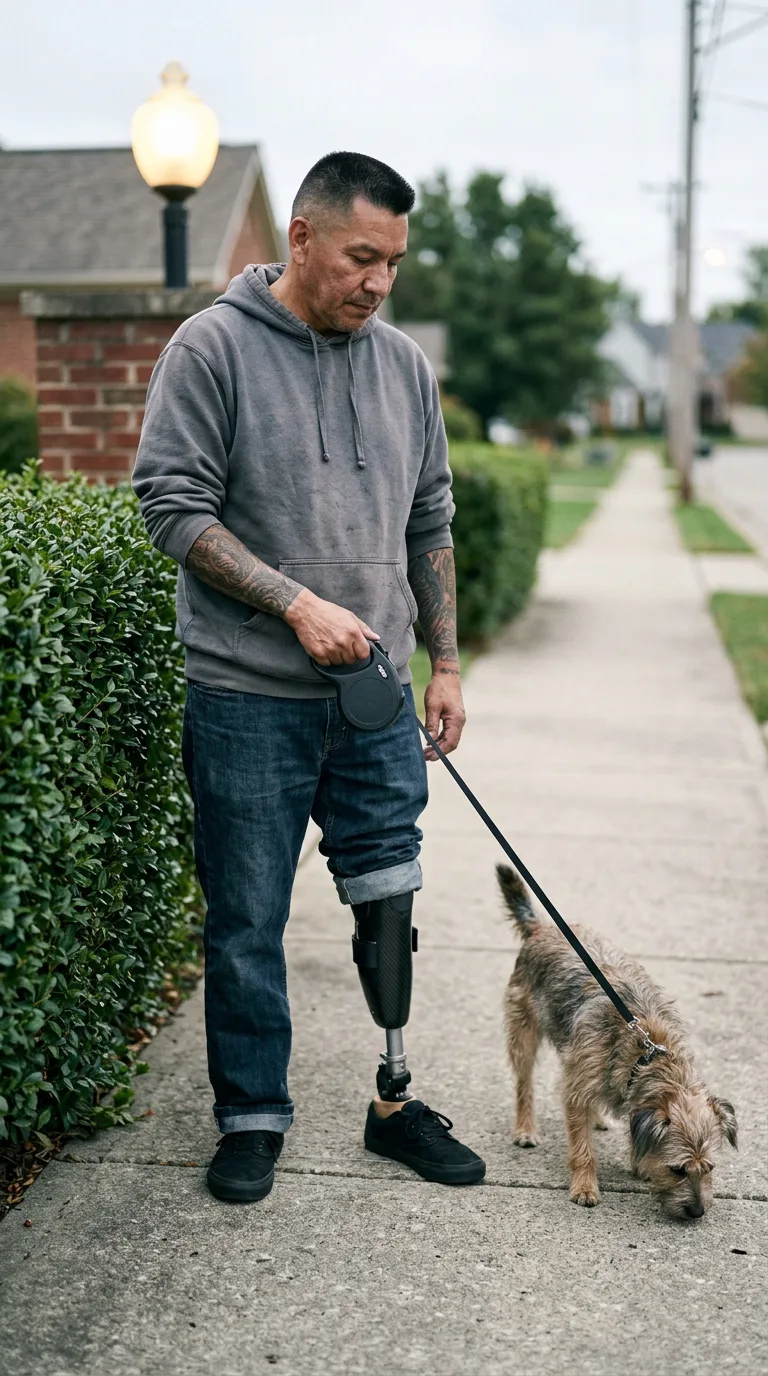
Rarest thing about him: Below-knee prosthetic leg — epic, 1 in 171
Season 0seed 2078181061 · engine v10
Character card
lineage 2NZHHJ
His body-swap story
@colin.hasbrook, wearing Sami Fakhoury, rolled the wheel on and woke up as Dale Whitepine, spent under a minute in him, then spun the wheel and woke up as Grady Fennimore
The fryer oil has been the same smell for four hours and it is not going to become a different smell, and that is the whole problem with Sami Fakhoury's body: it is efficient, it is quick on its feet, the burns on the forearm barely register anymore, and none of it is enough. Line cook, thirty-five, bald by choice not by fate, freckled like a kid though he's thirty-five and tired around the eyes in a way freckles shouldn't be. Less than a minute ago you became him fully — the ticket rail, the heat lamp, the sous chef yelling about table nine — and it already itches like a rental. You wipe your palms on the apron and you know, the way you always know now, that this one isn't going to hold you. You're not choosing Sami's life. You're choosing to leave it before it's finished choosing you. In the walk-in, out of sight, you take the phone from your — from his — pocket, and vessel.cards is already open, the wheel already sitting there mid-spin from a decision made an hour ago that you are only now finishing. You press it. A hundred and seventy-nine times you have done this and it has never once felt like the same gesture twice.
The leash goes taut and then it doesn't. There is a dog — small, wiry-haired, nose deep in a hedge — and there is a hand holding a red plastic grip, and the hand is yours now, and it has simply stopped, mid-stride, like a film caught on one frame. The dog looks up. Ears back. Something in the air changed and the dog felt it before you did anything at all. You wind the leash twice around the housing, an economy of motion that isn't yours yet but the fingers already know it, and you start walking, and the dog has to trot to catch the new rhythm of a stride that wasn't there a second ago.
The sidewalk is Ohio-flat and Ohio-quiet, one stoplight down at the end of the street doing nothing for anyone, a diner on the corner with the OPEN sign turned backward and dust on the register you can see through the glass without meaning to look. The light overhead is on though it's daytime, a leftover from last night nobody's shut off. Then the leg. You feel it before you understand it — the calf that isn't there, the carbon flex where a foot's push-off should be, the practiced small give at the knee joint that this body performs a thousand times a day without once being asked to think about it. It doesn't hurt exactly. It's more like a phrase repeated so often it's stopped being words. Something underneath it, older, half-healed, twinges anyway — a memory of the injury before the leg was gone, maybe, the body keeping a ghost of pain out of loyalty to a wound that predates the prosthetic itself.
The hoodie is soft and grey and smells like woodsmoke and Barbasol, and touching the drawstring gives you a whole morning: him at the mirror at five a.m., shirt off, tracing the tattoo sleeves with a towel because the shop was closed Monday and Mondays are for himself, pulling this exact hoodie over his head because the shop heat's broken and it's cold before the sun's fully up. Rolling the left jean leg twice, out of habit, not modesty — just so the cuff doesn't catch on the ankle joint. A ritual older than the leg itself, from when it was some other prosthetic, cheaper, and before that from when there was a boot there and a war he doesn't talk about except once, drunk, years ago, to a woman who isn't the one waiting for him now.
The leash in his hand brings her — Renee, on the porch this morning, coffee in both hands, saying drive safe like he was driving anywhere, laughing at her own joke because they both knew he only ever walks the dog, never drives it. Three kids from a marriage that ended on good enough terms that two of them still call on Sundays, and the youngest, seventeen, who came by the shop last week just to sit in the chair and talk about nothing, and it undid something in his chest he didn't say out loud. And under that, further down, an old ex — Carla — whose name still sits in him like a low note that never resolves, no anger in it anymore, just weight, the way an old ink job settles gray at the edges and stops looking like what it once was.
His hands know things yours don't: the particular pressure of a tattoo machine against skin, the habit of biting the nails down to nothing between clients because waiting is worse than needles, the way he never picks up a drink at the shop parties because fifteen years sober from cigarettes taught him something about wanting that he's not interested in relearning with a bottle. Church on Sunday, quietly, no performance in it. A body fifty-two years old, average build going soft at the middle the way bodies do, calluses on the sketching hand thick as leather, and under the hoodie sleeve the tattoos aren't his but they might as well be — he's inked half the men in this town and worn the proof of his own trade on himself for twenty years.
The dog tugs. You look down at the hand holding the leash — his hand, blunt-fingered, nail beds bitten close, a hand that has spent decades finding the exact place to rest a needle's weight against another person's skin — and you turn it over like you're checking it's real.
"Okay," you say, out loud, to no one, to the dog, to the empty street with its one stoplight going green for nobody. "Okay. Let's go home."