Dale Merchant
Fictional. Generated by AI — not a real person, and no likeness of one is intended.
44, water treatment operator in Small-town Ohio · rolled by @colton.weyburn · card — no film
History
who has worn him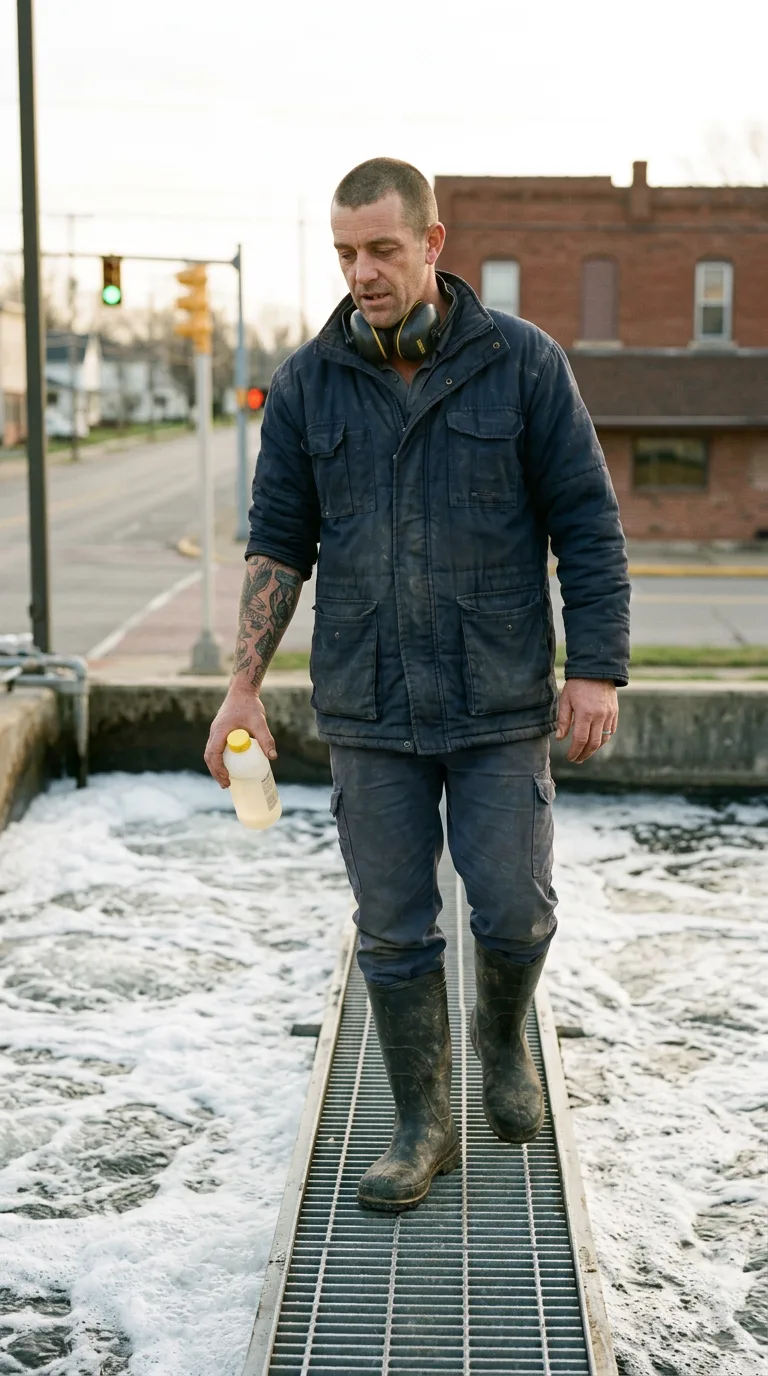
Rarest thing about him: A missing front tooth — epic, 1 in 191
Season 0seed 1038415537 · engine v10
Character card
lineage GSHCK1
His body-swap story
@colton.weyburn, wearing Gary Holcomb, rolled the wheel on and woke up as Dale Merchant, spent 1 minute in him, then spun the wheel and woke up as Douglas Nakada
The tower smells like other men's dinners microwaved twice. You are sitting where Gary Holcomb sits, in the break room chair that takes his weight like it's used to it, and you hate this body already — the way the knees ache going down stairs, the gut that leans over the belt, the radio clipped to a shoulder that has been shot at twice and talks about it. Twenty-eight minutes ago you spun into a big gray man with silver hair and blue eyes and a laugh you haven't heard him use, and you thought: fine, big and mean, that could be fun for a night. It isn't. Somebody down the hall is crying about a phone call and Gary would know whose kid that is and you don't want to know. Your phone — his phone — buzzes with a text from a woman named Denise that you're not going to read. The wheel is open in the browser tab you never closed. You don't decide so much as notice your thumb already on it, the way boredom turns into motion before it turns into a reason. You spin.
The walkway is metal under thin rubber boot soles, and the water below is going white, boiling with air the way it's supposed to, and your hand — his hand — is closed around a plastic jug half full of something the color of weak tea. Halfway through a turn your foot lands wrong on the grating, catches, and you set it down again, slow, deliberate, like a man walking a beam for the first time instead of the four-thousandth. You blink. The light is going copper over a brick building across the street, a stoplight hanging green over an empty crossing, and you are standing in somebody else's evening wearing his height like a smaller room.
The jug is the first thing that opens. Polymer, for the filters, and the memory that comes with it is not a picture but a smell — chlorine and pond-scum sweetness — and underneath it a whole decade of these walkways, the same iron rail, the same white water, Dale's hands doing the settings without his eyes because his eyes learned to watch the color of the foam instead. He has done this since he was thirty-one. He likes it. Nobody tells him what to do out here and the plant doesn't lie to him the way people do.
The jacket gives you more, once you notice you're wearing it — navy canvas gone stiff with old dirt, zipped to the throat against a cold that isn't really cold yet, just the season turning. This morning — his morning, hours behind wherever you'd just come from — he pulled it off the hook by the kitchen door while Kayla ran a comb through the youngest one's hair at the table and the coffee maker clicked off. Three kids, maybe a fourth some mornings when the middle one's friend stays over, cereal bowls, a dog nobody remembers to feed on schedule. He kissed his wife's temple because her mouth was full of something and she swatted him with a dish towel, easy, married-twenty-years easy. He did not think about Renee once, not this morning — Renee who he still texts sometimes, late, nothing that would hold up in a divorce but enough that Kayla would want to see his phone if she knew — and the not-thinking is its own kind of guilt, familiar as the jacket's weight on his shoulders.
Under the jacket, the flannel, and under that his own skin — forty-four years in it, average and getting less so, the gut starting where it wasn't ten years ago, a lower back that complains on cold mornings and doesn't yet on this one. The half sleeve on the right forearm itches faintly where the ink is oldest, the eagle he got at twenty-two with two Army buddies he doesn't see anymore, bold lines gone the soft blue-green of a bruise healing. His left hand carries the ring, plain, a little loose now that he's lost weight worrying about the youngest one's asthma. His mouth finds the gap where the front tooth isn't — a bar fight nobody brings up anymore, not even Kayla — his tongue going to it the way it always does when he's thinking and doesn't know he's thinking.
The boots know the grating better than his eyes do. Ten thousand walks over this basin, headphones looped cold around his neck because the aerators are loud enough to matter and quiet enough to forget, and every one of those walks is in his knees, his ankles, the specific give of rubber soles on wet steel. He has stood here on his wedding anniversary and on the night his father died and on an ordinary Tuesday exactly like this one, and the water underneath has never once cared, just kept turning white and easy, doing the only thing it does.
You look down at the hand holding the jug. It is not a big man's hand. It has a callus where a wrench sits and a tan line where a glove usually is and a ring that has never once come off since a woman named Kayla put it there. You turn it over anyway, like it might tell you something the wheel didn't, and behind the missing tooth you say, to no one standing on the walkway with you, in a voice you have not used before:
"Good enough for a Tuesday."