Gary Holcomb
Fictional. Generated by AI — not a real person, and no likeness of one is intended.
52, prison guard in Nashville · rolled by @colton.weyburn · card — no film
History
who has worn him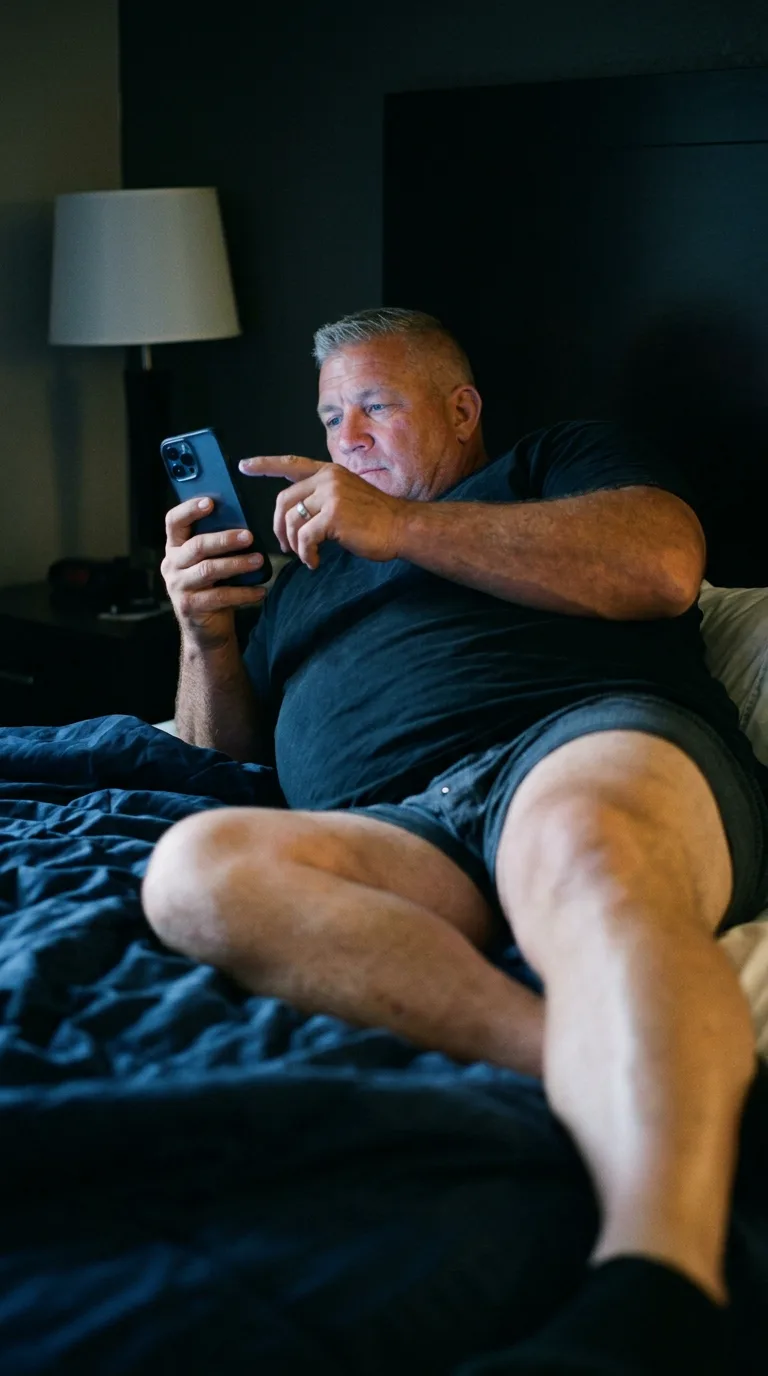
Rarest thing about him: Vapes daily — epic, 1 in 102
Season 0seed 863785563 · engine v10
Character card
lineage GSHCK1
His body-swap story
@colton.weyburn, wearing Marlon Abasi Whitfield, rolled the wheel on and woke up as Gary Holcomb, spent 28 minutes in him, then spun the wheel and woke up as Dale Merchant
Three minutes is nothing, except when it's someone else's mouth talking with your want in it. You'd made Marlon Abasi Whitfield say "sure, let's do it again" out loud in an empty exam room, to nobody, just to hear his voice agree with you, and the second the words left him you knew you were done with him — thirty-three years old, good hands, a dentist's steady patient hands, and none of it interesting once you'd worn it. That's the thing nobody tells you about the wheel: the body is never the itch. It's whatever's on the other side of spinning again. You stood there in his clean bright office smelling his mouthwash and his ambition and thought, not this one, not tonight, and you were already reaching for the site before you'd finished the thought.
The wheel doesn't care what you're leaving. It spins.
You are lying on your side in the dark and your thumb is moving before you've decided to move it — faster than it was, flicking through things a man was slowing down to look at, a fishing boat for sale, a granddaughter's — no, not yet, that's not yours yet — and the phone's blue light is doing something to the side of a face that has stopped blinking like it should. You feel the size of yourself first, the way you always do, arriving into a body like stepping into water that's the wrong depth. Big. Heavy through the shoulders and gut both. A mattress taking your weight in a way that Marlon's queen never did. Something metal and thin is warm against the base of your left ring finger.
The shirt is the first door. You didn't even mean to touch it — you're wearing it, it's simply against your back where you're propped on the pillow — but it opens anyway, the cotton going soft and known under whatever's left of the man who put it on. It comes in the order clothes always come in: sleeve first. Right arm through, easy, the automatic swing of forty years of getting dressed for a job that starts before daylight or, tonight, a job that started after midnight and is only now, hours in, letting him lie down on a break he isn't supposed to be taking. Gary. The name arrives with the second sleeve, unhurried, the way his own name always came to him — not a discovery, just a fact resuming. Gary Holcomb, standing in front of a dresser in a house that smells like his wife's candles, working buttons that don't want his fingers anymore because his fingers have gotten thick and stiff at the knuckle in the last few years, and Denise saying from the bathroom, you working the same shift as Tuesday? and him saying yeah, graveyard again, and neither of them minding it anymore the way they minded it fifteen years ago, when the kids were small and the house needed a father awake in daylight. The kids are grown now. A son who calls. A daughter who doesn't, much, and it isn't a wound anymore so much as a weather system he's learned to dress for.
The phone in your hand is warm from his palm and it gives you almost nothing — just the endless small itch of scrolling at the tail end of a night, the boredom of a body that has been sitting or standing at a gate since eleven, watching men who are not going anywhere not go anywhere. His feet, when you notice them, are bare and one of them is asleep from the angle he's been lying at, and there is a dull permanent throb behind your eyes that you understand, distantly, belongs to his blood pressure and the vape he hasn't had in an hour because he's supposed to be resting his eyes, not his thumb.
The bed under your hip brings the marriage back whole, the way the good rooms do. Twenty-six years. A woman who married a rookie corrections officer in a courthouse in Antioch and got, in exchange, a man who came home smelling like bleach and other men's fear and never once brought it through the front door with him, because his mother raised him church-going and his father raised him not to talk about work, and between the two of them he'd built himself into somebody who left it at the gate. He believes, in the plain unbothered way of a man who has never had to defend it, that God is watching and mostly pleased with him. He has never had a drink in his life and has never wanted one, but he has had a vape in his shirt pocket every day since the patches didn't work, and his cuticles — you find this without meaning to, your own thumb already worrying at the nail of your first finger — his cuticles are always a little raw, a little picked-at, a habit older than the marriage, older than the job, something his hands do while the rest of him holds still and does not raise its voice.
The ring is the last door, and it's the deepest one — thin gold gone a little dull, sitting low enough on the finger that you understand it's never once come off. A hallway smell comes with it: cinderblock painted the color of hospital hallways, keys on a chain against his hip, a radio clipped where his shoulder mic used to sit before they modernized the gate. Thirty years of watching men come and go through the same door and thinking, some nights, there but for. He is not an unkind man. He has never once told his wife that some shifts he comes home and sits in the truck in the driveway for ten minutes before he can make himself be a father again. He would tell you, if you were someone he trusted, that the job doesn't scare him anymore, and that not being scared anymore is the part that scares him.
You feel all fifty-two years of him settle into the mattress — the low ache in the lower back that never fully leaves, the good strength still sitting thick through the arms and chest under all that softness, a body that could still put a man on the ground if it had to and mostly, blessedly, hasn't had to in a long while. The phone is still lit in your hand, his hand, six inches from a face that quit scrolling toward anything and started scrolling away from everything, which is a distinction only you would notice, because you are the only one in here now.
You set the phone down on the comforter, screen still glowing, and you look at your hand in the dark — the ring catching the last of that blue light, the cuticles picked pink at the edges, a hand that has opened a hundred thousand doors it didn't choose to open. You turn it over once.
"Denise," you say, quiet, testing the shape of her name in his voice, not sure yet if you mean it as an apology or a greeting, "you still up?" — and you don't know if she'll answer, and you don't know how long you'll be the one waiting to find out.