Curtis Abernathy
Fictional. Generated by AI — not a real person, and no likeness of one is intended.
43, line cook in Seattle · rolled by @colby.nash · card — no film
History
who has worn him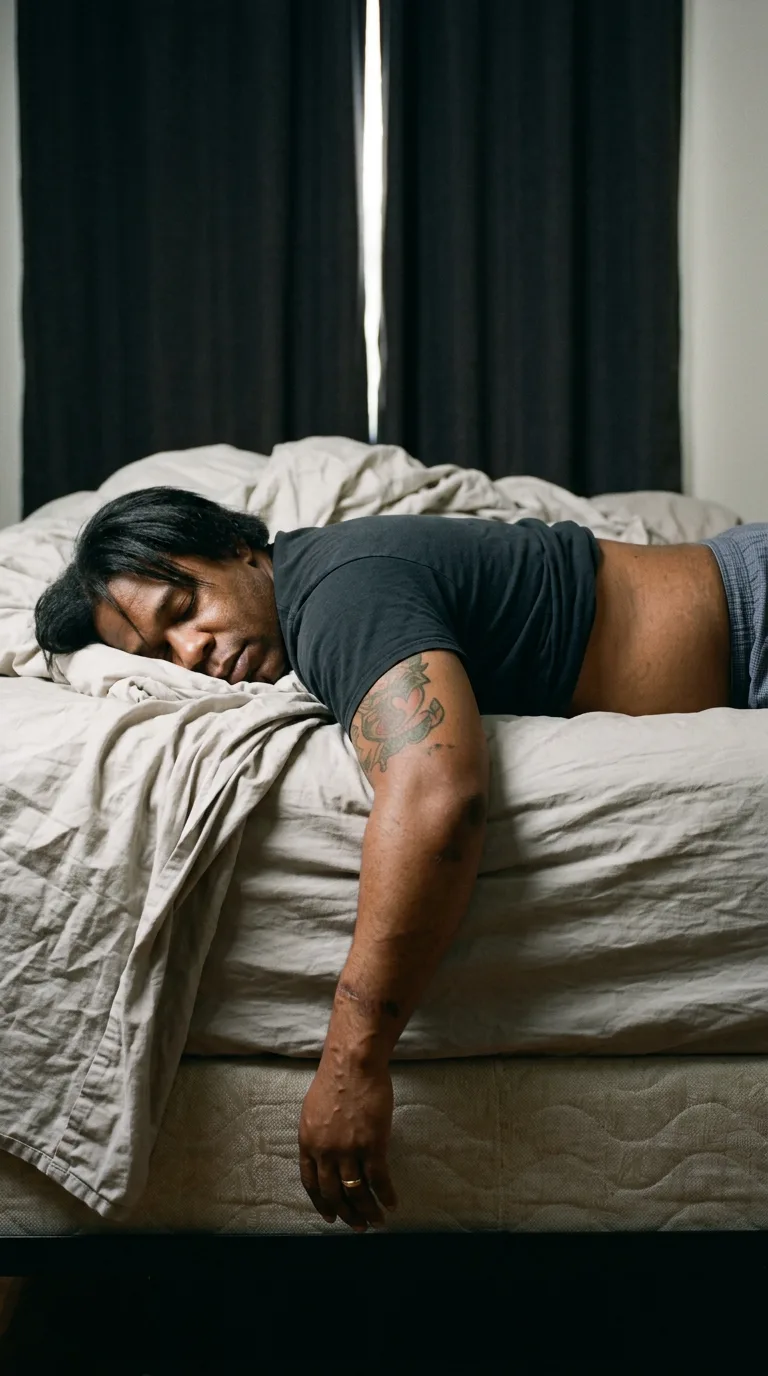
Rarest thing about him: Curtains, parted in the middle — rare, 1 in 79
Season 0seed 1736834769 · engine v10
Character card
lineage E1W54H
His body-swap story
@colby.nash, wearing Dean Halvorsen, rolled the wheel on and woke up as Curtis Abernathy, spent 44 hours in him, then spun the wheel and woke up as Wendell Ashworth
Sixteen hours and four minutes as Dean Halvorsen, and it turns out muscle is not the same as belonging in a body. You keep catching yourself in the barracks mirror surprised by the jaw, the gap in the teeth, the height of the ceiling from up there. Dean is easy in every way a body can be easy — young, strong, no ache anywhere — and you are bored inside him already, the particular boredom of a rich house with nobody's photographs on the walls. So you sit on the edge of his bunk at 0300 with his phone light too bright in his own gray eyes, and you open the site, and you tell yourself it's only curiosity working the wheel this time, not the itch, not really. The card that comes up stops your borrowed breath: a cleft chin, a chef's coat, Seattle. You know this face. Four spins ago you wore Philip Doyle for three minutes only, court reporter, sixty-five, and in Philip's mild green eyes you'd clocked this same man once, laughing in a break room, called him by a name Philip's memory supplied without being asked — *Curtis, man, you're gonna burn that whole tray*. A coworker's coworker, once removed, filed away like a photograph left in someone else's wallet. You didn't choose him for that. You tell yourself you didn't.
The rain-slick street outside becomes nothing, the barracks becomes nothing, Dean's whole gray-eyed body drops away mid-breath —
— and you are face-down in unmade sheets with one arm hanging off the mattress into cooler air, streetlight cutting a blade through the curtain gap, and the first thing that is yours is how *warm* this is, how much closer to the ground, how the belly presses the mattress in a way Dean's never did. The ragged pull of someone else's exhausted breathing evens out under your management like a held note. The hanging arm draws itself up. The body rolls onto its back. Hands fold at the chest, a shape this man has apparently never once made in sleep, and something in the room — you'll never know what, a habit, a wife's memory of watching him — would have found that wrong if anyone were awake to see it.
Then the shirt gives it up first — not this one, he's not wearing it, but the ghost of one, cotton against a back that carries fourteen years of ticket rails and hot line, and through that ghost-sleeve comes a whole morning: Curtis Abernathy standing in a kitchen lit gray-blue before six, pulling the same chef's coat over his head, favoring the left shoulder that's been barking since the banquet on Saturday, buttoning it one-handed while the other hand finds his phone to check a text from Renata — not his wife, his ex, asking can he take the kids Thursday because her shift changed — and the small flare of irritation that isn't really irritation, that's just the shape their whole decade together wears now, worn smooth as a doorknob. His wife Angela's voice from the other room, not annoyed, just tired in the particular key of two kids and a husband who works nights: *tell her you'll figure it out, don't fight about it before coffee.* And he doesn't fight about it. That's the whole marriage in miniature — Angela's steadiness absorbing what Renata's chaos still occasionally flings at him, six years on, and him grateful in a way he's stopped saying out loud.
The wedding band is on the hand that's under the pillow now, plain gold, and it brings Angela whole: the courthouse afterward with the kids too young to sit still, her hand finding his under the table at his mother's funeral two years later without either of them looking. The tattoo on the arm — American traditional, an anchor and a rose gone soft at the edges — comes with nineteen and reckless and a girl before either wife whose name the ink outlived. The feet against cool sheets know the particular ache of standing eight hours on a mat that's never quite thick enough, the burn scar on the forearm he doesn't think about anymore, the low hum of anxiety that lives under his sternum most days and has a name and a small orange bottle in the medicine cabinet and mostly, these days, behaves. Line work suits him better than it should for a man who worries this much — the ticket times give the worry somewhere to go.
You feel all of it arrive the way heat arrives in a cold room, not all at once but filling every corner eventually, and you lie there wearing a life instead of just a body, letting Curtis's forty-three years settle into a frame that already, gratefully, knows how to hold them.
Your — his — hand comes up into the streetlight. You turn it over. Old burn scar, a nick from a mandoline that never quite healed right, the ring catching light.
"There you are," you say, to no one, to him, to the ceiling, and you don't know yet if that means tonight or a year or the four minutes you once spent being nobody he'd recognize.