Craig Delvecchio
Fictional. Generated by AI — not a real person, and no likeness of one is intended.
30, bricklayer in New York · rolled by @marco.villagrana · card — no film
History
who has worn him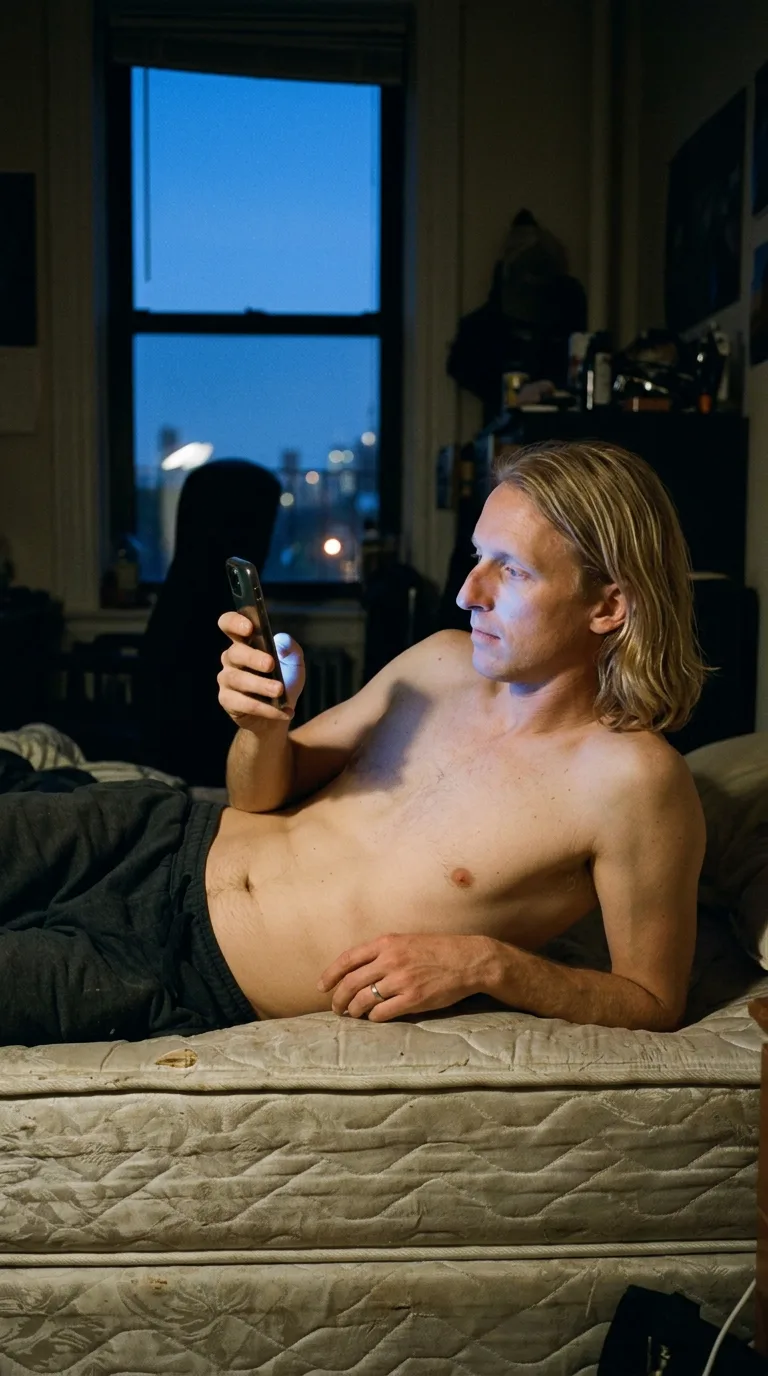
Rarest thing about him: Bricklayer — uncommon, 1 in 607
Season 1seed 1045238349 · engine v11
Character card
lineage LJL8SV
His body-swap story
@marco.villagrana, wearing Danny Reyes, rolled the wheel on and woke up as Craig Delvecchio, spent 4 minutes in him, then spun the wheel and woke up as Wesley Graham Tanner
Danny Reyes's phone buzzes on the kitchen counter, and you almost don't look, because the coach's Monday has been long and good and his shoulders ache in the specific, satisfying way of a man who ran drills all afternoon. Three minutes in him and already you know the shape of his evening: leftovers, ESPN, an early bed. It should be enough. You have learned, a hundred and fifty times over, that it is never enough for long. Something about being new in a body wears off fast, like a hotel room you've already hung your clothes in. What gets you moving again isn't the wrestling coach's life — it's a name that surfaced twenty minutes ago while you were still standing in his kitchen: Patrick Novogratz. You wore him five spins back, for four minutes, and in those four minutes you stood in his front hall and looked out through his window at the guy next door hosing down a scaffold, blond hair stuck to his neck, laughing at something no one else could hear. You remember Patrick's small flare of irritation at that laugh — something old, something about a woman, never finished, because you spun away before it finished. You have wondered about it since, the way you wonder about a page you didn't get to read. So you open the site on Danny Reyes's phone, thumb steady, and you spin, not for the money this time, not really, but to go stand on the other side of that fence and find out what Patrick never told you.
The wheel gives you weight before it gives you anything else — more of it than Danny had, but soft in the middle, folded onto a mattress with no frame, his side to a window full of blue dusk. A phone is already in your hand, six inches from a face that was, one half-second ago, mid-scroll. The thumb doesn't stop. It goes faster, sure of itself in a way the man never was in this exact moment, flicking past a face he'd paused on, past a joke he hadn't finished reading. Sodium light from the street leaks up through the blind slats and lies along a cheekbone that isn't Danny's, isn't yours, is simply here now, blue-lit and still.
The shirt comes first, because it's against your back, damp with the day's version of sweat that hasn't fully dried — and through it comes a whole morning: him pulling it over his head in a basement apartment that smells like the inside of a brick, the elastic waist of the canvas pants already shot at the knee from months of kneeling, the particular ache of pulling knee pads on over jeans that are themselves already ruined. Craig Delvecchio, and the name arrives with the memory of his own mother saying it, disappointed, on some birthday call. Thirty years old, and this morning like every morning he laced his boots sitting on the edge of this same mattress, and cracked his knuckles one hand then the other before he stood, an old tic he's never noticed himself doing.
The trowel hand remembers itself even empty — the exact heft of it, the flat scrape-and-tap rhythm of pointing a joint, brick after identical brick, ten hours today on a scaffold two stories up with the wind coming off the harbor smelling like diesel and low tide. His shoulders are wrong in a way his own body doesn't complain about anymore: strong forearms, soft gut, a back that will hurt at forty in a way it doesn't yet at thirty. The wedding band on the left hand is warm from his body heat, and it opens a wife, Lauren, her laugh in a kitchen two blocks from here, the two of them married four years now, him telling himself nightly that it's enough, that the itch under it isn't anything, that Sarah — the one from before, the one who left for Portland and never once called — doesn't still sit in him like a low fever some evenings when the light goes blue like this and the day is over and there's nothing left to do with his hands.
And there, threaded through the ordinary Monday tiredness, is Patrick — the neighbor, older, close-cropped, always half a step too friendly at the mail slot, always looking a beat too long when Craig came home shirtless and streaked in mortar dust. Craig's feeling about him is not what you expected standing in Patrick's hall five spins ago. It isn't irritation returned. It's a small, guarded pity — Craig thinks Patrick is lonely, thinks Patrick watches him the way a man watches a life he didn't choose, and Craig has never told Lauren that some evenings he waves at the guy just to be kind, and never told her, either, that once, drunk on the stoop in June, Patrick said something about an old girlfriend of his own that got away, and Craig had said nothing back because he understood it exactly, completely, down to the marrow — that ache has a name and its name is Sarah for one man and something else for the other, and neither man has ever said the name out loud where his wife could hear it.
You feel that recognition settle into the borrowed chest like ballast, oddly heavier than you expected the answer to be.
The thumb stops. The hand it belongs to turns over, slow, palm up in the blue light, and you look at the crooked bridge of a nose broken once, though you can't see that, only feel where the memory of the break sits, dull, in the cartilage when you press two fingers there without meaning to.
"Huh," you say, out loud, to no one, in his voice, and it comes out lower than Danny's, rougher at the edges from thirty years of use. "Didn't think it'd be you."