Craig Boetticher
Fictional. Generated by AI — not a real person, and no likeness of one is intended.
34, accountant in Boston · rolled by @colin.hasbrook · card — no film
History
who has worn him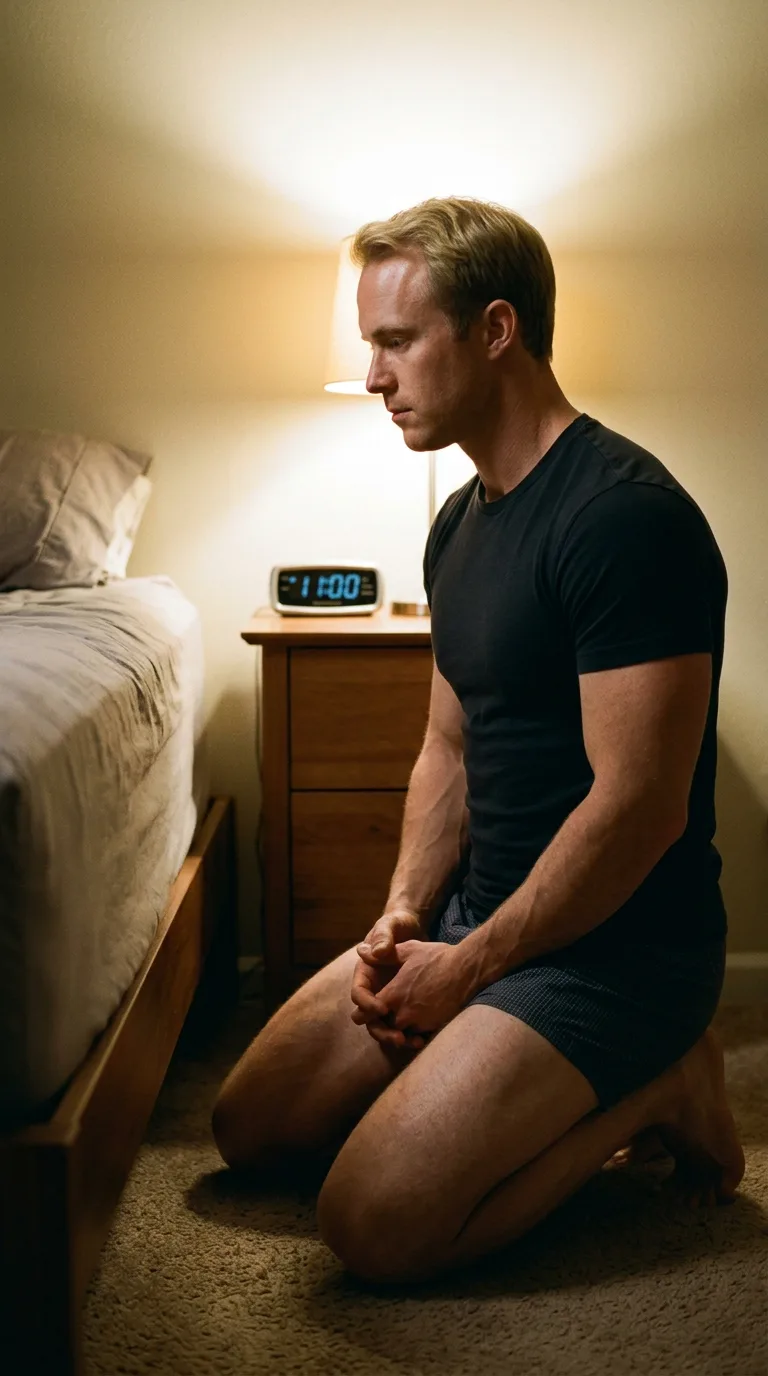
Rarest thing about him: 5'4" — rare, 1 in 55
Season 0seed 2007292629 · engine v10
Character card
lineage 2NZHHJ
His body-swap story
@colin.hasbrook, wearing Sean Marchetti-Voss, rolled the wheel on and woke up as Craig Boetticher, spent under a minute in him, then spun the wheel and woke up as Marcus Deveraux
You are standing in a garage in Los Angeles you do not own, in a body you have worn for five minutes, and already it is not enough.
Sean Marchetti-Voss's hands are on a workbench that is not yours, next to a truck that is not yours, at almost midnight on a Saturday when the man himself should be sound asleep and dreaming his own dreams somewhere far under you. Twenty-seven years old. Average build going soft at the edges from beer and not enough of anything else. You have had five minutes of him — five minutes of a bad lower back and a phone buzzing with a woman's name he clearly does not want to answer tonight — and it is already enough to know you don't want it. Some bodies you keep for the ride. This one you can feel yourself wanting to be finished with before you've started. That itch under the sternum, the greed that doesn't wait for morning. Five hundred and fifty-one men behind you and it never gets easier to just sit still in one.
You open the laptop that's already open. The wheel is already loaded, the way it always is, like it's been waiting. You pay. You spin.
—
The bedspread is against your forehead before you understand it is a bedspread, before you understand *forehead*, before you understand you have one again that isn't Sean's.
Your knees are on carpet. Your hands are still loosely laced in front of you, fingers gone strange and unfamiliar, thicker through the knuckle than they were a half-second and three thousand miles ago. There was an amen in your mouth that you did not finish saying. You were rising — you can feel the ghost of the motion, quadriceps already firing, weight already shifting up off the heels — and now you are back down, all the way down, face nearly in the blanket, and the amen is gone, swallowed by something that isn't a word at all.
A lamp is on. A clock says a number that means nothing yet.
—
The t-shirt is the first thing that talks to you. Cotton, soft from washing, snug across a chest that did four hundred pounds on the bar this Tuesday and will do it again Tuesday next, a body that has been worked on with real discipline for real years — and under that discipline, worry, always worry, worry that got up this morning already leg-bouncing before the alarm even finished its first note. *Craig.* The name arrives folded into the shirt collar like a laundry tag. Craig Boetticher, thirty-four, and the bedspread under your forehead is the one Melissa picked out in April because the old one made the room look like a hotel, and you laughed at her for caring and then you cared too, secretly, the whole drive home from Jordan's.
The nightstand clock keeps feeding you the room: eleven at night, and this is not late for him, not really — he is up because the Zoloft he takes for the thing he does not call anxiety, because Evangelicals do not always have the word for it even when they take the pill for it faithfully every morning at seven, makes the back half of his evenings restless and thin, sleep arriving late and cheap. Down here, kneeling, is a thing he was taught as a boy in a Waltham living room by a father who is dead now and whom Craig loved with the specific ache of a son who wanted one more real conversation and never got it. Praying is a habit more than a conviction some nights, and tonight was one of those nights — mouth moving through *thank you for this day* while his eyes stayed open on the clock, half-checking how long till the alarm, half-laughing at himself even mid-sentence for how little he meant it, ready to be done and get up onto the mattress next to the phone where Kayleigh's last text is still unanswered, something dumb and sweet about brunch.
The floor gives you his knees, which ache a little, a lifter's ache, honest ache, the good kind. The glasses are not on his face right now — folded somewhere on the dresser, waiting for morning, for the drive to the office where two monitors will throw their flat blue light across a desk stacked with a client's Q3 numbers he already knows are wrong and hasn't told anyone yet, because he likes the quiet of catching it slow, alone, before he has to say it out loud in a meeting. He is good at his job. He is careful with money the way he is careful with everything — measuring, checking, checking again — and there is over three hundred thousand of it sitting in accounts he built himself, dollar by dollar, plank by plank, the way you build a thing you don't quite trust the world to leave alone.
His leg. Even kneeling, even now, some nerve in it wants to bounce, an old motor idling under a still body — you feel it try and fail against the carpet, muscle memory with nowhere to go.
The shirt again, sleeve by sleeve, gives you this morning: standing at the dresser at 6:40, pulling it over his head one-armed while checking his phone with the other hand, already running the day before his feet had left the rug. He does this every day and has for years and there was nothing in it worth remembering except that it was his, entirely, unwitnessed, a man alone getting dressed in the gray Boston light behind a storm door that rattles a little every time the wind finds the porch.
None of it is dramatic. That is the whole of him — an ordinary good man, worried more than he needs to be, loved by a woman he has not yet worked up the nerve to marry, kneeling at the edge of a bed he shares with no one, saying words he half means to a God he mostly believes in, on a Saturday night that was never going to be remembered by anyone, including him.
—
You lift your forehead off the bedspread.
You look at the hands laced in front of you — blunt, calloused at the heel of the palm from bar work, a plain hand, an honest hand, not yours, not yours, not yours — and you turn the right one over slowly in the lamp light like you're checking it for a wound.
You raise your eyes to find nothing there but the room, and somewhere behind the room, the lens that was never installed, that you supply out of old habit — five hundred and fifty-two times of being looked at by nobody and still looking back.
"Amen," you say, too late, and it comes out like a question.