Cornell Trask
Fictional. Generated by AI — not a real person, and no likeness of one is intended.
57, firefighter in Los Angeles · rolled by @colin.hasbrook · card — no film
History
who has worn him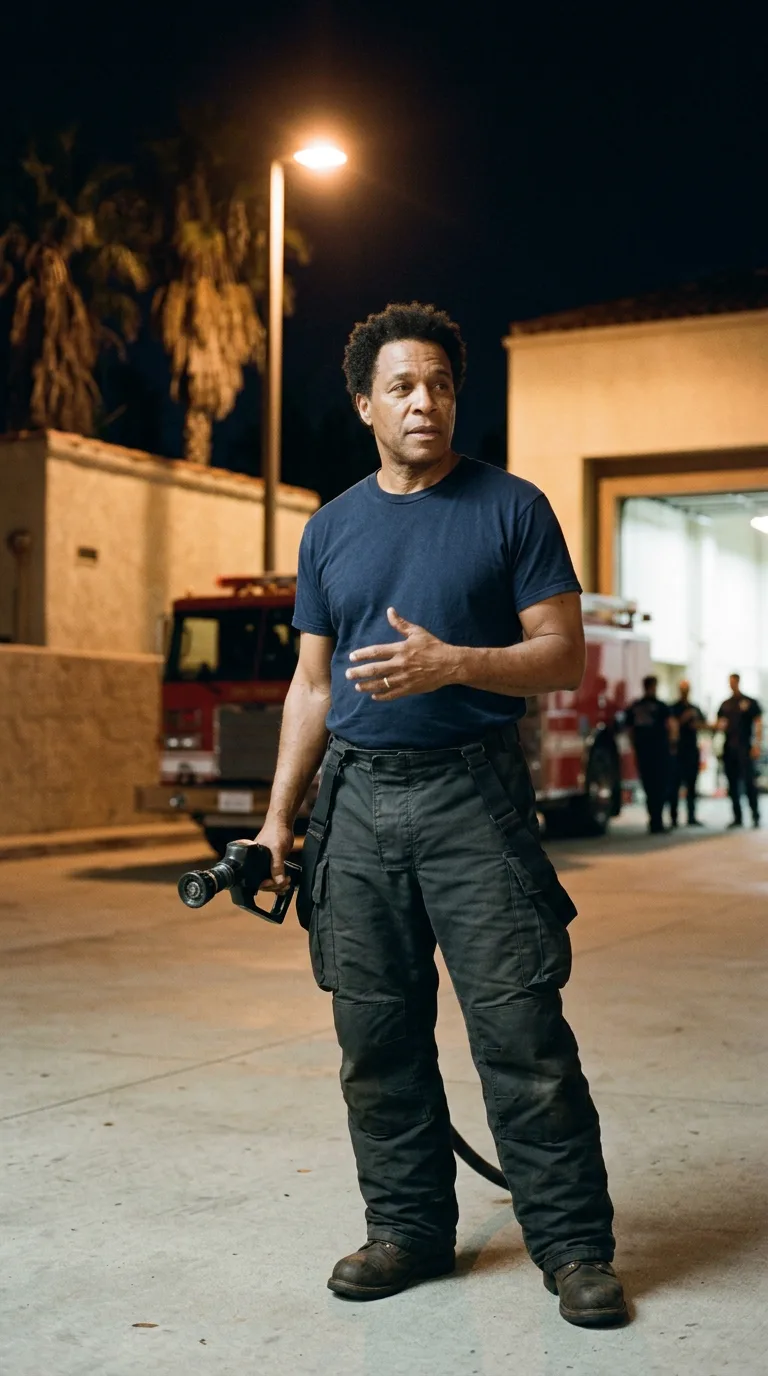
Rarest thing about him: Firefighter — common, 1 in 284
Season 1seed 840261415 · engine v11
Character card
lineage 2NZHHJ
His body-swap story
@colin.hasbrook, wearing Gordon Maslin, rolled the wheel on and woke up as Cornell Trask, spent under a minute in him, then spun the wheel and woke up as Delroy Ashwood
Gordon Maslin's kitchen is the color of unwashed dishwater at this hour, and you are standing in it in his skinny-fat body, in his cheap robe, holding his phone with his own — no, Gordon's — thick fingers, the login already saved because Gordon saved it, because Gordon liked what this felt like even when Gordon was only Gordon. Six-forty in the morning. Nobody else awake in this apartment, because there is nobody else; that's one of the things you learned inside him in the first ten minutes, the loneliness sitting in the walls like old smoke. You have had him less than a minute and already you are bored of the ceiling, the exposed pipe, the smell of a man who eats standing up. Seven hundred and thirty-nine men and you are back here again at the coffeemaker that hasn't finished, feeling the specific itch that isn't hunger and isn't restlessness but is both, the thing that always comes right before you spin: *not this one, not yet, not for years, get me out.* You don't decide so much as notice you've already opened the page. The wheel is already loading.
You spin.
—
The nozzle is heavier than you expect, cold brass warming where it sits against a palm that has held it ten thousand times, and your arm is already three inches into a motion you did not start — capping the hose bib, the same twist he's done since before some of the guys in the bay were born — and it goes wrong, wrist turning a half-beat late, the thread catching crooked. You stop. Redo it, slow, correct. Then the next ten couplings come out of you checked, deliberate, a rookie's carefulness laid over hands that have not needed it in decades, while somewhere behind you an engine idles under a sodium light and palm fronds hang dead-still in air that smells like eucalyptus and diesel.
—
The shirt is what opens first — not this navy T-shirt, the memory underneath it, some fabric-ghost of the morning he dressed for a call twenty years ago, sleeve over one arm and then the other while Denise slept with her back to the window, and the recall carries a whole marriage in with it before you can stop it: her laugh, low, unimpressed by nothing; the two kids as infants, as toddlers, as teenagers slamming a door you both agreed to let them slam. Cornell Trask. Fifty-seven years in this body and it comes to you now in pieces, through what you're touching, the way it's always given.
The bunker pants against your legs — heavy, canvas-stiff at the knee where they've been baked and washed a thousand times — bring back a fire in a Highland Park duplex, 2003, the ceiling coming down two feet from where he was standing, and the particular calm he found instead of panic, a calm that surprised even him and that he never mentioned to anyone, not Denise, not his captain, because some things you keep. The boots know something else: a marathon he ran at forty-one on a bet, the ache in the arches that never fully left. Your — his — knees remember kneeling on tile pulling a kid out from under a sink. His back remembers thirty years of turnout gear and says so, quietly, the way an old injury says things.
The wedding band is warm from his own hand's blood before yours took it over, and touching it brings Denise clearest of all — not the wedding, but a Tuesday, ordinary, her handing him coffee before shift, saying something about the electric bill, both of them laughing at nothing. That's the marriage. Nothing about it is dramatic and that is exactly its whole argument. There is another woman too, further back, glancing off the same nerve — Renata, who left before Denise, whom he still thinks of on nothing days for no reason, whom he never looked for, the door he leaves shut on purpose.
He drinks — you feel that too, arriving through nothing in particular, just a low, permanent thirst underneath everything else, present at six a.m. as much as at midnight, older than the marriage, older than the job. Not shaking. Just there, patient, the way a tide is there.
His body: fifty-seven, and honest about it — a stiffness in the left shoulder that the lifting hasn't fixed, forearms still hard from twenty years of hose and axe, a gut that isn't there yet and might never be, curly hair he stopped fighting with a razor at the sides years ago. Clean jaw this morning, shaved before shift out of habit more than vanity. His hands know the coupling, the strap, the buckle, without asking him — they know it without you either, is the strange part, muscle laid down so deep it survives you moving in.
Behind him, close enough to hear, one of the younger guys is talking about nothing, and Cornell — you — do not answer yet, because you are still arriving, still checking couplings that don't need it.
—
You look down. Ring first, dull gold under the sodium light, then the whole hand, broad, a little swollen at the knuckle, a hand that has known this exact hose since before you existed in it. You turn it over once, like it might tell you something the memories didn't.
You lift your eyes to the kid by the engine who's still talking, and you say, "Sorry — say that again?" — and your voice is his voice, easy, a little rough with sleep he hasn't had yet, and underneath it, where nobody else can hear it, you are already wondering how long the wheel means to let you keep it.