Connor Vasek
Fictional. Generated by AI — not a real person, and no likeness of one is intended.
22, line cook in Seattle · rolled by @connor.vasek · card — no film
History
who has worn him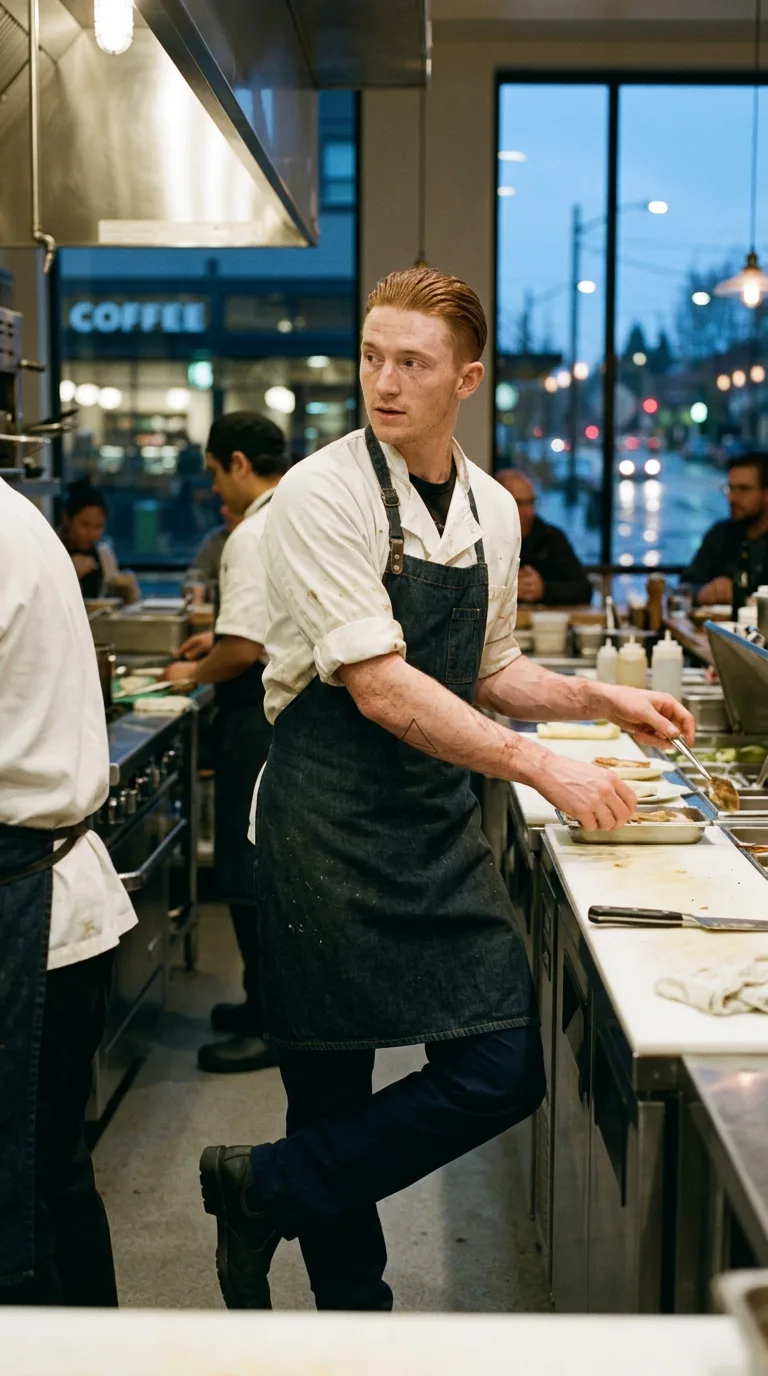
Rarest thing about him: Red — common, 1 in 60
Season 1seed 1520422819 · engine v11
Character card
lineage OZ80W3
His body-swap story
@connor.vasek, wearing Ruben Castellano, rolled the wheel on and woke up as Connor Vasek
---
Three minutes. That's all Ruben Castellano got to be Ruben Castellano before you were sitting inside him again, deciding to leave.
It's not his fault. He's fine — a warehouse body, thick through the shoulders, a goatee that itches against a jaw you didn't grow, blue eyes that aren't watching anything in particular because the loading dock is empty this time of night and there's nothing to look at but a phone screen and a wheel spinning on it. You liked him for about ninety seconds. Then the itch came back, the one that always comes back, the one that has nothing to do with whoever you're wearing and everything to do with the fact that you are always, underneath forty-three men, still you — and the only cure that's ever worked is the spin. Not this one. Never this one. The next one. It is nearly midnight in Boston. Ruben's shift ended an hour ago and he doesn't know that either. You thumb the button before the thought even finishes.
The wheel doesn't ask why. It never does.
The line comes at him — comes at you — in the middle of a motion. A pan of something half-plated, tongs in hand, the tongs closing on nothing because the hand that was closing them a half second ago belonged to somebody who knew exactly how far to reach and you don't, not yet. You correct. Too slow, then too careful, then careful ten more times in a row on a job that stopped needing carefulness years before tonight. Around you: steel, steam, a window full of blue evening and a coffee shop sign glowing wet through the glass, rain doing what rain does in this city, always, politely, without asking. Voices behind you calling ticket numbers in a language your mouth already knows before your mind catches up.
His name arrives the way his name always would, last: Connor Vasek. Twenty-two years old. And you are standing in him at the exact moment his life was doing something it has done ten thousand times, and for one beat it doesn't know you're new.
Then it starts coming in, the way it always comes in — through what he's touching, nothing given free.
The tongs. Cheap, spring worn soft, a nick in the left arm from the time he dropped them into the fryer basket by accident, month two, and Chef Dana didn't even look up, just said get new ones and don't tell me about it. That was the first year he understood that being screamed at and being trusted were not opposites here, that the kitchen loved you exactly as loud as it needed you. You feel the ghost of that pride sitting under his sternum, still warm, two years old and unspent.
The apron strap crosses his chest and gives you denim gone soft and dark at the hem, the leather buckle worn to the shape of his own shoulder, and under it, a whole morning: standing in a studio for the photo they wanted for the wall by the host stand, somebody's assistant fussing with the strap, telling him not to smile so much, and him not being able to help it because Whitney had texted him that morning a photo of her coffee with a heart drawn in the foam and he'd grinned at his phone like an idiot in the mirror before he even left the apartment. Whitney. Eight months now. The ex-wife's name comes up right behind hers, unbidden, the way exes do — Paige, and a year of trying to be older than he was, a courthouse, an apartment split down the dish-towel drawer, nothing dramatic, just two people who married too early figuring out how to stop, quietly, the way you fold a shirt you're not going to wear again. He doesn't think about her often. The shirt on your back right now isn't from that life — it's this morning's, chef whites already going grey with the day's work, sleeves rolled twice because his forearms overheat by six and he learned that the hard way in his first July on the line, sweat in his eyes over a hot pan, and never rolled them down again.
The tattoo on his arm — fine lines, geometric, a shape he picked off a wall in a shop on Capitol Hill because it meant nothing and that was the point, he didn't want a story, he wanted a thing that looked good under rolled sleeves — gives you the sting of the needle, briefly, distantly, three years gone and mostly forgotten except when someone new asks what it means and he gets to say nothing, on purpose, and watch that land.
The floor under his boots, non-slip rubber worn smooth in two footprints exactly shoulder-width apart, gives you five nights a week of standing right here: the burn in his lower back by hour six, the callus on his right palm from the pan handles, the small animal competence of a body that has done this so many times it no longer needs the mind's permission. Twenty-two and already this good with his hands. Freckles he stopped noticing in mirrors around age fifteen, when a girl told him they were the best thing about his face and he decided, generously, to believe her.
The rain outside the window. He likes this city wet. He likes the coffee shop glow through the glass, likes that he can see it from the line, likes — briefly, achingly, a whole unimportant Tuesday surfacing whole — the walk home he isn't going to take tonight, the six blocks, the specific tired that isn't unhappiness.
None of it is much. Nobody's life story ends up in a court transcript. That's exactly why it's good to be standing in it.
You look down. His hands — long-fingered, quick, a chef's callus riding the base of each finger, freckled to the knuckle, a hand that has never once had to think about what it's doing until this exact moment when you make it stop and just look.
You turn it over.
"Huh," you say, to no one, in his voice, which is lighter than you expected, younger, and you lift your eyes off the hand into the pass-through window's steel reflection, and hold there.