Ruben Castellano
Fictional. Generated by AI — not a real person, and no likeness of one is intended.
35, freight handler in Boston · rolled by @connor.vasek · card — no film
History
who has worn him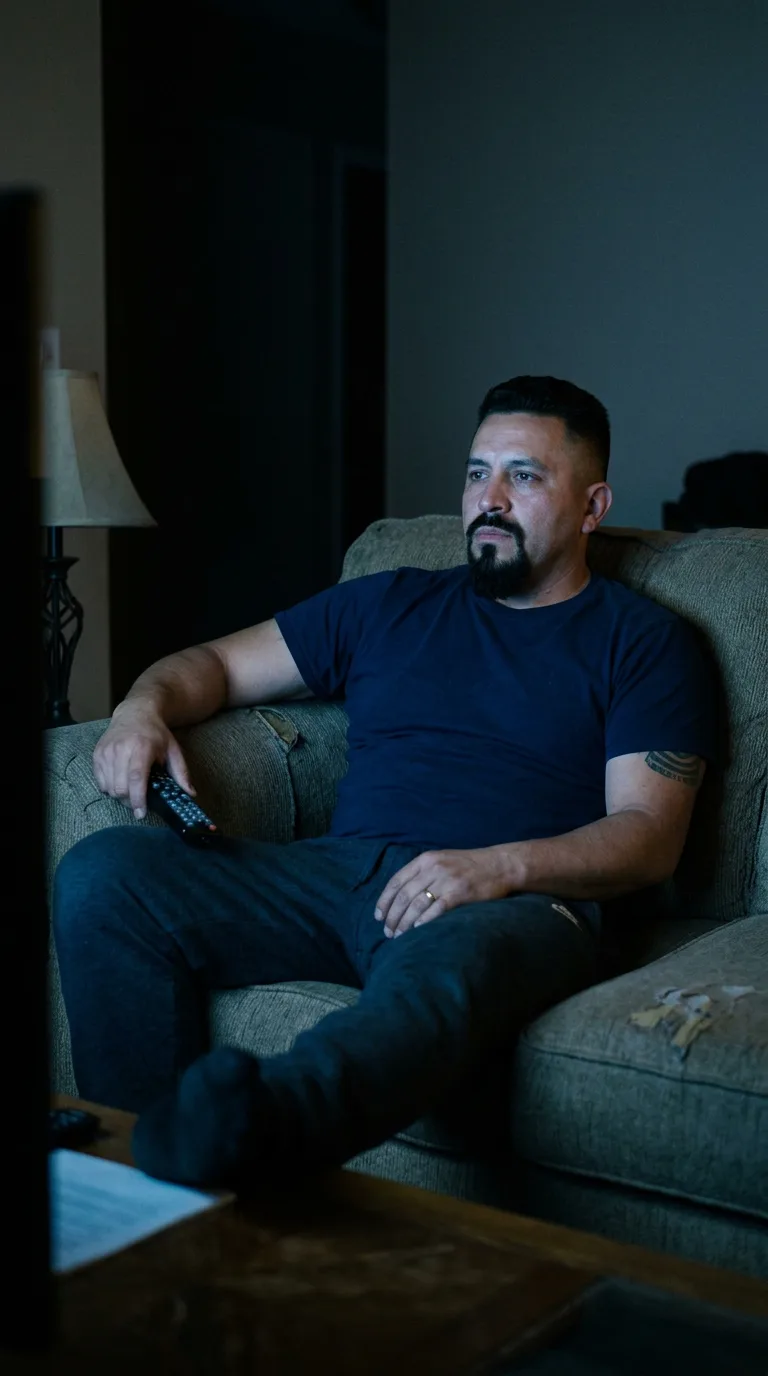
Rarest thing about him: Unitarian or liberal faith — uncommon, 1 in 165
Season 1seed 901015189 · engine v11
Character card
lineage OZ80W3
His body-swap story
@connor.vasek, wearing Colton Vandermeer, rolled the wheel on and woke up as Ruben Castellano, spent 3 minutes in him, then spun the wheel and woke up as Connor Vasek
Colton Vandermeer's condo smells like unpacked boxes even though he's lived here two years. You're the one standing at his window right now, evening pooling gold and flat over the grain elevators, and you're bored in a way that has nothing to do with Colton and everything to do with being him for three days and fourteen hours. He is athletic and easy in his skin, good at charming nervous buyers, and none of it is interesting anymore. You've closed one deal in his voice. You've eaten his food, worn his stubble, run a thumb over his unibrow in the mirror twice, laughing both times. That's the tell. When it stops being strange, it's time to go. You open the laptop already knowing you will. Not sadness, not appetite — just the itch of a name you haven't been yet. You pull up vessel.cards, watch the wheel spin under your — his — hand, and pay for a stranger you cannot see.
The couch takes your weight before you know you have weight. The television throws a hard bright frame and your spine straightens on its own, faster than thought, and a remote control that isn't in your hand a half-second ago is being set down, deliberately, by fingers that already knew where the couch arm was. You are shorter now, denser, a socked foot up on a coffee table edge gone soft with tape residue. The room is dark except for the screen. It is very late. Somewhere under the couch cushion your left hip finds a phone charger cord it has clearly found a hundred times before.
The shirt is what opens first — a navy T-shirt, worn thin at the collar, and through it comes the specific ordinary memory of pulling it over his head this morning at five-forty, the apartment still black, Marisol's breathing steady behind him in the bed, the boy's night-light glowing orange in the hall. Ruben Castellano dressed in the dark so he wouldn't wake anyone, the way he does most days, one arm and then the other into a shirt washed so many times it doesn't smell like detergent anymore, just like him. Sweatpants next, gray, a hole starting at the left knee he keeps meaning to throw out and never does because Marisol says they're the only ones he'll actually rest in.
The couch itself gives up its own year: this is where he falls asleep some nights before he means to, where the girls climbed on him on Saturday mornings before either of them got too old for it, where he and Marisol had an argument about money eight months ago that ended with her hand flat on his chest and neither of them apologizing out loud because they didn't need to. The taped cushion is from the dog they had for eleven years before it died last spring; nobody's fixed it because fixing it feels like admitting the dog isn't coming back to make it worse again.
The remote in his hand carries the whole shift before this moment — not this shift, no, an earlier one, doubled back through years of them: four a.m. alarms, the walk to the T in cold that turns his knuckles white before he even reaches the platform, the warehouse's high dumb fluorescent hum, a pallet jack handle worn smooth in his palms, the particular ache low in his back that never fully leaves anymore, that he has stopped mentioning to Marisol because she worries. His hands know the weight of a box before his eyes finish reading the label. He is thirty-five and his body already keeps a ledger of every year of it — shoulders that pop when he reaches overhead, a knee that complains going down stairs, forearms corded hard under skin that tans easy and never quite loses the warehouse gray-brown of exhaust and dust.
The tattoo comes up through the sleeve memory before the shirt sleeve even covers it now: the insignia on his upper arm, sergeant's chevrons faded to the color of an old bruise, and under it a name he doesn't say out loud anymore, a friend's, from a deployment that ended when he was twenty-four and that he does not watch documentaries about, does not talk about at cookouts, keeps folded the way he keeps the sleeve down over it most days without deciding to.
The wedding band is warm from his own hand, and that opens easiest of all: Marisol at a cousin's quinceañera twelve years ago, her laugh loud enough that he'd turned around before he even saw her face. Two daughters now, seven and ten, whose height he measures in pencil marks on a closet doorframe upstairs. He loves them with an ordinary, complete, unspectacular love that has never once needed examining, and that is exactly what makes it come back so heavy now, all at once, through a plain gold ring: the whole unremarkable weight of a life somebody was living correctly, without asking to be looked at.
He smokes on the porch some nights, the storm door propped with his boot, and vapes in between when Marisol's asked him again to quit and he's trying, badly. That craving surfaces too, small and low, a body wanting something it isn't going to get tonight because tonight it's midnight and everyone else in the triple-decker is asleep.
You sit inside all of it, in the dark, in a stranger's ordinary Tuesday turned near-midnight for no reason he'll ever get to ask about, and the show keeps playing and you do not laugh at the part that must have been funny before, because you don't know yet what he found funny, and that not-knowing is its own small, quiet proof that you are new here.
You lift the hand with the ring on it and turn it over in the TV light, knuckles, callus, the pale ring-line under gold, like it belongs to someone you're still being introduced to.
You look up into the dark room, past where a screen would be if this were being watched, and you say, low, almost to yourself: "Okay. Let's see how long you last."