Colton Whitfield
Fictional. Generated by AI — not a real person, and no likeness of one is intended.
26, sheriff's deputy in Eastern Kentucky · rolled by @connor.waskiewicz · card — no film
History
who has worn him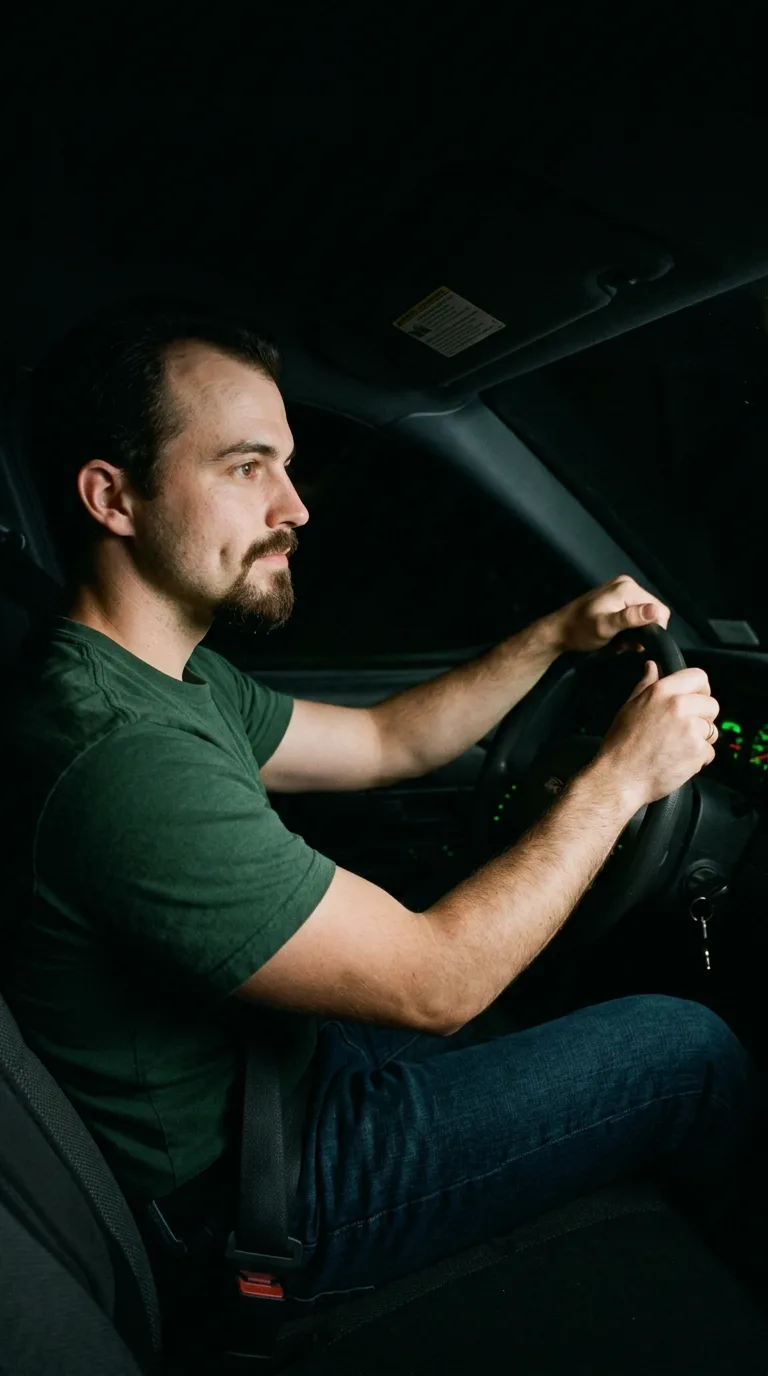
Rarest thing about him: February 29th — epic, 1 in 1,542
Season 1seed 451924302 · engine v11
Character card
lineage 2NZHHJ
His body-swap story
@connor.waskiewicz, wearing Kai Furtado, rolled the wheel on and woke up as Colton Whitfield, spent 1 minute in him, then spun the wheel and woke up as Gerald Poehlmann
The delivery bag is still on Kai Furtado's shoulder when you decide, standing in the elevator of a Honolulu walk-up with the smell of someone else's garlic chicken souring the plastic. It's not the shoulder that's wrong, exactly — it's the six flights, the tip that didn't come, the white streak in the beard catching the fluorescent light in the mirrored panel like a warning label. You have had this dad-bod thirty-four-year-old kindness for less than a minute of feeling him properly settle into the meat of him, and already you know the shape of the rest of Kai's night: setting the bag down, sitting on the edge of a bed that isn't yours to be tired in, doing this again tomorrow. It's not misery. It's just Tuesday, forever, in a body built for it. You want out before you've finished wanting in.
You take the phone out. Vessel dot cards loads the way it always does, patient, gray, the wheel already spinning behind the login like it never stopped. Nine hundred and sixty-eight men behind you, and none of them ever felt like a decision so much as an itch. You pay. You spin.
—
The wheel stops on a highway that doesn't exist yet for you, and then it does: dark two-lane, trees pressing close on both shoulders, a dashboard glowing up into a jaw you don't own. Your — his — hands are at ten and two. The seatbelt is snug over a chest that breathes different than Kai's, tighter, younger, no give in it. A ring is cold on the left hand at ten o'clock. Three miles from home, though you don't know that yet, you only know the road unspools the same as it must have every night for years, and something in the muscle memory of the arms wants to keep it unspooling.
You let the car drift a foot toward the center line — not your intention, just the settling of new weight into an old grip — and then pull it straight in one motion that feels like apologizing to no one. Both hands come off the wheel and go back on, lower, wider, the way hands go when the person driving has stopped being entirely sure of the errand. The turn signal clicks on. Left. For a exit that, you will learn in about four seconds, belongs to a Baptist church and a boat ramp and nothing else this man has ever needed at this hour.
He does not wake up to notice. There was no waking to begin with. There is only now, and now is yours.
—
The shirt is what opens first — the collar against a shaved neck, the two chest pockets, the small hard rectangle of a nameplate pinned crooked because his wife re-pinned it that morning while he was still chewing toast, laughing at something the youngest one said about the dog eating a sock. Colton. Deputy Whitfield. The tan poplin remembers itself: 5 a.m., the closet with the too-loud hangers, three kids' worth of noise already going in the kitchen, and him standing in his boxers turning the shirt right-side-out, one arm in, feeling the old ache in his left shoulder from softball wake up like it does every single morning of his life, a small tax he pays for being twenty-six years old and having played too much of it too hard too young. He rolls it. He always rolls it. The sleeve short and snug on a bicep that is a working man's bicep, not a gym one — hauling a spare tire, hauling a deer, hauling the middle kid onto his shoulders at the fair.
The belt is next, and it is heavy the way it is always heavy, the leather worn soft in the places his hip rubs it a hundred times a shift, and there's a memory in the weight of it: qualifying day at the range four years back, his hands sure on the grip already because his daddy had him shooting cans off a fence post since he was nine, and the instructor saying something about natural aptitude that made him duck his head because Colton has never once in his life known what to do with a compliment straight to the face. The dimples give him away every time anybody tries. He's never been able to look stern for longer than a stopped car's worth of a lecture before some fool cracks a joke and there they go, deep as thumbprints, undoing the whole uniform.
The wedding band is the loudest thing in the room, though it makes no sound at all. It comes with an aisle in a white clapboard church up past the Hazard road, and her face, and the reception where her daddy shook his hand too long and too hard, sizing him. It comes with all three kids at once, unfairly, stacked on top of each other — the hospital corridor smell, a nurse's voice, his own face wet with something he didn't examine at the time because there wasn't a version of him raised to examine it. It comes, too, with a name that isn't his wife's, that he does not let himself think except in the specific hour of specific nights, a name attached to a laugh from a decade back, a truck bed, a summer that ended the ordinary way summers end for men who marry the girl their whole town expected them to marry. He loves his wife. That fact sits next to the other fact, unresolved, the way the two front seats of the cruiser sit next to each other without touching.
Under it all, the body: twenty-six, athletic, a hairline already retreating like it's got somewhere better to be, and he has made peace with that the way he makes peace with most things, sideways, with a joke first. The goatee he grows because it distracts from the hairline and because she likes it against her neck. Feet that know the exact give of a cruiser's floor mat, hands that know the exact heft of a flashlight, a body that has hauled a man twice its size off a porch in Perry County and felt more scared after than during. Comfortable, not rich. A house with a cable footbridge two hundred yards off that the kids aren't allowed to cross alone yet. A faith that isn't performance, that he actually means, most days, and that makes some of the other thing sit heavier than it would on a man who didn't.
The dash glow is on your knuckles now, his knuckles, and three miles from a driveway with a porch light his wife leaves on, the road bends the way it always bends, and none of it — not one mile of it — is yours yet, except that it is, completely, the second you stop calling it borrowed.
—
You look down at the hand on the wheel — not Kai's, not the delivery bag's, this one, ringed, dimpled scar-free knuckle, twenty-six years of Kentucky sun already starting a farmer's tan at the wrist despite the desk-adjacent nature of half the job — and you turn it over slow in the dashboard light like you're checking it for a leak.
"Well," you say, out loud, to the empty cab and the church-and-boat-ramp exit sliding past unclaimed, your voice coming out lower than Kai's, southern in a way your mouth hasn't been in years, "guess I ain't going home tonight."
You reach over and click the signal off.