Colton Braswell
Fictional. Generated by AI — not a real person, and no likeness of one is intended.
23, delivery driver in Houston · rolled by @connor.waskiewicz · card — no film
History
who has worn him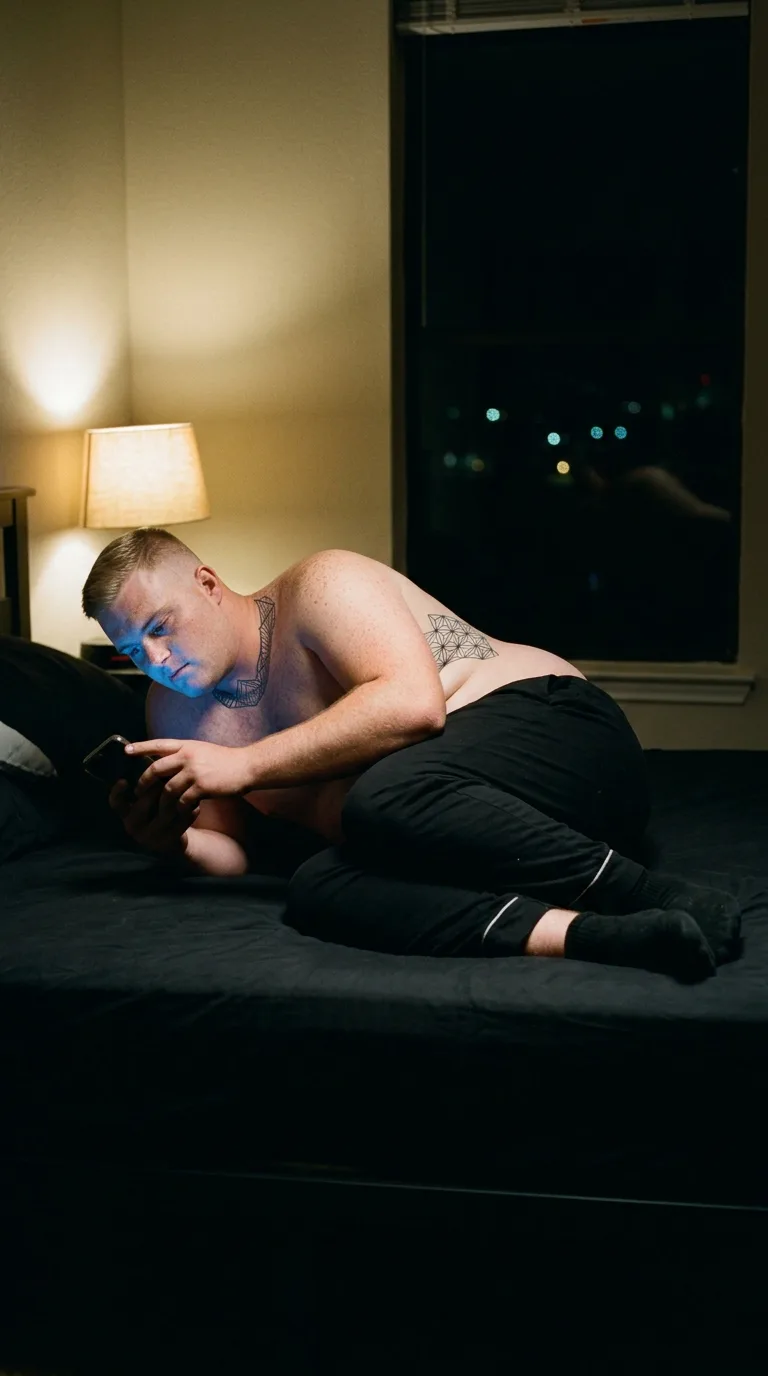
Rarest thing about him: Back piece — common, 1 in 80
Season 1seed 1522333477 · engine v11
Character card
lineage 2NZHHJ
His body-swap story
@connor.waskiewicz, wearing Gary Suchecki, rolled the wheel on and woke up as Colton Braswell, spent 17 minutes in him, then spun the wheel and woke up as Reginald Achebe
You are Gary Suchecki for less than a minute, and already the ceiling of his bedroom is wrong — too low, water-stained in the corner above the dresser, the exact stain you noticed the first time you took him and never once since, because Gary does not look up. Gary looks down. Gary has spent thirty years learning to look down, at case files, at ankle monitors, at the particular hopeless tilt of a nineteen-year-old's head across a metal desk, and being him has felt, for eleven months of your time, like wearing a coat somebody else sweated through. The stubble itches. The knees ache going down stairs. He wakes at eleven a.m. some days because he worked a double, and lies there hating the light. You did not choose him for love. You chose him because the wheel gave him to you and there was something to finish in that little Ohio house, and now it's finished, and the phone is on the nightstand where his hand — your hand, for one more breath — is already reaching, because boredom in a body is still boredom, and boredom is the only thing that has ever reliably sent you back to the site.
The page loads the way it always loads: patient, cheap-looking, a wheel that does not need to dress itself up for what it does.
You spin.
And you are on your side in the dark, heavy in a way Gary never let you feel heavy, a phone six inches from a face that has freckles across it — you can feel them without seeing them, a texture under the light — and the thumb that was slowing down, that was about to give up and put the phone face-down and sleep, picks back up. Faster. Steadier. Not stopping on anything. Blue light lies along one cheekbone and does not move when you don't blink, and somewhere behind you a window holds a smear of gas-station green and a parking-lot orange, too many small lights for a bedroom in a town that sleeps at this hour, which means it isn't sleeping — which means whoever this is came home from somewhere at a wrong angle to the night.
He did. Colton did. Delivery route ran until almost two, a Friday route stacked with Amazon overflow because two guys called out, and he got home and didn't have it in him to shower, just shed the polo and the belt with the handheld scanner still clipped to it and dropped face-down on top of the comforter in his work shorts, and that's the sock still on one foot, mid-calf, ribbed, damp. The other foot is bare. That's the first thing that comes through, off the sheet against your — his — bare shin: the specific relief of finally sitting down after nine and a half hours of stepping in and out of a van in Houston heat, the driver's seat shaped wrong for a body this size, the small brutal comedy of the AC dying in July for the third time that summer.
The shirt is on the floor, not on you, but your palm remembers it anyway from the last time it touched skin — brown cotton, company-issued, a size too honest about what it clings to — and putting it on this morning comes back whole: standing in front of the mirror at five-forty a.m., pulling it down over the ink first, the fine geometric lines that start at both shoulders and disappear under the collar, four sessions over two years, money he didn't tell his mother about, and the particular vanity of checking that the top edge of the piece still showed a little at the neckline before he decided he didn't care either way. Freckles under the bathroom light. The clippers buzzing the sides two days ago at the barbershop on Bellaire, the guy joking about how blond hair shows every grain of stubble on the shave and none on the head, Colton laughing because he liked being touched by someone paying that kind of attention. Clean jaw. He shaves every day even though nobody's checking, an old habit from a boyfriend two years back who liked it that way, and the boyfriend is gone and the habit outlived him, which is its own small joke Colton makes to no one.
The scanner on the nightstand, cool plastic, brings the loading dock at four p.m., the AC in the warehouse worse than the van, the foreman's clipboard, three hundred stops on a Friday and his feet already screaming by stop forty. Brings the van itself, back doors open in a strip-mall lot at dusk, heat coming up off asphalt in a shimmer, boxes stacked to his chin, the particular full-body satisfaction of muscle doing what it's built to do even when the body carrying it gets called things behind its back by guys half his size. He is strong under the weight. He has always been strong under the weight; heavy since fifteen, and strong since about the same age, and those two facts sit together easier in him than most people assume.
Nothing here about anyone waiting for him. No ring, no ex who calls, no one who'll notice the light on this late except maybe a neighbor. Twenty-three and single and fine with it, mostly, scrolling men on an app at midnight the way you do when the shift ends too wired to sleep and too tired to do anything about it — bites at the edge of his thumbnail between swipes, has since he was a kid, worries it down past comfortable, a habit his mother used to smack his hand for and gave up on by the time he was ten.
Twenty-five to seventy-five thousand dollars sits somewhere in an account he doesn't check often enough, saved without a plan, just the reflex of a kid who watched his father go broke once and decided never again. No church, no grip on anything past this room and this phone and this job. A beer with coworkers on a Saturday sometimes. That's the whole shape of him, and it is, you understand now, a small and complete life, the kind you don't get sent back to the wheel over — the kind somebody else might have just stayed in.
You stop the thumb. You bring the hand up in front of the face, slow, and look at it in the phone's blue light — thick fingers, a bitten nail on the index, a callus at the base of the thumb from nine and a half hours of a scanner grip — and it is not a hand you have ever worn, and you turn it once, palm to knuckle, the way you always do, the way you did the first time, the nine-hundred-and-somethingth time now meaning nothing at all to the wanting.
You lift your eyes to the black rectangle of the phone's camera, glass gone dark, and you say, to no one who will ever hear it as him:
"Didn't even feel that."
Then the thumb starts moving again.