Gary Suchecki
Fictional. Generated by AI — not a real person, and no likeness of one is intended.
44, probation officer in Small-town Ohio · rolled by @connor.waskiewicz · card — no film
History
who has worn him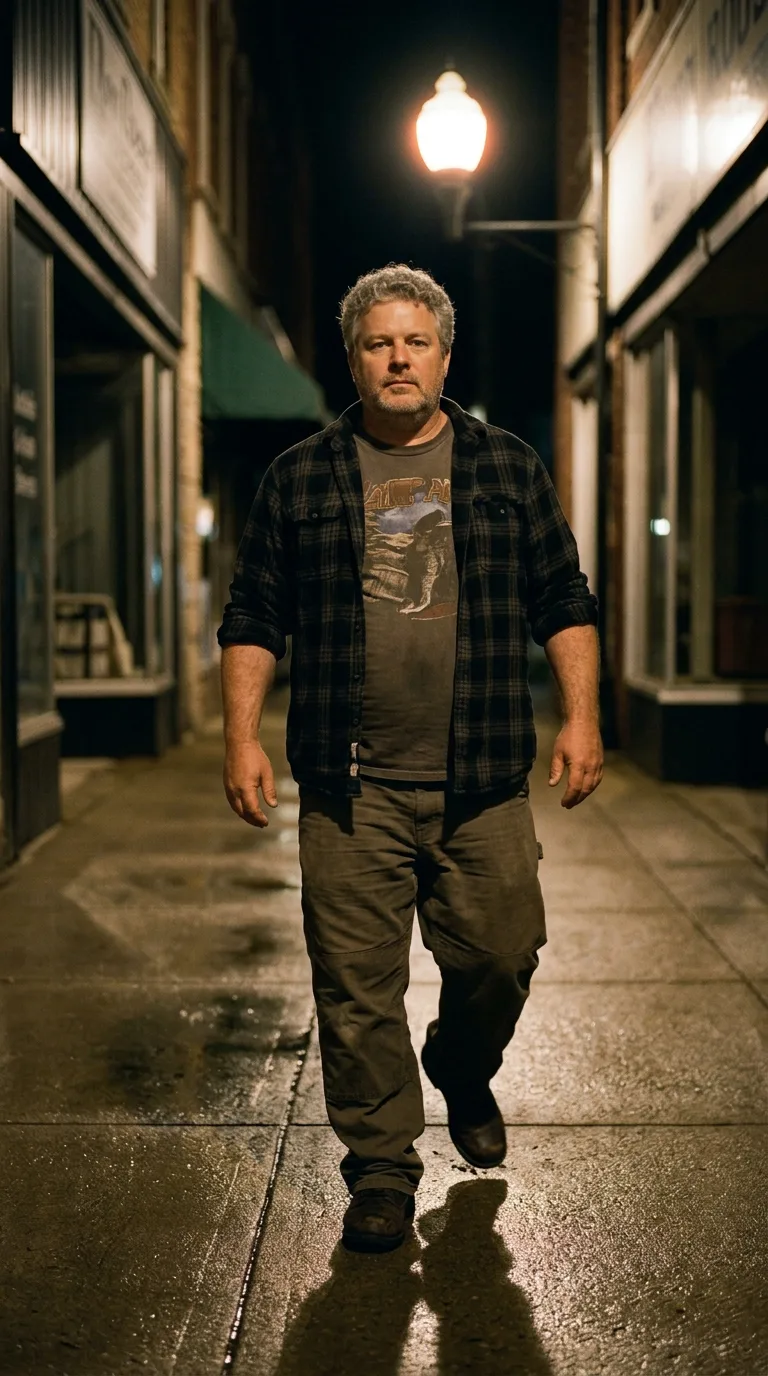
Rarest thing about him: Probation officer — uncommon, 1 in 2,438
Season 1seed 898207167 · engine v11
Character card
lineage 2NZHHJ
His body-swap story
@connor.waskiewicz, wearing Patrick Sullenberger, rolled the wheel on and woke up as Gary Suchecki, spent under a minute in him, then spun the wheel and woke up as Colton Braswell
Patrick Sullenberger has been you for forty seconds and already the kitchen smells wrong — bleach and browned garlic, somebody else's Thursday dinner rush still on him, ticket printer chattering in the next room like a headache with a pulse. Your hand, his hand, is on the office door. Behind it: a schedule you didn't write, a walk-in fridge that's five degrees warm and about to become somebody's problem, a night that stretches out flat and known and finished before it starts. That's the thing about a body on its forty-first second — you can already see the whole shape of tomorrow in it. You spun for this fifteen minutes ago because the manager before him bored you inside of a week, and this one is already showing the same seams. The wheel is one tab over. You go back to it not because anything is wrong, only because nothing is, and the site is patient, and so, tonight, are you.
The wheel turns and gives you Ohio.
You catch a parked car that isn't yours to catch, palm flat on cold wet metal, and the scuff of a dragging shoe simply stops happening. Forty steps come after that, even, unhurried, a body's weight settling into itself the way a truck settles onto its springs. Heavy through the middle, solid through the legs, boots you didn't lace tonight already broken in around your feet like they've been there for years. At the corner you turn left. Somewhere under this skin a mouth still full of last call's bourbon isn't asking why.
The jacket is a flannel, unbuttoned, damp at the shoulders from a rain that's already quit, and the second your arms register its weight, something comes back that isn't yours: standing in front of a dresser mirror seven hours ago, cursing this same shirt for shrinking, pulling it on anyway because the good one was in the wash. Under it, the shirt — an old concert tee, soft as a rag from a hundred washes, a desert scene half-cracked off the cotton — and touching it gives you a stretch of years rather than a night: a friend, dead now, who drove nine hours to that show; a truck with a bad clutch; the particular ache of being twenty-two and thinking you had all the time there was.
The cargo pants are heavier, current, and they open a different door. Not memory so much as habit: a badge clipped where your hip expects it and isn't there tonight, a manila folder that isn't in your hand right now but has been in it ten thousand times, the exact practiced weight of it against a ribcage while you knock on somebody's door at nine in the morning and try to look like you're not about to change a man's whole week. Gary Suchecki, probation, six years in this county after four in Franklin doing the same work for worse pay. You feel the stoop under a phantom boot — paint peeling, the particular give of a second step that's been loose since before he took the job — and a woman's voice through a screen door, not unkind, saying *he's not up yet* in the tone of a woman who has said that sentence to men like you for a long time.
The boots are the loudest thing on him. Leather gone soft and dark at the crease, resoled twice, and standing in them gives you the whole unglamorous arithmetic of the body: forty-four years old, five-eight, built wide rather than tall, a lower back that announces itself getting out of the car, knees that know weather before the weather arrives, forearms still strong from nothing in particular — closing filing cabinets, hauling a mower, splitting wood he didn't need to split. Good hands. Blunt, scarred only by ordinary years, and right now empty, and wanting, without being asked, something to chew — a toothpick that isn't there, a habit so old it survives even this.
Somewhere in the jacket pocket, fingers you're borrowing find a photograph he carries and forgets he's carrying — a woman, laughing at something off to the side, a diner booth behind her that closed two years ago on this same street. Touching the corner of it gives you an ache that isn't dramatic, just permanent, low and familiar as the ringing in a bad ear: her name was Dana, she left for Columbus, she's fine, he's fine, neither of those facts helped. He drinks on nights like this one because of her the way a man favors a bad knee — not thinking about it, just walking differently. Two, maybe three times a month he does exactly this: closes the bar down, walks the long way, doesn't examine why.
At the corner the streetlight throws your shadow long and doubled against wet brick. The stoplight up ahead cycles red to green to red for nobody. Somewhere in this town it's the deepest part of Friday morning; somewhere in the body you left it was barely Thursday evening — a manager clocking a double shift with no one now behind his eyes to mind it, and the gap between those two clocks sits in your chest like a held breath, not wrong exactly, just wide.
You stop walking. You bring both hands up in front of your face, and they are not the hands you had forty seconds and nine hundred and forty-nine men ago — thick-knuckled, cold, a white scar of old callus along the first finger from a lifetime of paperwork.
"The hell," you say, out loud, to the empty street, in a voice you've never used before and already know a little — Gary's voice, gravel-soft, the voice of a man who talks people down for a living and is, for once, talking to no one at all.
You keep walking. Not home. Somewhere.