Colin Harmon
Fictional. Generated by AI — not a real person, and no likeness of one is intended.
30, nursing assistant in Nashville · rolled by @glenn.aldercy · card — no film
History
who has worn him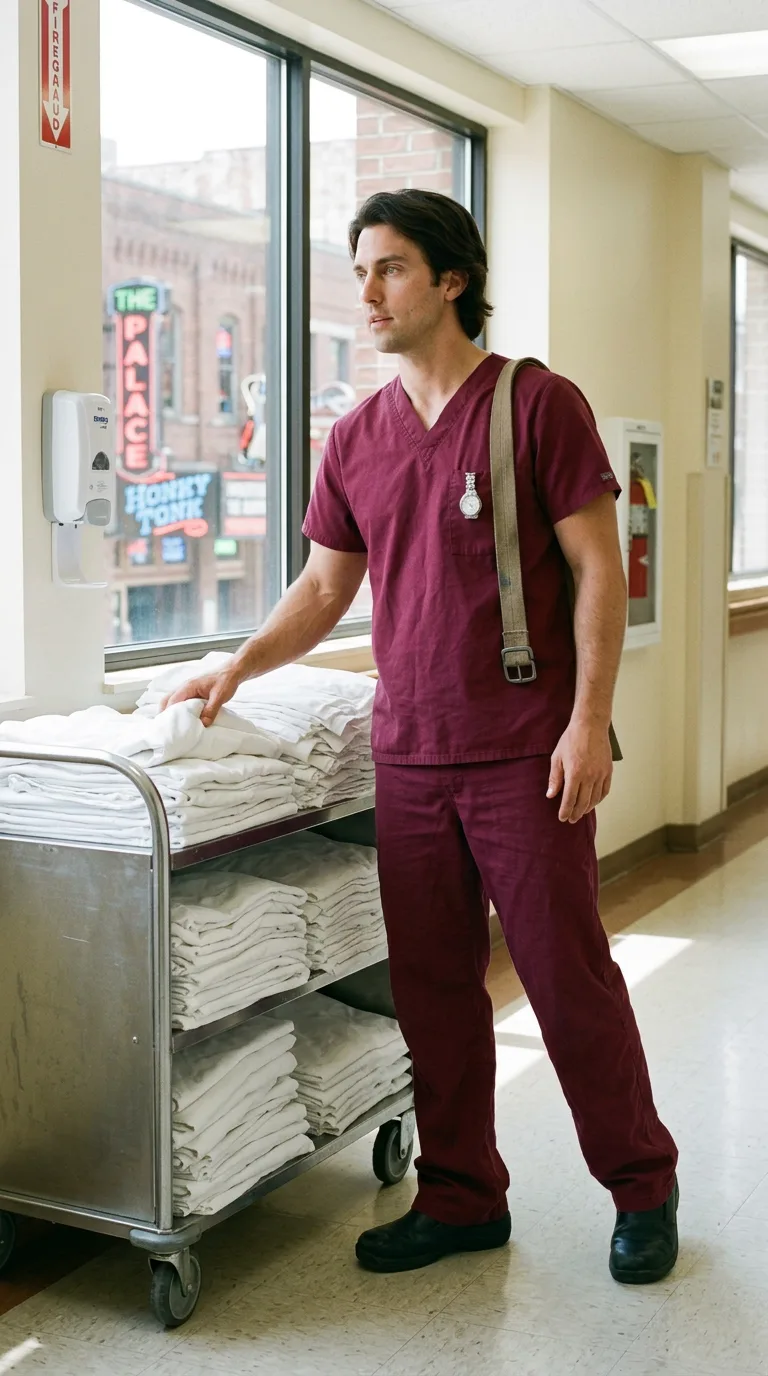
Rarest thing about him: Nursing assistant — common, 1 in 466
Season 1seed 1599973641 · engine v11
Character card
lineage EU5SNZ
His body-swap story
@glenn.aldercy, wearing Ernesto Cabazos, rolled the wheel on and woke up as Colin Harmon, spent under a minute in him, then spun the wheel and woke up as Brady Holcomb
The recliner is Ernesto's, and the Sunday light through his living room window is Ernesto's too, thin and gray-gold the way Ohio does it in whatever month this is. You've had less than a minute in this body and already you know its complaints: the knee that clicks going down stairs, the gut that sits low and soft over the belt, the goatee that itches when he's nervous, which he is not, because Ernesto doesn't get nervous. Ernesto gets bored. That's the whole trouble. You spun him up eighteen men ago wanting a rest — a body that wouldn't be asked to run anywhere, a house that was paid off, a dog that was already fed. You got all of it. You have been sitting in this recliner for what feels like eleven months and was actually forty seconds, and the television is showing a rerun of a show Ernesto has already seen, and his phone is face-down on the armrest, and there is nothing in this room that wants anything from you. You spin again not because this life is bad but because it is finished — you have already felt everything it has to offer, and it offered it to you in about the time it takes a kettle to boil. The site is still open in the next room on a laptop you didn't close. You get up, Ernesto's knee clicking its one complaint, and you go back to it the way a man goes back to a vending machine that has never once given him the wrong thing.
The wheel spins. It does not ask what you are leaving. It only ever answers what's next.
—
You are standing in a hallway that smells like bleach and overcooked green beans, under fluorescent light so white it has no temperature at all, and your hand is on a stack of folded sheets. Your hand. Smaller than Ernesto's, the knuckles leaner, the nails cut close and clean the way the job requires. There is a watch pinned upside-down to your chest, ticking against something that is not your heartbeat yet. For half a second the hand does the wrong thing — it goes to lift the top sheet off the cart at the wrong angle, catches, corrects, lifts it right. Then another. Then ten more, each one checked, counted, as if the body is making sure of itself for the first time in years. Through the window beside you, red and green neon is fighting the daylight on a honky-tonk sign across the alley, losing, the way it always loses when the sun's actually up. Nobody in the hallway notices a nursing assistant pause mid-fold. Why would they. He's done this ten thousand times.
—
The sheet against your palm is rough-soft, industrial cotton gone thin from a thousand washes, and it opens like a door. You are twenty-two and this is your first week, and you fold a sheet wrong in front of a charge nurse named Denise who doesn't yell, just refolds it herself without a word, which is somehow worse, and you go home and practice folding towels on your own bed until your roommate tells you to cut it out. That's the shirt doing it, really — the maroon scrub top, sun-faded at the shoulders where you carry things, soft the exact way three years of this exact shirt gets soft, and it gives you the morning you put it on today: pulling it over your head in a bedroom with the shade still down, humming something country and tuneless because the radio alarm had already clicked off, dimples showing in the bathroom mirror at nothing in particular, because they always show, because your face does that without being asked. You remember being a kid and hating being told you had a nice smile, wanting instead to be told you were strong, fast, useful — and then growing into a body that turned out to be all three and the dimples never left anyway.
The belt with the watch clipped to it crosses your chest diagonally, and it remembers four years of this job in the weight of it: the watch that your grandmother gave you when you got your CNA certification, pinned to a scrub top because you refuse to wear it any other way, because she was the one who drove you to the testing center and sat in the parking lot the whole three hours rather than go home. She's gone two years now and you still go to Mass some Sundays, not every Sunday, because the shifts don't always allow it and because you've never fully decided if that's an excuse or the truth. You are thirty and single and it doesn't weigh on you the way people think it should; there was a woman two years ago who said you worked too much and wanted too little, and she wasn't wrong, and you let her go without much of a fight because the fight would've cost more than the loss did.
Your shoes — black, flat-soled, gone soft in the arch from years on linoleum — remember the specific ache that lives in the balls of your feet by hour six of a double, an ache you've stopped calling pain because it's just Tuesday, just Sunday, just whatever day has a number on the schedule. Your forearms, lean and corded under skin that tans easy and never really burns, know the exact amount of lift it takes to turn a resident in bed without hurting either of you, know it the way other men know how to drive a stick — nobody taught you the thought, just the motion, over and over until the motion was the thought. Your jaw is smooth because you shaved forty minutes ago in a mirror fogged from the shower, razor pulled in the same four strokes you've used since you were sixteen, and the skin under your palm when you touch your own cheek now is faintly tender in the good way, freshly bared.
Behind you down the hall a call light is blinking outside a door, patient, unbothered, the kind of blink that means someone needs water and not an emergency, and you know this because your body has learned to read the difference the way it learned everything else here — through repetition, through caring whether you wanted to or not. There is no one waiting for you at home tonight except maybe nobody, and that used to feel like a lack and mostly now just feels like Sunday.
—
You look down at your hand on the sheet, turn it, watch the tendons shift under skin that's thirty years younger than the one you walked in with an hour and a world ago. The watch ticks against your sternum, small and borrowed and not yours and entirely yours now. You lift your eyes off your own hand into the window glass, where your reflection's dimples sit there doing nothing and showing anyway, and past it the neon sign flickers red through the daylight like it's trying to prove something nobody's asking it to prove.
"Okay," you say, to the hallway, to nobody, to the ten more sheets still waiting on the cart. "Let's go."