Brady Holcomb
Fictional. Generated by AI — not a real person, and no likeness of one is intended.
33, teacher in High-desert Nevada · rolled by @glenn.aldercy · card — no film
History
who has worn him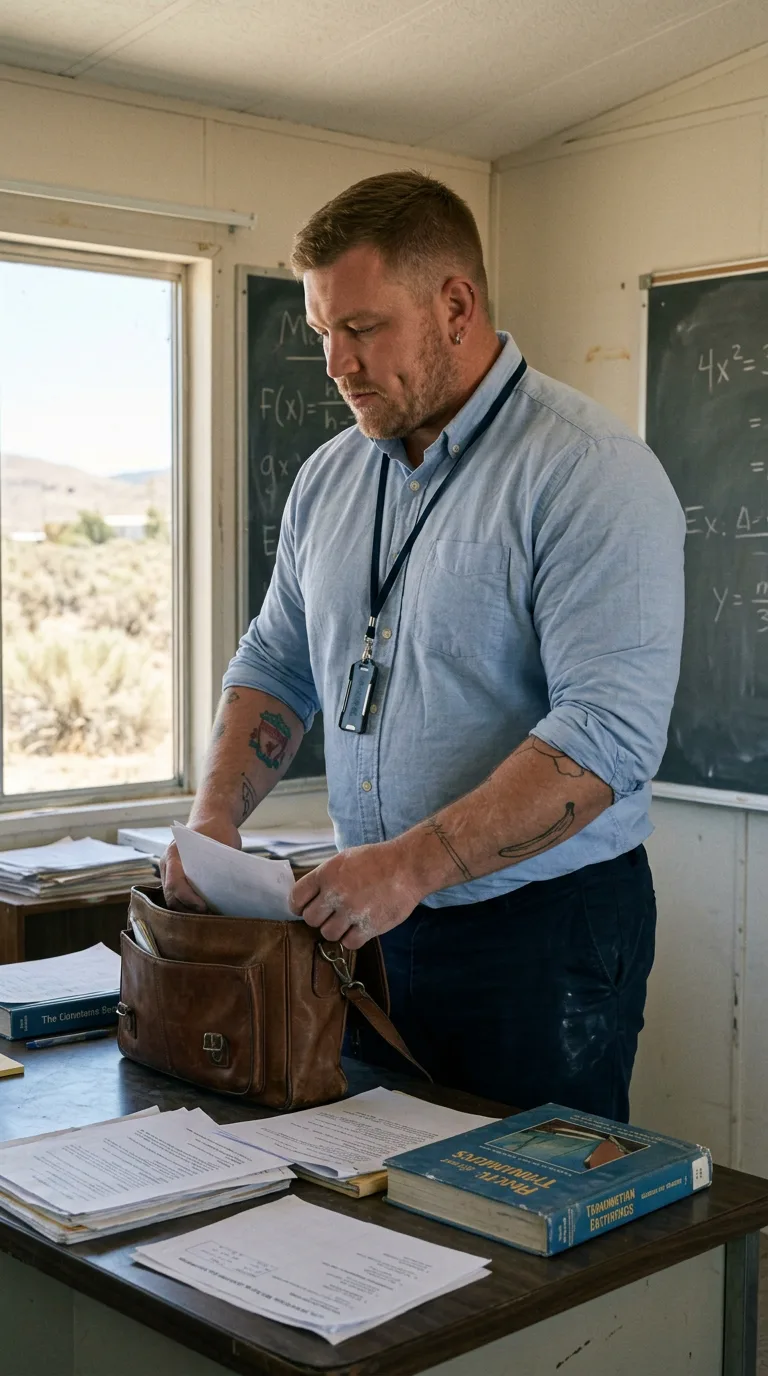
Rarest thing about him: Sports team — common, 1 in 67
Season 1seed 118336937 · engine v11
Character card
lineage EU5SNZ
His body-swap story
@glenn.aldercy, wearing Colin Harmon, rolled the wheel on and woke up as Brady Holcomb, spent under a minute in him, then spun the wheel and woke up as Glenn Aldercy
---
Colin Harmon's apartment smells like dryer sheets and the particular staleness of a Sunday that has already decided nothing is going to happen in it. You stand at his kitchen counter in his body, thirty years old, hazel-eyed, the dimples sitting there in the mirror-reflection off the microwave door even though you are not smiling, and you are bored in a way that has a texture to it, like a scab you want to pick. You spent eleven hours last night turning this man, suctioning lines, charting vitals, holding an old woman's hand while she asked you, in the voice of somebody else's grandmother, whether her son was coming. You did it well. Colin does it well, has done it well for years, his hands already knew the tape and the IV pole and the practiced gentleness before you ever arrived in him. That's the trouble. It is his. You are thirty-nine minutes off shift and already restless with a competence that was never, not once, a decision you made. You want something unspent. You open the laptop on his kitchen table — his login autofills, muscle memory in a browser — and you go to the page with the wheel on it, and you pay, and you spin, telling yourself it is only curiosity, the way you have told yourself eighteen times before.
The wheel stops.
You are standing over a bag.
Weight comes first — more of it than Colin's, settled low and solid through the gut and the shoulders, a body that has carried itself a long way without complaint. Light comes second, hard desert light cut into slats by a venetian blind, falling across a leather satchel gone soft and dark at the corners. Your hands — his hands, thick-knuckled, a faint white dusting of chalk already ground into the creases — are inside the bag, mid-motion, sliding a paper into a side pocket it does not belong in. The motion stutters. You feel it stutter, feel the half-second where the wrist does the wrong thing and the paper creases wrong, and then — without you asking it to — the hand corrects, slides the paper out, refolds it, puts it in right. One correct motion. Then another. Then ten more, each one checked, each one deliberate, a task that has not needed thinking about in years suddenly being thought about by somebody who has never done it before. Outside the window, sagebrush and hard blue shadow and a mountain with snow on it even though it's May.
That's when the room starts talking to you through your own skin.
The lanyard around your neck is the first thing — a thin nylon strap, a laminated badge turning cool and then warm against your (his) sternum — and it opens on a Tuesday in August, fluorescent light, a woman in the front office handing it to him and saying *welcome to the district, Mr. Holcomb*, and the small, private pride of that, the kind you don't tell anyone about because it would sound like nothing. Brady Holcomb. Thirty-three. Teaches math to eleven kids in a trailer with blocks under it because the real school burned wiring two winters back and the county hasn't found the money since. He loves it in a way that embarrasses him. He prayed about taking the job, actually prayed, kneeling by the bed the way his mother taught him, and the answer that came back wasn't words, just a feeling like a hand on the back of the neck, steady, *go*.
The satchel strap under your palm gives you the drive out here this morning — forty minutes of two-lane road, sun already murderous at nine a.m., gospel radio low because the signal drops in and out past the second cattle guard and he likes having something on anyway. He is not tired the way the hour would suggest he should be; there's no graveyard shift in this man's life, no adjustment to make, just an ordinary Sunday morning spent catching up on grading before the week starts, because weekdays don't leave room and he doesn't like falling behind the kids who are already behind enough.
The shirt — pale blue oxford, sleeves rolled twice at the forearm — gives you the closet it came from, a single-wide trailer with a step down to hard-packed dirt, the hanger it hung on, his girlfriend Dana's voice from the next room this morning saying *you're not actually going in on a Sunday* with no real complaint in it, just the shape of an old argument worn smooth. You feel, distantly, warmly, what he feels when he thinks of her — not heat, nothing urgent, just a kind of ease, a future assumed rather than discussed. The small silver hoop in your left ear is cold and then isn't; it came from a dare at twenty-two, outlasted the friend who dared him. The tattoos on your forearms — the crest, the others — are older, half-remembered nights, a version of him that laughed louder and slept less, before the degree, before the trailer-classroom, before he decided what he was for.
Your lower back aches, low and familiar, the particular ache of a heavy-built man who stands at a whiteboard six hours a day. Your knees know the three steps up into this room without looking. Your forearms are strong from nothing more dramatic than chalk and paperwork and carrying boxes of textbooks that are older than some of his students. None of it hurts exactly. All of it is used.
Under your hand, the satchel's buckle. Under that, his whole unhurried Sunday — the quiet he'd built on purpose, the one he was about to spend on fractions and prayer and a girlfriend two miles down the road — folding up and going still, like a held breath nobody told him to hold.
You stop. The paper is in the right pocket now. The room is very quiet — a trailer, a desert, a Sunday, no students, no bell.
You look down at your own hands — his hands, blunt and sun-browned, chalk in the creases, strong — and turn them over once like you're checking them for damage.
"Okay," you say, out loud, to no one, in a voice that isn't yours yet and already is. "Let's get through these."