Colby Anselm
Fictional. Generated by AI — not a real person, and no likeness of one is intended.
29, water treatment operator in Atlanta · rolled by @marco.villagrana · card — no film
History
who has worn him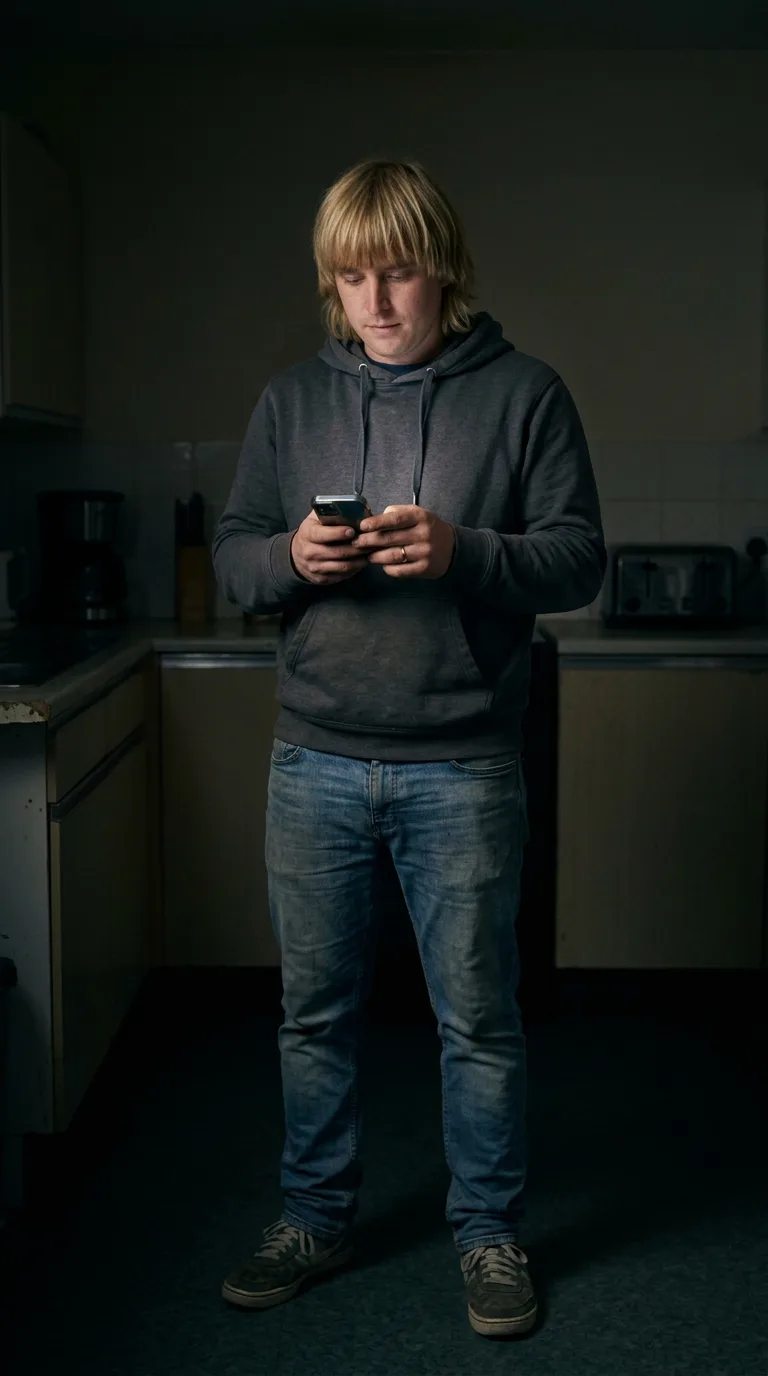
Rarest thing about him: 5'3" or under — rare, 1 in 69
Season 0seed 613562553 · engine v10
Character card
lineage LJL8SV
His body-swap story
@marco.villagrana, wearing Andrés Solano, rolled the wheel on and woke up as Colby Anselm, spent 3 minutes in him, then spun the wheel and woke up as Brett Sowinski
Three minutes. That's all Andrés Solano got to be his own man before you climbed into him at a dig site outside Miami, and now the sun's going down on a day he didn't get to have. You're standing in his kitchenette, his kitchenette, with a beer he opened sweating on the counter, and you already know you're leaving. Not because the body's wrong — it isn't, it's warm and solid and there's a nice ache in the shoulders from real work, work you didn't do — but because three minutes was enough to feel the whole rest of it coming: bone reports, grant emails, a dissertation chapter due to somebody who isn't you and never will be, no matter how long you sit in the chair. You didn't take him to write footnotes. You open the site on his borrowed phone with his borrowed thumb, and the wheel is already loading before you've admitted to yourself why.
The card that comes up doesn't matter yet. What matters is the drop, the half-second nowhere, and then —
The kitchen is dark and it smells like somebody's been cooking onions two nights ago and hasn't run the fan since. Your thumb is still up off the glass, a habit stopped mid-gesture, hovering the way it does when a number on a screen is bigger than a mortgage payment. Below you the price sits there, unbought, and the phone is already turning itself face-down against the counter under a hand that used to be yours a heartbeat ago. The hand sets it down. The hand does not pick it back up. You feel the counter's cheap laminate edge digging faint and cool into a hip you didn't choose, the give of old sneakers on cracked linoleum, the particular smallness of standing five-foot-three inside a kitchen built, like most kitchens, for someone taller.
The hoodie is what talks first. Fleece gone thin at the elbows, a drawstring that's lost its little plastic tips, and with it comes a whole morning: pulling it over his head in a bathroom with the fan broken, the mirror fogged from someone else's shower, his wife already gone to drop their kid at daycare so it's just him and the quiet and the particular ritual of getting dressed for a job that starts with fluorescent light and ends with the smell of chlorine that never fully leaves the skin. He'd stood in front of the closet a second too long, not for the hoodie — that part was automatic — but for the jeans, worn soft at the knee, the ones from before the raise that never came. He'd told himself he'd buy new ones. He tells himself a lot of things.
The wedding band is next, plain gold, a little loose these days, and it brings the wife whole — not a scene, just her voice from another room saying something ordinary, laughing at something on her own phone, the particular gravity of a marriage that is fine, that is genuinely fine, that just doesn't feel like enough some nights when the numbers don't move. Under that, quieter, guiltier: a name that isn't hers. A woman he hasn't called in four months and still thinks about on the walkway some mornings when the basin water goes white and churns and nobody's watching him watch it. He never did anything he'd have to explain. That's the whole shame of it — that nothing happened and he still carries her like something happened.
The gum comes up from nowhere, a phantom taste, jaw already working before you notice it's working, the mouth doing what it does when the mind is elsewhere: chewing through a double shift, chewing through the exact moment his kid took a first unsteady step and he was the only one who saw it happen, chewing through last night's second beer on the porch step with his back to the cul-dac-sac, the neighbors' sprinklers going in the heavy Atlanta dark. His body is compact, unremarkable, strong in the forearms from turning valves and hauling hose, a little soft everywhere else, a crick low in the back from bending over meters that were never designed for a man his height. Nothing hurts exactly. Everything is thirty going on tired.
The phone under your palm, face-down and cooling, is the last door — a whole year of watches he'd never buy, savings math he redoes on breaks, the particular quiet grief of being a man who does necessary work for the water forty thousand people drink and still can't get ahead of the rent. He wasn't going to buy the watch. He was never going to buy the watch. He just liked, for four minutes a night, standing in the dark pretending the number wasn't real.
You lift the hand off the counter. Small hand, blunt fingers, band catching what little light there is.
"Okay," you say, to the dark kitchen, to nobody. "Not yet."
Not the wheel — not tonight. Just his hand, turning over once in front of his own face, like he's checking it's really there.