Casey Vantrease
Fictional. Generated by AI — not a real person, and no likeness of one is intended.
18, soldier in New York · rolled by @malik.overton · card — no film
History
who has worn him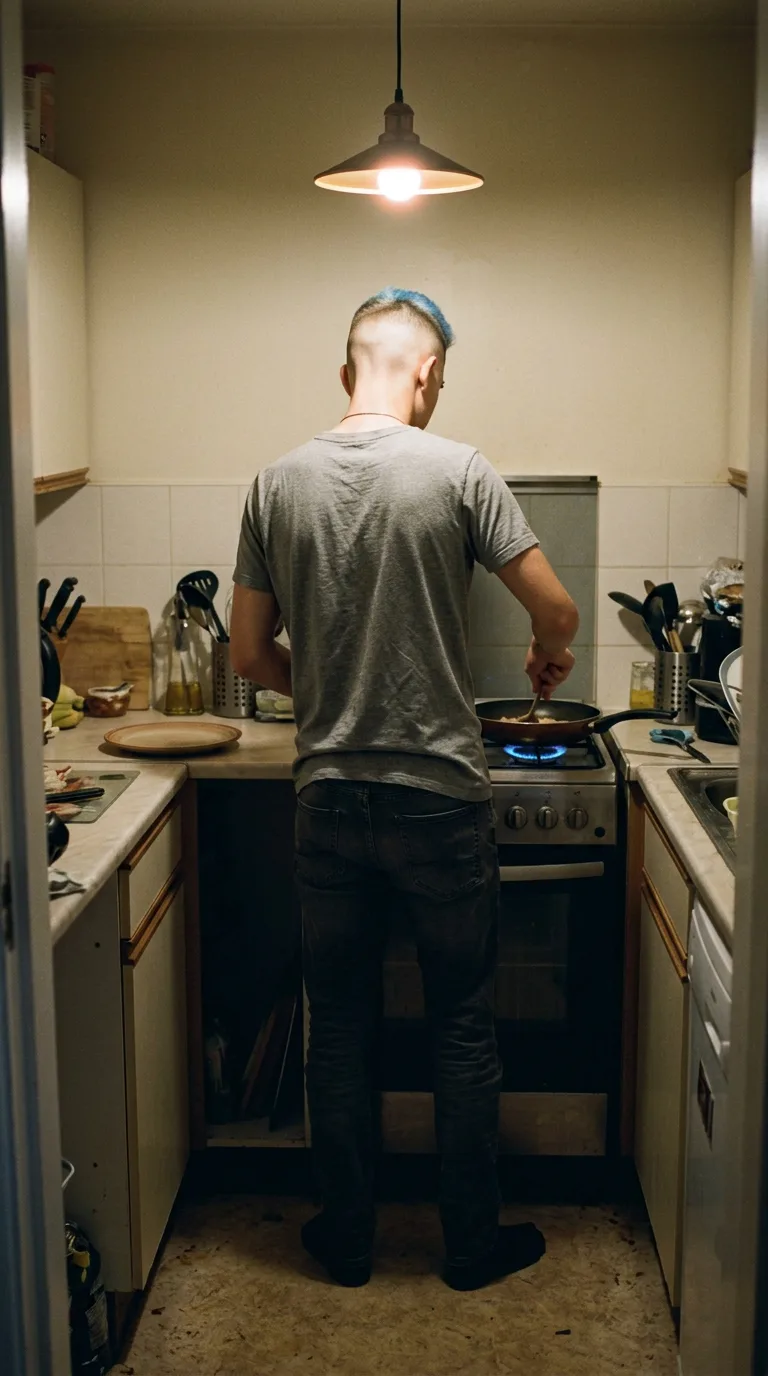
Rarest thing about him: Eyebrow — legendary, 1 in 174
Season 0seed 196621328 · engine v10
Character card
lineage WV6PBZ
His body-swap story
@malik.overton, wearing Owen Hallstrom, rolled the wheel on and woke up as Casey Vantrease, spent 7 minutes in him, then spun the wheel and woke up as Rigo Estévez
The dad bod is heavy on the barstool tonight, elbows on the counter, a beer going flat by the laptop. Forty-six years old, gray hair he never asked for, dimples that used to charm somebody once, and the migraine this body doesn't have but the memory of one keeps ghosting through the temple anyway, a habit left over from somebody younger. Los Angeles is orange going to rust outside the window. It has been less than a minute since you decided this one was not enough — not because the dimples aren't good for a laugh, not because the work is hard, but because you already know how tonight goes: takeout, television, sleep, the same five feelings on rotation. You have worn six kinds of tired now and this is the newest kind, the specific tired of a body that already told you its whole story on the first day. You open vessel.cards again out of the same appetite that got you here the last five times, the simple animal greed of not knowing yet, and you spin before the beer goes any flatter.
The wheel turns and stops being yours to watch.
You are mid-stir, wrist turning a small circle in a pan that smells like garlic gone golden, and the circle reverses itself under your own unfamiliar hand before you understand you have a hand at all. Salt falls from fingers thinner than any fingers you've had in five bodies. You do not taste it. A cabinet door is already open above the counter — his memory of reaching, not yours — and a second plate comes down and sets itself beside the first with a small ceramic knock, deliberate, like it matters, though you don't yet know why it would.
The dog tags are gone from around this neck — he's out of uniform, off duty, a T-shirt only — but the ghost of their weight is still there in the memory the shirt gives you the second it registers against your back: cotton gone soft from washing, a collar stretched from being pulled over his head too fast too many mornings in a row, reveille, boots already half-laced from the night before because sixty seconds matters when a sergeant is counting them. The barracks cold at 0500. The particular ache of standing at attention with a migraine starting behind one eye like weather coming in, and swallowing it because nobody wants to hear it. This body is nineteen pounds lighter than the one you left, all snap and wire, no cushion anywhere, and it knows things the other one didn't — how to fall correctly, how to run when the lungs are already done arguing, how to stand still for an hour without swaying.
The eyebrow barbell is a small cold weight you didn't expect, and touching it — reflexively, the way his hand goes there when he's thinking — gives you the mirror at nineteen, the argument with his mother, the scar underneath it older than the piercing, some bike, some curb, some stupid summer he doesn't fully remember either. The blue hair is dye over blond, and the memory that comes with running fingers through it is the barbershop chair, the fade going up the sides while he watched a stranger with buzzed clippers, and the small private thrill of doing something to himself that the uniform couldn't touch back.
The stove's heat on his forearm brings the rest of tonight, or what was going to be tonight before you arrived in the middle of it: he'd been thinking about her while he cooked, the woman who got away, no one's name he lets himself say out loud anymore, but there's a whole unlit hallway of her in him — a laugh in a car with the windows down, a fight about nothing that turned out to be about everything, the specific quiet of the apartment after. He cooks for one most nights and sets one plate. Tonight, hand not fully his own anymore, he took down two, and some part of him that is now only residue wanted, badly, uselessly, for someone to be coming.
Nobody is coming. You are already here.
You look down at his hands — the wooden spoon still faintly turning though the wrist has stopped, the barbell glint at the edge of your eyebrow catching the pendant light, knuckles thin, one thumb with a faded nick from a knife that wasn't paying attention once. You turn the hand over slow, like checking it for damage, though it isn't damaged, it is only new.
"Who set the second plate," you say, to the empty kitchen, not really asking, and you leave it standing there — because somewhere back in Los Angeles a gray-haired man is still sitting at a counter not knowing yet that he isn't sitting there anymore, and somewhere ahead of tonight, no telling how far, the wheel is still spinning whether you touch it again or not.