Amir Nassif
Fictional. Generated by AI — not a real person, and no likeness of one is intended.
19, cop in New York · rolled by @colin.hasbrook · card — no film
History
who has worn him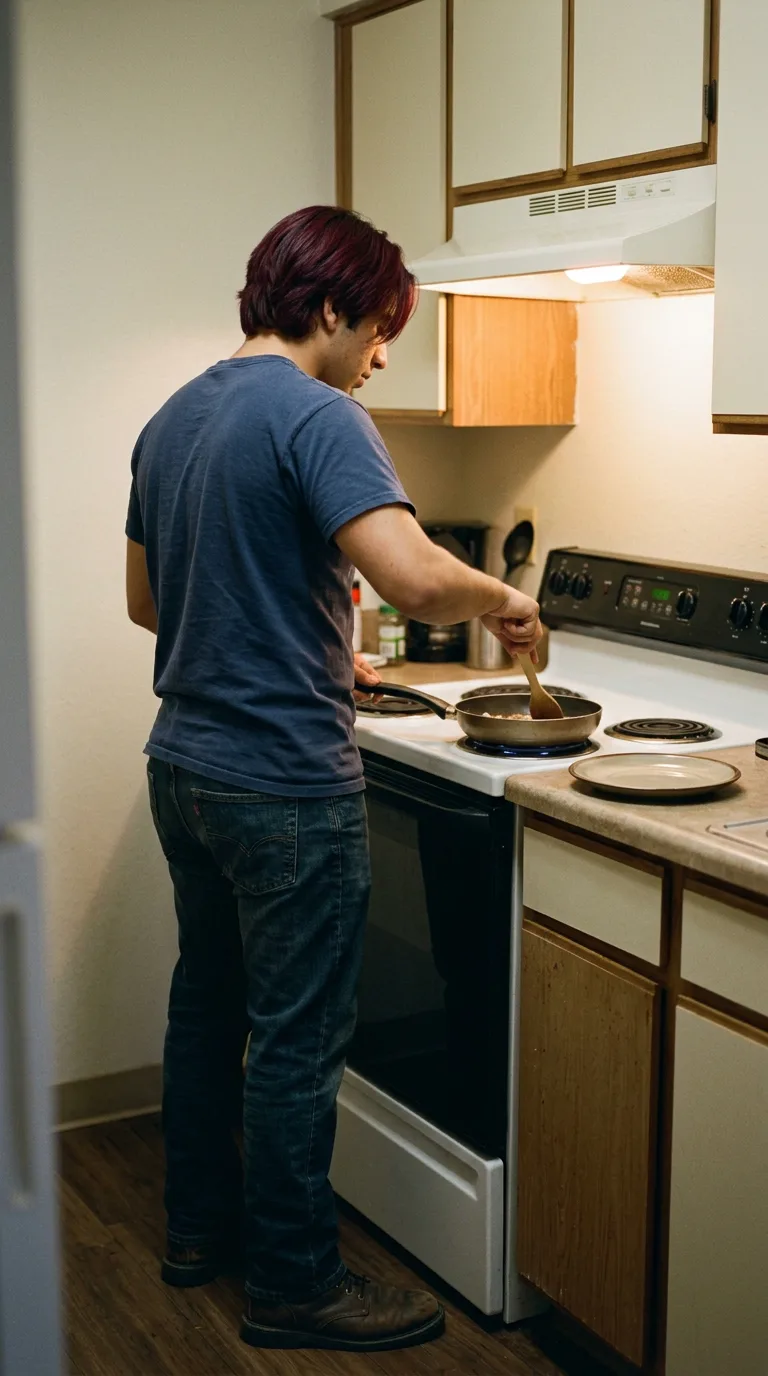
Rarest thing about him: A gold tooth — epic, 1 in 146
Season 0seed 861753852 · engine v10
Character card
lineage 2NZHHJ
His body-swap story
@colin.hasbrook, wearing Aaron Kessner, rolled the wheel on and woke up as Amir Nassif, spent 9 minutes in him, then spun the wheel and woke up as Colton Meskill
You are standing in Aaron Kessner's kitchen — no, his platform, the conductor's booth, wherever he keeps himself between runs — and the coffee in his hand has gone cold because you have been staring at the same signal board for six minutes without seeing it. He is thirty-five and built like a man who runs before shifts and eats like he still does his old job, and none of it is the problem. The problem is that he has been you for forty seconds and you already know the whole shape of his Friday: the 4:10 to Memphis, a locker with a photo of a dog that isn't even his dog anymore, a woman in car 3 he is too polite to flirt with twice. It is a fine life. It is exactly as fine as it was fifty spins ago, in somebody else's fine life, and the sameness of the fineness is what does it — not despair, nothing so dressed-up, just the small itch of a man who has been given four hundred and sixty-three answers to the same question and has stopped believing any one of them is the last. You set the coffee down on the console. You take out your phone. The wheel loads the way it always loads, patient, a little smug, and you spin it without a reason you would say out loud, only the old one underneath: there might be a better afternoon somewhere, and you have the coin to go looking.
The stirring stops mid-circle. It starts again the other way, and that reversal is the only ripple, the only sign, of the change — you, arriving into a wrist mid-turn, a wooden spoon in a nonstick pan, weight settled short and compact on two feet that are not the feet you had four seconds ago in Nashville. You salt the pan without tasting it, an old habit that isn't yours yet but your hand does it anyway, muscle ahead of you. You reach up and take down a second plate and set it beside the first, and some part of you that is still catching up to itself wonders why, before the room answers for you.
The shirt is the first thing that talks. Grey cotton, soft at the collar from a hundred washes, and it gives you a morning: him standing in front of a mirror at six a.m., pulling it over his head one-armed because the other hand is holding a phone to his ear, his mother's voice on it, asking in Arabic if he ate, and him saying yes, Mama, in English, because some words come out easier in the language he does the job in. The jeans next — Levi's gone soft at the knee, a coffee stain worn pale near the pocket that nobody would ever notice but him — and they give you the locker room, the boots going on last, always last, because his training officer told him once that a man who puts his boots on first is a man in a hurry to leave, and Amir never wanted to look like he was in a hurry to leave anything.
The pan handle gives you more. It gives you nineteen years compressed into heat against your palm: a kitchen in Bay Ridge smaller than this one, his father teaching him to sear onions low and slow because burnt onions are a sin worse than most, his sisters loud in the next room, the sound of Arabic and English overlapping at the dinner table like two radio stations fighting for the same frequency. It gives you the academy, six months back, the weight of a belt he wasn't used to yet, the first time another recruit called him "smiley" for the gold tooth and meant it as a compliment before he even knew the guy's name. It gives you dusk in a precinct lot, leaning on a cruiser's warm hood, radio traffic murmuring, feeling — for one whole exhale — like the job fit him, like the tooth that shows when he grins wasn't the only shining thing about him.
It gives you why there are two plates. Not a girlfriend — there is no girlfriend, hasn't been, hasn't mattered — but a habit from a mother three boroughs and one long shift away who taught all her kids that you don't eat food alone in a quiet room, you set a place across from you even if nobody sits there, because emptiness at a table is a kind of disrespect to the cooking. He has done this every night since he moved out. He has never told anyone. It is the thing he carries that he would never bring up, and you have it now anyway, for free, because his hand set the plate down before you'd finished becoming him.
You feel the height first, after that — how close the counter is, how the cabinet above the stove used to bang his forehead once, months ago, and he's ducked under it out of habit ever since without thinking. Nineteen-year-old shoulders, still filling out, a body that startles awake in the mornings a little sore from a gym he's inconsistent about. Brown eyes tired at the rims from a double the day before. The tooth catches light even here, under a kitchen bulb, when your mouth moves at all.
You look down. The spoon is still in your hand, sauce cooling on it, and you turn the hand over like the spoon might explain itself, like his own knuckles are a stranger's knuckles, which, for about four more seconds, they still sort of are.
"Okay," you say, out loud, to the empty second plate, in a voice with a tooth of gold behind it that isn't yours yet and might not be tomorrow. "Let's see what you've got going on."