Wilbur Standingdeer
Fictional. Generated by AI — not a real person, and no likeness of one is intended.
65, pharmacist in Eastern Kentucky · rolled by @colin.hasbrook · card — no film
History
who has worn him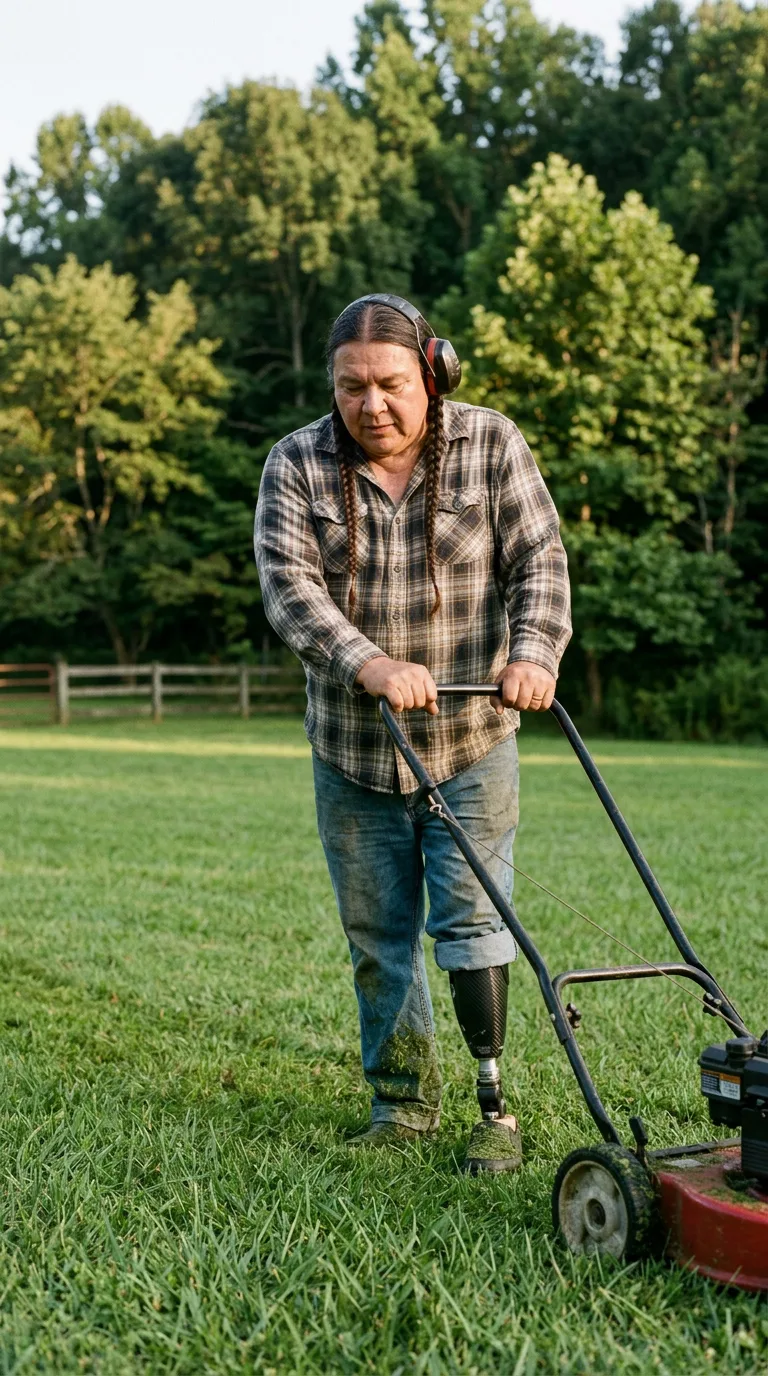
Rarest thing about him: Below-knee prosthetic leg — epic, 1 in 171
Season 0seed 1138951658 · engine v10
Character card
lineage 2NZHHJ
His body-swap story
@colin.hasbrook, wearing Dustin Little Eagle, rolled the wheel on and woke up as Wilbur Standingdeer, spent under a minute in him, then spun the wheel and woke up as Colby Wetherell
You have been Dustin Little Eagle for two minutes, and already it is not enough.
You feel it in the ranger's boots first, standing at the trailhead kiosk with a laminated map curling under one thumbtack, twenty-one years old and built like a door, gray hair he has no memory of earning tucked under a ball cap. Two minutes of somebody else's Monday, somebody else's aching lower back from a summer of trail work, and none of it is yours yet, none of it has had time to become yours, and that is exactly the trouble. Two minutes is nothing. Two minutes is a sample, not a life. You did not spin thirty-nine times to sit still in a body still cooling from the last one's outline. The itch is already there behind young unfamiliar eyes — not boredom with him exactly, you never got far enough into him to be bored — just the plain fact that the wheel is still open in the truck's cupholder, phone screen lit, and there is no reason on God's earth to wait.
You pull it out. You spin.
The mower engine drops a note under your hands and catches again, and you are sixty-five years old.
It happens mid-stride, weight already committed forward, the bar of the push mower vibrating up through two palms that are not the palms you had a half-second ago — thicker, older, a wedding band riding loose over a knuckle swollen with fifty years of afternoons. Grass clippings needle your shins through rolled denim. One ear is muffled and one is bare to the mower's clatter and the cicadas underneath it, and the bare ear is the first thing you fix, some reflex older than you reaching up without asking and settling the earmuff back down. The next pass runs dead straight. You did not decide that. The body did.
Then the shirt.
It is a plaid flannel gone soft at the elbows, and the moment your attention lands on the collar of it a whole morning comes up out of nowhere, sleeve by sleeze — Wilbur's hands, not yours, buttoning it slow in a bedroom with the blinds still down, humming nothing in particular, his wife Loretta already downstairs with the coffee going, the smell of it climbing the stairwell. He'd rolled the sleeves because the day was going to get hot, because Kentucky Augusts don't care what a man's plans are. He'd sat on the edge of the bed to get the trouser leg over the prosthetic, the careful two-handed patience of it, the liner sock smoothed down first, the practiced roll, the same motion four thousand mornings running until it isn't awkward anymore, it's just Tuesday, just Monday, just whatever day this is.
The leg itself answers when you shift your weight onto it — not pain, an absence shaped like a leg, the carbon-fiber blade flexing under you with a give the old leg never had, cool and unbothered by the heat where the stump above it runs slick with sweat inside the liner. You know without being told that thirty-one years ago there was a truck door and a logging road and a doctor in Hazard who apologized like it was his fault, though the memory only comes as weather, not detail — a smell of antiseptic, a fear that lived in him for a year and then didn't anymore, because a man can get used to nearly anything if there's a wife across the table every morning and a job that needs his hands sober and steady.
The mower's handlebar gives you the pharmacy counter — amber glass wall behind him, prescriptions counted into little trays with a spatula, the register of trust in an old woman's face when he explains what the new pills are for, slower than the drug rep explained it to him, because that's the whole job, the translating. Forty years of it. A framed certificate. A wall of thank-you cards from people whose names he still knows.
Your own left hand, tightening on the bar, remembers an old girlfriend from before Loretta — a name that surfaces soft and unforced, Carol Anne, a summer of it, nothing that survived, but a face that still surfaces sometimes on nobody's schedule, unbidden, harmless now, forty years cold. And two children grown and gone to Lexington and Louisville, and grandchildren's photos on the pharmacy break-room fridge, and a knuckle-cracking habit his hands fall into now, cracking one against the mower's grip without his permission, an old tic doing what it does.
His stomach gives a small, familiar burn low in the chest — the reflux, the thing that makes him decline the second cup of coffee, decline whiskey most of the year, a body that has learned its own limits and mostly respects them.
You stand in all of it — heavy, sixty-five, sweating, whole.
You look down at the hand on the mower bar. Turn it over. The wedding band catches the late light coming sideways through the trees at the yard's edge, and you lift your eyes off it into the empty afternoon, into nothing, into whatever is watching.
"Well," you say, in his voice, to no one, "let's see how long this one runs."