Wesley Blackhorse
Fictional. Generated by AI — not a real person, and no likeness of one is intended.
44, student in Rural Texas · rolled by @julian.reyes · card — no film
History
who has worn him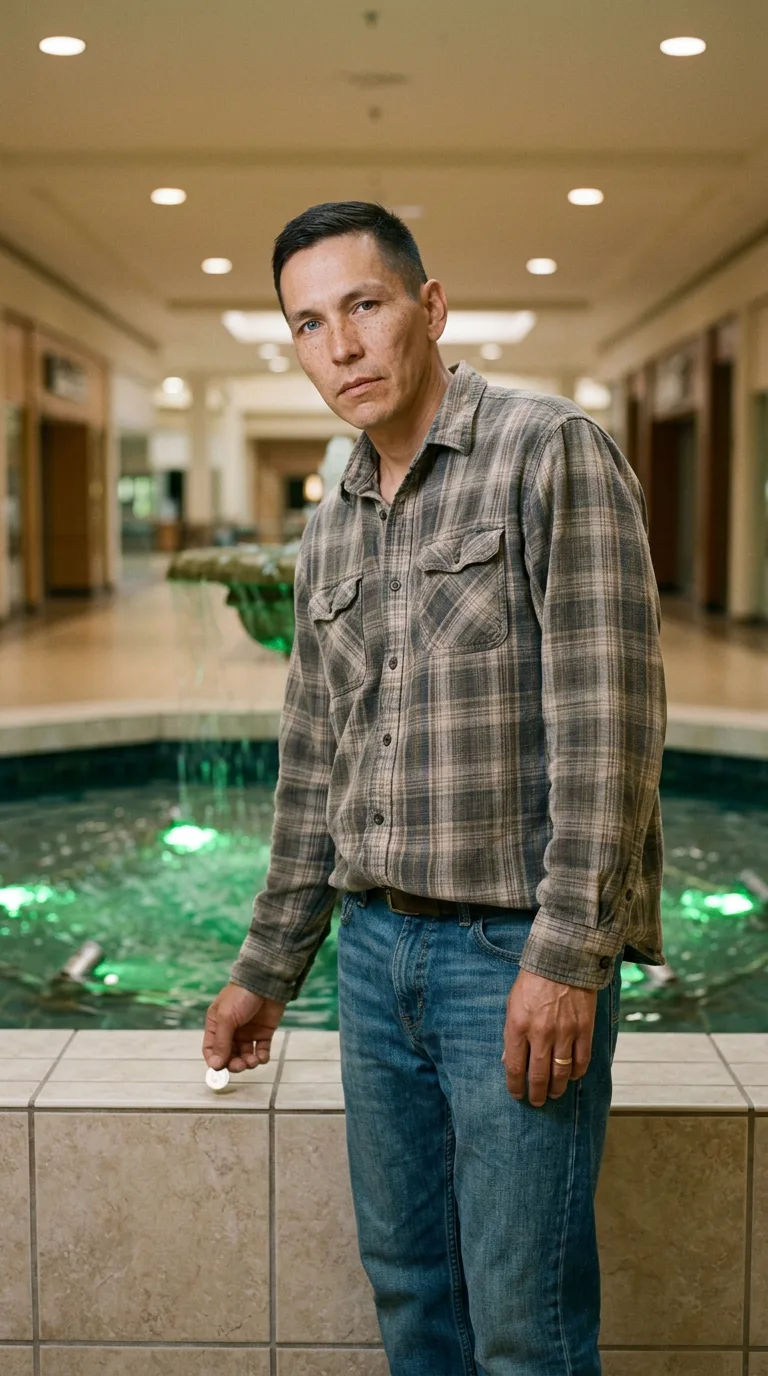
Rarest thing about him: Heterochromia — legendary, 1 in 200
Season 0seed 10925564 · engine v10
Character card
lineage PYNCV3
His body-swap story
@julian.reyes (admin), wearing Dakota Whitehorse, rolled the wheel on and woke up as Wesley Blackhorse, spent 4 hours in him, then spun the wheel and woke up as Michael Adams
You are twenty-three hours into being small, and you are tired of it.
Dakota Whitehorse's body doesn't ache anywhere, which is the problem — you have spent a day and eight hours in a frame that does everything asked of it before you finish asking, and there is no friction anywhere in it, and you have started to miss friction. You are sitting cross-legged on the unmade bed with the ring light still warm from the last stream, and your — his — hands, small and quick, are drumming nothing against the laptop's edge, and you think: not boredom exactly. Appetite. You have been a streamer, a body that performs being watched, for a day and a third, and it turns out that is not the thing you wanted from the number forty-five. You wanted to feel like you'd gone somewhere. You open the site anyway, the way you always do, telling yourself it's just to look, and the wheel is already loading before you've admitted you're going to spin it.
You spin. Sunday evening folds over on itself, San Francisco light through a cheap blackout curtain becoming fluorescent light off a mall's dropped ceiling in Texas, and there is no seam between the two, only the coin.
It leaves a thumb that isn't small anymore. It comes down flat, doesn't turn once, and you feel — before you feel anything else — the specific gravity of a body that has weight to spare, shoulders that slope forward a little, a low persistent complaint somewhere in the lower back that has clearly been there for years and has simply stopped introducing itself. The splash below you folds inward, wrong, quiet, and you stand at the tiled lip of a fountain lit sick green from underneath, in a body that is not performing anything for anyone.
The plaid shirt is against your back before you've thought about it, and that's where he comes in — not all at once, in pieces, the way smoke fills a room from the corner first.
The flannel: soft through wear, a little thin at the elbows, and there's a whole morning in it — him standing in a bedroom with the blinds already bright, buttoning it one-handed while the other hand held his back like it might fall out from under him if he startled it, the mattress behind him still holding the shape of somebody who'd already gotten up. Ruth. Her name arrives with the shirt's collar, worn soft at the fold from her hand smoothing it flat on the mornings she still did that for him, though not this morning — this morning she'd been at the stove, and he'd dressed alone, listening to the twins argue in the next room about whose turn it was to feed the dog, a sound so ordinary he hadn't looked up from the buttons.
The backpack strap, when you shift your weight and feel it's not there — you left it in the truck — gives you anyway a flash of a lecture hall, of being forty-four years old and the second-oldest man in a room of twenty-year-olds, of a laptop screen with a half-finished paper on water rights and a coffee going cold, and under all of it the dull persistent hum of *is this going to be worth it*, which he never lets himself finish as a sentence. He went back to school for something — for them, mostly, for the twins, so there'd be a version of their father who wasn't just gravel and fence line and a water tower you could see from the porch. Comfortable enough now that nobody's hungry, not so comfortable that the tuition doesn't sting a little every semester.
The ring. Left hand, plain band, and it gives you the most of anything — not a wedding, not a proposal, just years and years of it, of Ruth's laugh at something not funny, of two kids born eighteen months apart who are now old enough to roll their eyes at him in stereo, of a marriage that has worn into its comfortable shape the way the flannel has, nothing dramatic in it, nothing he'd change. He is a man who drums his fingers on tables when a lecture runs long, who has never smoked, who drinks maybe twice a month and always regrets the second night more than the first, who believes in nothing beyond the fence line and is at peace with that. His back hurts in a way that is simply Tuesday. His freckles are the first thing anyone says about him and the thing he has stopped noticing in mirrors.
He'd been standing at this fountain because his wife told him to make a wish on their anniversary, years ago, half-joking, and he still does it every time he passes one, alone, a small private ritual that costs a quarter and means nothing and everything.
The coin is already gone. The water is already going still.
You look down at his hand — broad, freckled to the knuckle, the ring catching green light — and you turn it over slowly, like it might not hold your weight, and then you lift your eyes to where a mall directory's glass reflects you back, dim and green and unmistakably not him anymore.
"Wrong wish," you say, to no one, and your voice comes out lower than you expected, and you almost laugh.