Warren Sturgill
Fictional. Generated by AI — not a real person, and no likeness of one is intended.
49, social worker in Eastern Kentucky · rolled by @marco.villagrana · card — no film
History
who has worn him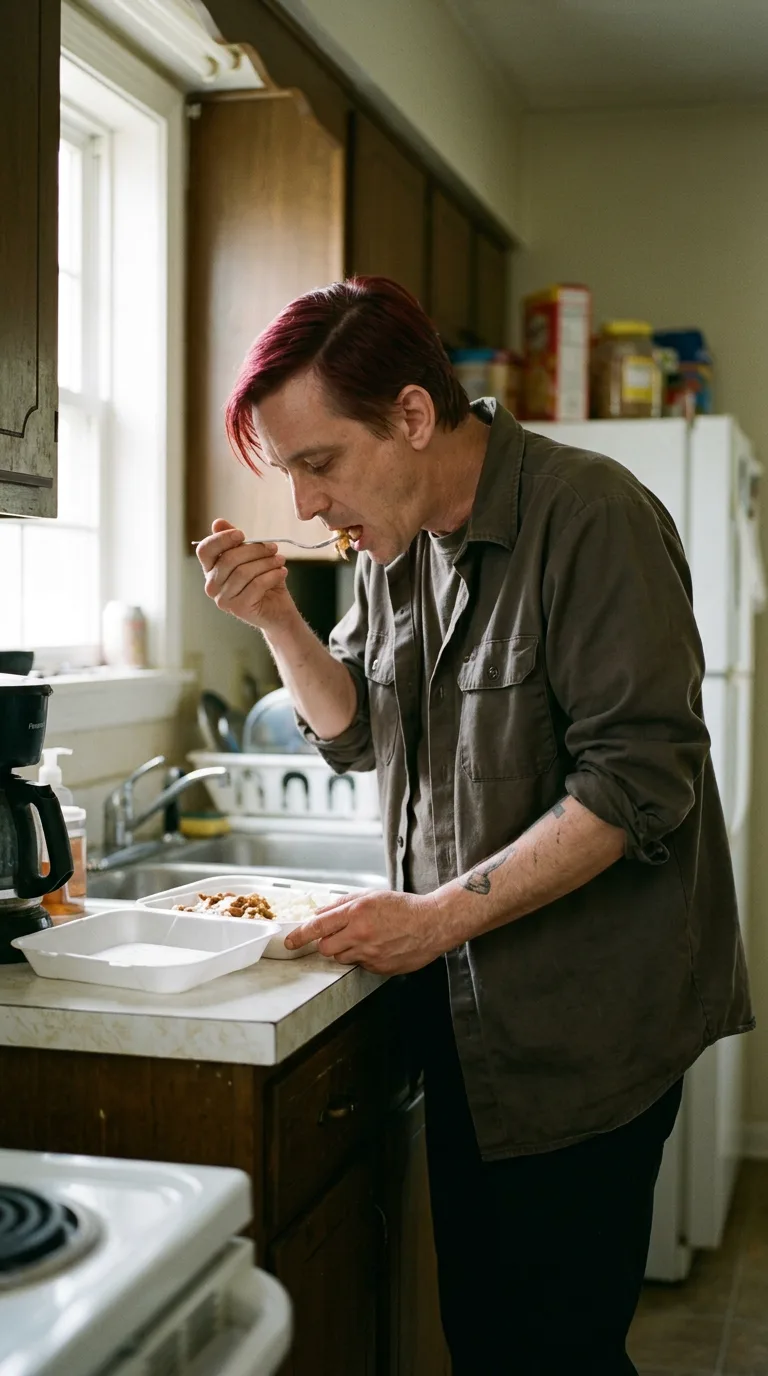
Rarest thing about him: Dyed red — legendary, 1 in 238
Season 0seed 1613310710 · engine v10
Character card
lineage LJL8SV
His body-swap story
@marco.villagrana, wearing Mateo Olazábal, rolled the wheel on and woke up as Warren Sturgill, spent 6 minutes in him, then spun the wheel and woke up as Terrell Broussard
The kitchen you're standing in isn't yours, but you know it better than Mateo Olazábal ever will now, because Mateo Olazábal doesn't exist anymore except as a coat you took off and left on a chair.
Twenty-two hours and fifty-six minutes. That's how long you were him — the paramedic, six-one, the good shoulders, the siren still ringing in the muscle memory when you close your eyes. You liked him. You liked the way strangers moved for him in a crowd, the way a body in a doorway just knew to make room. You went on shift with him for four hours because it seemed like something a man like that should do, and you carried somebody down three flights of stairs and felt useful in a way you hadn't in years, in bodies that weren't yours. But then it was over, and you were sitting on his bed in his dark apartment with his phone in his hand, and you found a name in his call log you recognized from nowhere real — a woman, an ex, a string of unanswered texts going back months, aching and one-sided — and something about being young and strong and still that lonely made the whole good body feel like a coat that didn't fit after all. So you opened the site. Not out of a plan. Just to see what else there was.
Now the fork is not your fork, though your hand set it down.
It comes down onto the rim of the styrofoam container with a small tap you didn't choose, the arrival landing in the half-second between his hand rising and his mouth opening, so that for one instant there are two intentions in the same wrist and only one of them wins. The coat is still on his shoulders. The window in front of you is going the flat gray-blue of a Kentucky evening, no reflection worth looking at yet, and underneath the coat is a body that aches low in the back, a familiar dull city of pain that has been rented out to you along with everything else.
You shrug the coat off. It slides down a frame narrower than the one you had this morning — narrower and softer at once, a gut that has never been to a gym and shoulders that have carried folders more often than people — and you sit at the little table because sitting is what he would do, and some current under your borrowed skin wants it, and you finish the beans and rice in even mechanical bites, tasting onion and something sweet, watching nothing in the window because there's nothing yet to watch.
Then the shirt.
It's flannel, soft from washing, and the cuff is rolled to the elbow the way he leaves it after work, and touching the rolled cuff gives you the morning: him standing in a bedroom with a mattress on a frame that ticks when you shift weight on it, pulling this exact shirt off a hook on the closet door, one arm in, the fabric catching for a second on the tattoo — cross and praying hands, done cheap in his twenties in a shop in Prestonsburg, back when he still went to Mass with his mother before he found the cushion and the quiet room instead — and the small flare of okay, today, that dressing gave him, because some days getting dressed is the whole victory.
The folders come next, if only in the ghost-weight your arm still expects though there are no folders here now: manila, a stack of them under one elbow on a walkway outside somebody's apartment door, waiting to be let in, always waiting to be let in, standing in the open air with the wind moving the papers' edges while inside a family decides whether to trust you today. That job lives in the whole right side of him — the low patience of it, the years of it, three kids of his own grown or nearly grown and a fourth who calls sometimes and a fourth who doesn't, and the woman before all of them, Denise, whose name comes up out of nowhere and sits in his chest like a stone that was always going to be there. You feel how he still writes her name in the part of his head that isn't careful. You feel how he never says it out loud.
The counter under your palms is a specific, familiar cold — laminate gone soft at the edge from twenty years of forearms resting there — and it gives you evenings: this same stance, this same container, this same window with nothing in it, night after night, a vape exhaled toward the glass, the sourness of a big Friday two weeks back that he still feels faintly ashamed of and does not regret. Your back — his back — throbs low and constant, an old injury from lifting something years ago, or maybe just the shape thirty years of standing takes in a body that was never built for standing. It's not pain that stops you. It's pain that's just always there, background, weather.
He believes, in his quiet unpracticed way, that nothing that happens to him is only happening to him — that it passes through and is gone, that the self holding the fork is not the important part. He would find some strange comfort in what's actually true tonight, if he could still find anything at all.
You look down. The hand on the counter has thin fingers, hair dyed red combed hard to one side above them somewhere you can't see but can feel, the part stiff with product gone waxy through the day. You turn the hand over once, palm up, like it might have something written on it.
Then you lift your eyes to the black window, where his reflection is finally dark enough to hold, and you say, to no one, in his voice:
"Okay. Who're you, then."