Warren Pettibone
Fictional. Generated by AI — not a real person, and no likeness of one is intended.
56, chief executive in Nashville · rolled by @colin.hasbrook · card — no film
History
who has worn him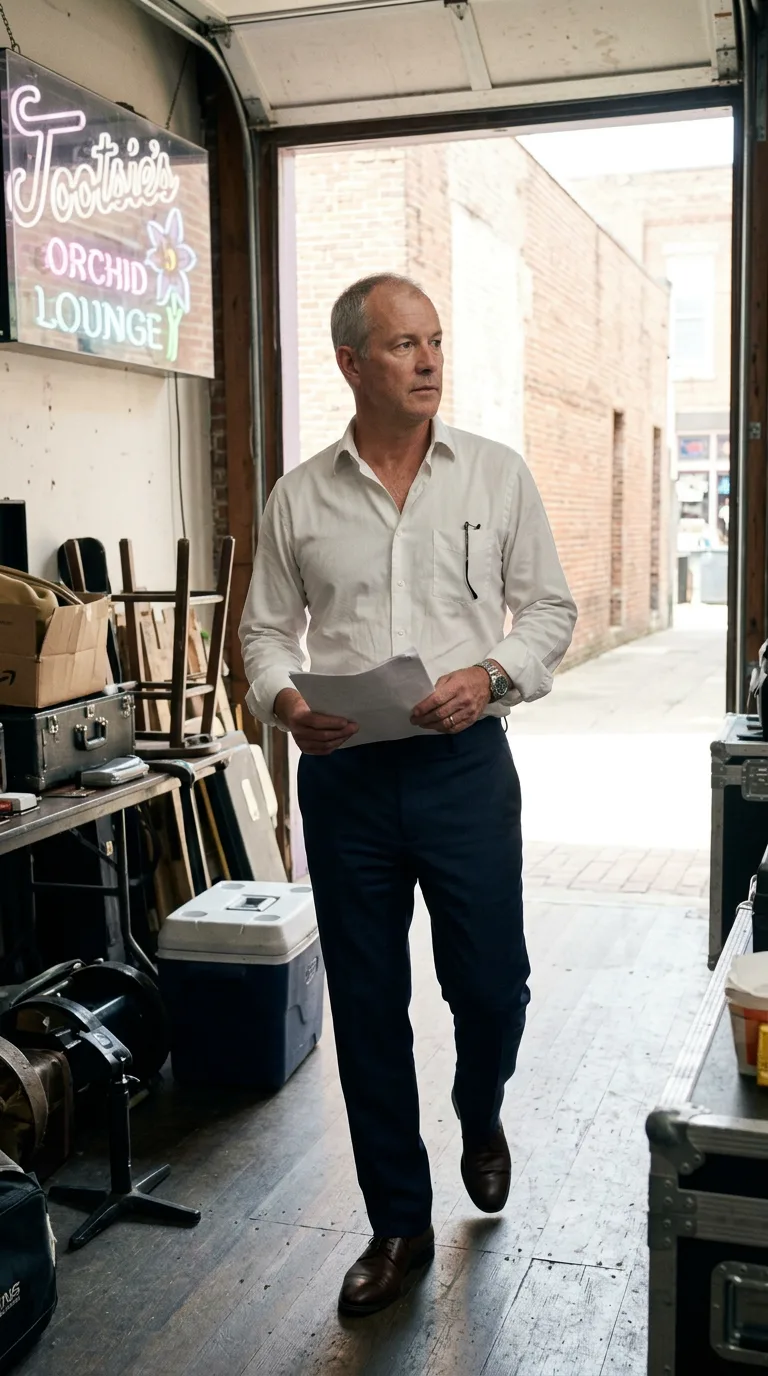
Rarest thing about him: Clenches his jaw — common, 1 in 21
Season 1seed 1682290032 · engine v11
Character card
lineage 2NZHHJ
His body-swap story
@colin.hasbrook, wearing Curtis Aldenberry, rolled the wheel on and woke up as Warren Pettibone, spent under a minute in him, then spun the wheel and woke up as Kenji Okafuji
Curtis Aldenberry's kitchen is quiet except for the machine ticking through its cycle, and you are standing in his good hands at his marble counter, still in the pajama pants he sleeps in, feeling nothing wrong at all — which is the problem. Thirty-five years old, a beard he trims twice a week, a view of the harbor going gray-gold with morning. Six hundred and some employees who report to a face that isn't his either. You've had him less than a minute of his own time and you already know how the rest of the day goes, because you've watched nine hundred of these mornings from inside nine hundred men: the emails, the calls, the assistant who knocks twice. It isn't boredom exactly. It's that you can feel the whole shape of him already, like a hallway you've walked before you've entered it. Coastal Maine is beautiful and it is Tuesday-shaped forever. Your thumb finds your phone before you've decided anything. The site loads the way it always loads, patient, gray, the wheel already spinning by the time you've paid, because it knows you don't actually deliberate, not anymore, not at seven hundred and seventy-four.
The wheel stops on a loading dock alley behind a honky-tonk in another state, another clock, a man two hours ahead of you and wide awake mid-morning for reasons that will turn out to matter.
—
The paper in your hand is real before your name is. It's a stapled setlist, warm from a hand that was just wiping sweat off a fader, and your feet are already moving, one shoe catching slightly on a cable run you didn't lay. The light coming through the open bay door is white and flat, alley light, and there's a neon flower burning pink even in daylight off to the side — TOOTSIE'S, half-lit, half-forgotten by the sun. Your body is shorter than the one you left, thicker through the middle in that soft, ordinary way, and your scalp is bare enough at the crown that you can feel the air on it, a strange cool spot you didn't have an hour and two states ago. Somewhere behind your sternum a jaw is already tightening — his, not yours, an old unconscious clench — before you've even understood there's a decision being made about a monitor mix. The motion breaks. You set the paper down wrong, pick it up, set it down again the correct way, slow, deliberate, like a man double-checking a signature he's signed ten thousand times.
—
The shirt is what opens first. Cotton gone soft from washing, sleeves he rolled himself forty minutes ago, standing in front of a mirror in a house outside Franklin while Dana was still asleep — and there it is, the bedroom, blue predawn light, her shape under the quilt, the particular quiet of a house where nobody else is up yet because tour load-in starts absurdly early and always has, for thirty years, since he was twenty-six and thought this was going to be temporary. He buttoned this shirt watching his own hands do it and thought, the way he thinks most mornings now without any drama in it, that his hands look old. Not weak. Old. Spotted a little at the knuckle. Sure of themselves in a way that has nothing to do with what they look like.
The watch on the wrist gives you the rest of it in a rush that has weight to it, the metal already warm: Warren Pettibone, fifty-six, majority owner of a production company that's run sound and lighting for half of lower Broadway and three arena tours besides, worth more than anyone guesses from looking at a man in wrinkled chinos hauling flight cases in an alley at eleven in the morning because the overnight crew called in short and he has never in his life been the kind of boss who won't get his own hands on a case lock. He built this from a single PA rental van in 1994. He still comes in on load-in mornings not because he has to but because the alternative — an office, a desk, watching it on a screen — makes something in his chest go tight in a way no doctor has a name for.
The floor under your feet is worn plywood ramp, and it gives you the sound of it: forklifts, a snare drum being tuned somewhere inside, a river of noise he stopped hearing as noise decades ago. His body knows this weight without asking — the case latch under his palm even now, muscle memory older than most of the marriages in this building, hands that can find a bad XLR in the dark by feel alone. Nothing hurts exactly, but there's a permanent low ache low in the back from thirty years of stooping over road cases, and the knees announce themselves on the stairs these days, briefly, then forgive him.
Dana is the wife — nineteen years, met her when she was running merch for a band he was mixing, a whole marriage built out of green rooms and long silences in vans that turned, somehow, into something durable. Their son Cole is twenty-two now, in Knoxville, not in the business, thank God, thinks his father works too much and is not wrong. There is a version of this morning, most mornings, where Warren thinks about retiring and does not say it out loud, because saying it out loud would mean admitting he doesn't know who he is without a headset on.
The wedding band on the left hand is warm too, plain, thin from wear, and it gives you nothing dramatic, just years, ordinary and stacked and his.
—
You look down. The hand holding the setlist is not a hand you have ever owned — spotted, thick-knuckled, steady in the particular way of someone who has done a physical job with these fingers since before some of your other bodies were born. You turn it over once, slow, like you're checking it for damage that isn't there. The neon behind you buzzes pink against the brick. Somewhere inside, a snare rings out and dies.
You lift your eyes to the light coming down the alley and say, to no one, in a voice gone a little gravelly at the register you don't know yet, "Well. Let's get to it, then."