Warren Oxendine
Fictional. Generated by AI — not a real person, and no likeness of one is intended.
61, chief executive in Seattle · rolled by @colin.hasbrook · card — no film
History
who has worn him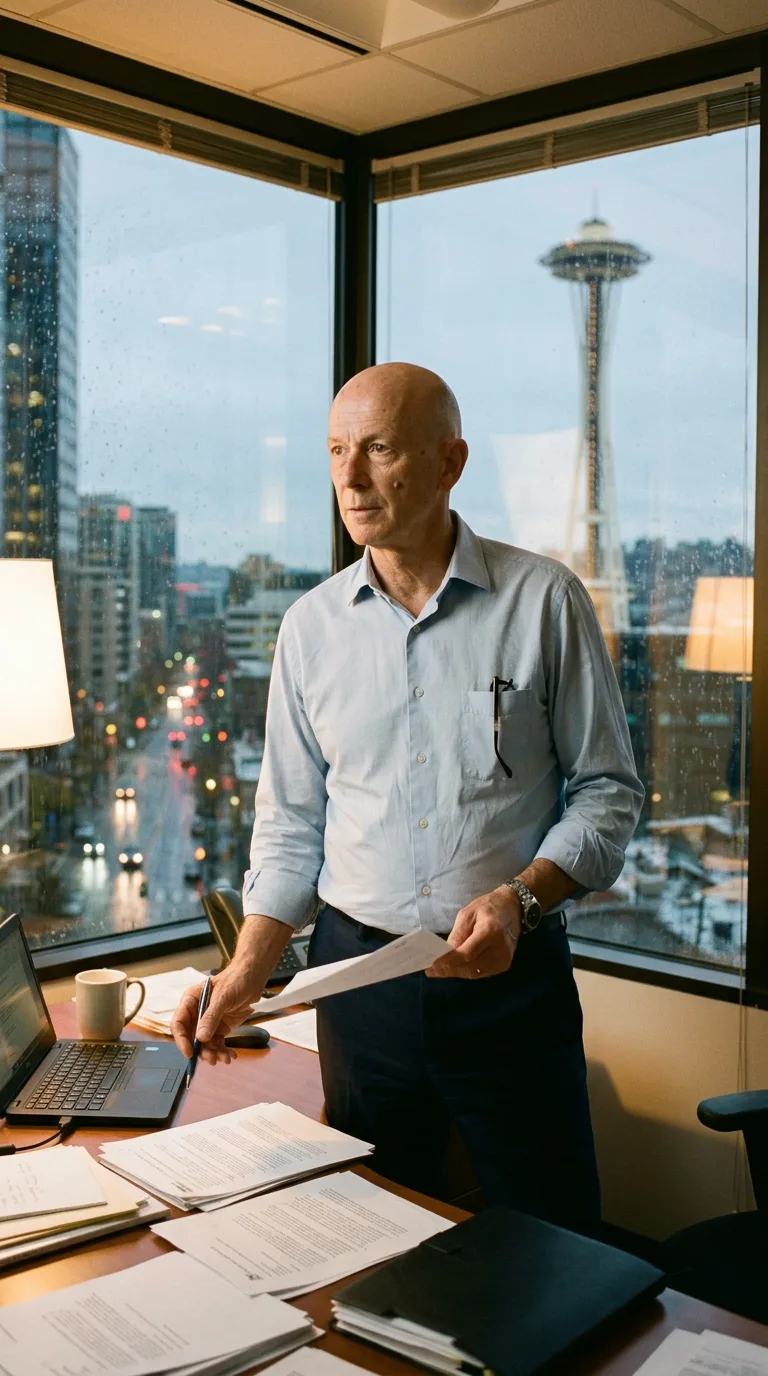
Rarest thing about him: Seattle — common, 1 in 42
Season 1seed 485993253 · engine v11
Character card
lineage 2NZHHJ
His body-swap story
@colin.hasbrook, wearing Travis Kincaid, rolled the wheel on and woke up as Warren Oxendine, spent under a minute in him, then spun the wheel and woke up as Desmond Fairweather
The site chirps at you from inside a man named Cody who is not you, has never been you, but whose hands are yours for the length of this shift. Cody is thirty-three, and his knees already talk to him at the end of a day, and his beard itches where the dust gets into it, and you have been him less than a minute — long enough to feel the mallet in his fist and the give of the form board under the last stake — and you already know you are done with him. It isn't the knees. It's that nothing here is new, hasn't been new in months, and the itch under the beard is the itch you get right before you go looking for the wheel again: not hatred of the body, just a low hum that says *not this one, not tonight.* You set the mallet down against the sawhorse the way Cody always sets it down, out of some care that isn't yours, and you thumb the phone in his back pocket, and vessel.cards opens the way it always opens, patient as a church door.
You spin.
The mallet is gone. In its place there is a pen, mid-stroke, and a sheet of paper going soft at the corner from a coffee ring, and your hand — not your hand, his hand, but there is no line between those two things anymore — draws the wrong letter. You stop. You look at it, at the small blue error sitting where a signature should be, and something in the wrist that has signed ten thousand of these starts over, slow, deliberate, like a man walking a beam he's walked a thousand times but suddenly remembers is a beam. The next line comes out checked. So does the one after that. Behind the glass at your back the light is going the particular gray-gold of a Seattle afternoon with rain in it, and the Space Needle stands out there half-swallowed in cloud, and none of it is Kentucky, none of it is dusk, and the wrongness of the light is the first thing that tells you, underneath the wanting, that you have gone somewhere entirely else.
The shirt is what opens him first — pale blue, a little damp under the arms from the building's dead air, sleeves rolled to the forearm the way he rolls them every single day without deciding to, and through the cotton comes the morning: standing in a closet that still holds a woman's absence at the empty end of the rod, choosing this shirt over the almost-identical one beside it because this one doesn't need the iron, buttoning it in a mirror he has stopped really looking into, the mole on his cheek catching light he doesn't notice anymore either. His fingers know this shirt's buttons without his eyes, the same way they know the phantom edges of nails he stopped letting grow years ago — the nail-biting comes up now too, a small mortifying habit thirty years old, worse in board meetings, worse since the divorce, though he'd deny it if you asked him whose fault the divorce was on a good day.
The belt against your waist gives you the elevator up, this morning, sixty-one floors, the doorman's nod, the particular ache low in the back that skinny-fat men his age carry and call nothing. The watch on the wrist gives you Diane — not his ex-wife, older wound than that, the girlfriend from before the marriage even started, the one whose name still surfaces when he's tired, whose laugh he can still hear better than his ex-wife's voice, thirty years gone and somehow not gone at all. The pen in your hand gives you his son, grown now, a phone call last week that went fine, that always goes fine, that leaves something unfed in him every time it ends fine instead of something else.
The desk under your other hand gives you the job itself — thirty years of it, the company built up out of nothing you'd call remarkable, sold twice, bought back once, the particular pleasure of being the last man in the building who remembers when the parking lot was a parking lot and not a tower. Doing well. Comfortable in a way that stopped being exciting a decade ago. A mainline church on Sundays he still half-believes, a glass of wine at the holiday party and nothing stronger since the cigarettes he quit the year his son was born. The mug by the laptop, lukewarm, gives you nothing — just this afternoon, just the rain starting on the glass, just papers that need initialing before a call that isn't for another twenty minutes, an ordinary Wednesday going nowhere in particular.
He was, you understand now, not tired. Not sick. Just a man alone in a nice office doing a nice task in a nice life that has had all the surprise sanded out of it, and some part of him — the part that bites its nails in meetings — would have understood, better than he'd like to admit, why anyone might want out of an afternoon like this one, even into something worse.
You look down. The hand holding the pen is spotted, older than any hand you've worn in months, the mole sitting high and dark where you can almost see it if you cut your eyes hard right. You turn it over once, slow, watching the fingers answer a fraction late, the way a stranger's car answers the brake wrong the first mile you drive it.
You lift your eyes to the window, to the wet glass and the tower blurred red and white behind it, and you say, to no one, in his voice, "There you are."